
Panel Moderator: What Event Hosts Should Look For
A panel moderator is the person who guides a panel discussion so the audience hears a coherent conversation, not a series of disconnected talks. For an event host, the question is not only whether someone can speak well, or how often they speak on stage. The question is whether that moderator can keep panelists balanced, keep the session on time, and leave the room with a few clear ideas.
This article is for organizers who are choosing a panel moderator. It is not a tutorial on how to run the hour. If you already have a moderator and need a working method, use the existing panel moderator guide. That guide is the place to learn how to moderate a panel. If you are still deciding whom to book, start here, then review the keynote speaker page and what organizations should evaluate before booking a keynote speaker for related booking questions.
Table of contents:
- What a panel moderator does for the host
- What to look for before you book
- Questions to ask before you book
- When you need an outside professional
- How this role differs from other stage roles
- After you choose someone
What a Panel Moderator Does in a Panel Discussion
In a panel discussion, several people share the stage. The moderator's job is to turn their expertise into one conversation the audience can follow. That includes framing the topic, introducing the panelists, asking questions, managing time, and closing with takeaways. A good moderator is not a fourth panelist, and should speak less than the guests. The focus stays on the guests and on the people in the room.
Hosts sometimes hope a well known speaker will automatically make the discussion interesting. Name recognition can help attract an audience and can make the lineup look interesting. It does not, by itself, produce an informative panel discussion. An interesting bio is not the same as a useful hour. An informative panel discussion depends on preparation, structure, and the ability to draw out contrast without turning the hour into an argument.
What Event Hosts Should Look For
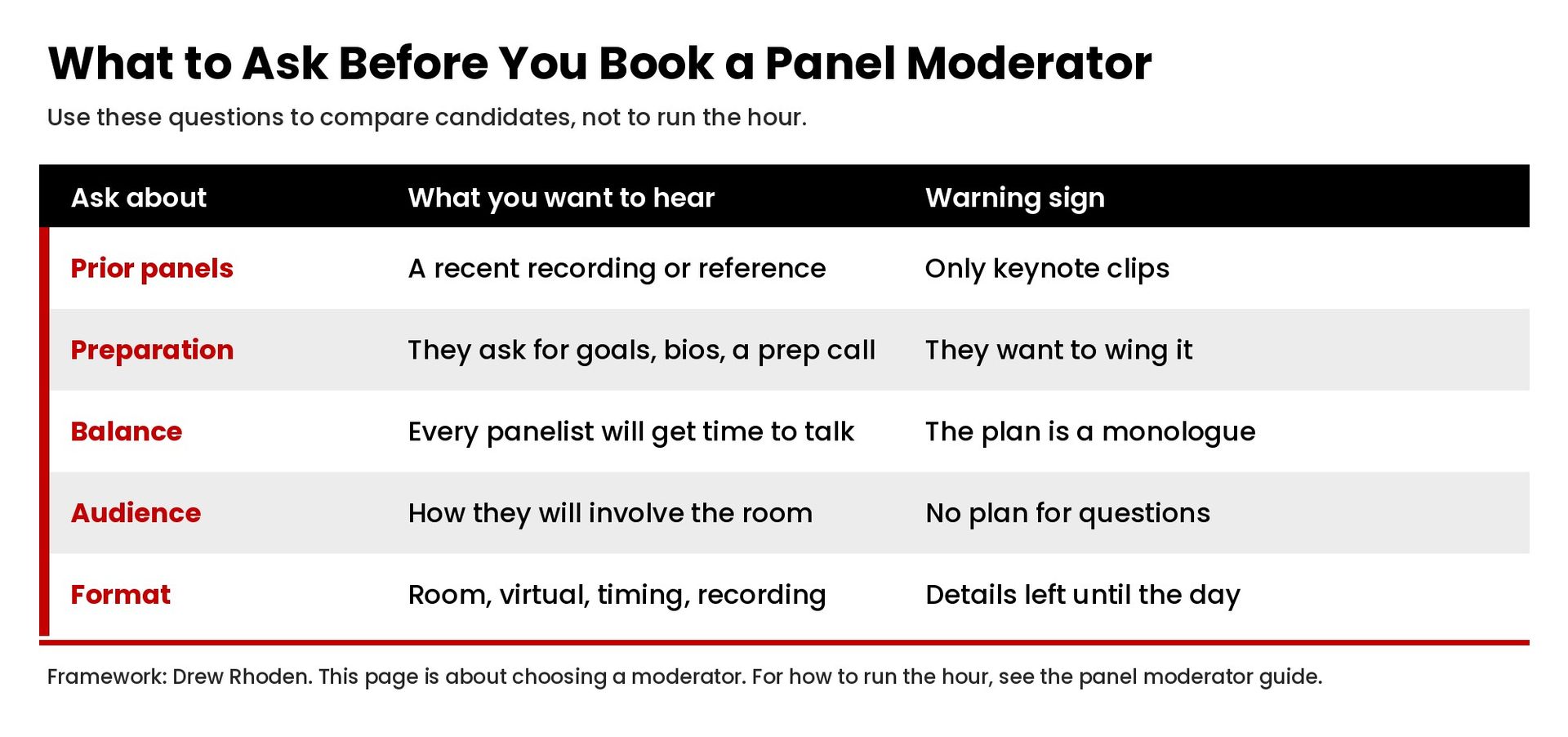
Look first at whether the person has moderated panels, not only whether they have given a keynote. Moderating panel discussions is a different skill. Ask for a recording of a recent panel, or for references from conferences where they did this work. Watch whether every panel member and the other panelists get a fair chance to talk, and whether the moderator listens before asking the next question. Interesting panels usually come from that balance, not from one long monologue.
A professional panel moderator should also be able to prepare. That means they will want a goal from you, bios of the panelists, and time for a short prep call. If a candidate does not want to research the panelists or the audience, that is a warning. Good research usually shows up in the first question they ask you. Research is part of the job, and it should include recent articles or talks by those panelists. Open ended questions, and the judgment to follow a useful response, come from that work.
Listen for how they describe the audience. The best candidates talk about the people in the seats: what those people already know, what would make the panel useful, and how to keep the format interactive without losing control of the clock. They should be able to connect comments from the audience to the larger discussion, and they should know when to wait and when to move on. That sense of timing is hard to fake. If you are interested in a candidate, spend a few minutes on a recording and see whether the room stays with them. Creating that line of attention, in a live room or in a virtual one, is the practical test. Panelists notice it. In a streamed event, people watching from around the world notice it too.
Personality matters, but less than people think. A lively presence can help. So can a calm one. What you want is a moderator who can keep meaningful conversations going when the energy drops, and who can keep one strong personality from taking over the room. Fun is a side effect of a well run panel, not the main test.
Questions to Ask in Advance
Ask these questions before you confirm the booking:
- What is one thing you do in the first few minutes to set the tone?
- How do you prepare questions, and how do you handle a panelist who gives a long, off-topic answer?
- Have you run both in-room and virtual panels, and what changes for you in each setting?
- How do you involve the audience without letting comments take over the plan?
- What do you need from us a week before the event?
Pay attention to the sentence that follows a short answer. A thoughtful moderator can give an example from a real session, not only a general tip. If they forget the audience and talk only about themselves, keep looking.
This is also the moment to discuss logistics, and to discuss length, number of panelists, whether there will be a Q and A, whether the session is recorded, and who will be in the room. Do not leave those details for the day of the event.
When You Need a Professional Panel Moderator
Not every panel needs an outside professional. At some meetings, a department leader can moderate well if they prepare, if they are willing to stay out of the spotlight, and if they have taken a short internal course or coaching on the role. At larger conferences, or when the topic is sensitive, a professional panel moderator is often the safer choice. They are less likely to be a party to the internal politics of the group, and they are more likely to treat the panel as a structured process.
Be careful not to confuse this role with a high stakes meeting facilitator. A facilitator in a private meeting is there to help a team decide something. A panel moderator is there to create a public conversation that has value for an audience. The practices overlap, but the impression you want in a conference hall is different from the impression you want in a closed strategy meeting.
How This Role Differs From Other Stage Roles
Hosts sometimes book a keynote speaker and then ask that person to moderate later in the day. That can work if the speaker has this specific skill and enough time to prepare. It can go worse if the speaker treats the panel as a second talk. Moderating panels requires listening more than speaking. If you already have engaging panel presentations elsewhere on the agenda, the moderator's job is to complement those sessions, not to compete with them. An engaging moderator still leaves air time for the panelists.
If You Need a Method to Moderate a Panel
If you need a method for the person you already booked, the site's panel moderator guide covers preparation, introductions, a simple script, virtual panels, audience questions, and the close. Use that page when you are ready to moderate a panel. This page is about choosing the right person first. Imagine the audience leaving with a clear set of ideas, not with a bunch of half-finished stories. The value of the hour is in those ideas, and in stories the audience can actually use. That outcome starts with the booking, not only with a script.
After You Choose Someone
Once you have a moderator, put the goal, the format, the timing, and the prep call on a shared plan. Give them the bios and any articles or talks that will help them research the panelists. Then let them do the job. Hosts who try to control every question often drain the life out of the discussion. Stay available, and stay out of the way unless a change in the program requires a new brief.
The importance of that handoff is easy to underestimate. A strong choice can still produce a flat panel if the host and the moderator do not agree on the purpose. Align on the purpose first. Then, if you want to talk through a panel for your event, contact Drew Rhoden or call (888) 209-4055.
share this
Related Articles
Related Articles