


Education Keynote Speaker: What Hosts Should Evaluate
An education keynote speaker is a keynote speaker hired for a school, district, university, or education conference. The audience may be teachers, educators in a professional development setting, students, families, or a mixed group. The talk has to fit that room. A message that works for a business crowd will not automatically work for a faculty in-service day, and a talk written only for students may not serve teachers who came for practical classroom ideas.
This article is for the host who is evaluating a keynote, not a general essay about all education speakers. The site already has pages on speakers for schools, a college speaker setting, and education speakers who help students build resilience. Those pages have their own focus. This page stays on what to evaluate before you book an education keynote. For the broader booking process, see the keynote speaker page. This article does not discuss fees, and it does not rank a list of names.
Table of contents:
- What an education keynote speaker is asked to do
- Who is in the audience
- What to evaluate in a sample
- Topics that belong in an education keynote
- Why best speakers lists are a weak starting point
- After you book the next event
What an Education Keynote Speaker Is Asked to Do
Education speakers are often booked to open a program, close an in service day, or set the tone at back to school kickoffs. A keynote speaker for educators is there to give the room a shared message they can use in teaching, leadership, or school life. That is a different job from a breakout session, a workshop, or a classroom visit. The keynote has the whole time of a single opening or closing hour, and the room is usually large.
Hosts often want the talk to inspire. That is a fair hope, but it is not a complete brief. Teachers and other educators have heard many talks that inspire for a morning and then fade by the next week. A useful education keynote should also leave practical ideas, language a team can share, and a next step people can try in the classroom or in their programs. If the only goal is a feel good hour, the booking will be hard to judge later.
The keynote's job is to give the room a focus. That may be school culture, student engagement, professional development, or a current challenge in instruction and learning. The speaker does not have to solve the school's entire year in one talk. They do have to understand the audience well enough to speak to the work those people actually do, and they should speak in language the room uses.
Who Is in the Audience
Start with the people in the seats. A keynote for teachers should sound different from a keynote for students. Teachers want insights they can use in instruction, classroom management, or collaboration with colleagues. Students want a talk that respects their time and speaks to their life, not a lecture written for adults and then shortened. Educators in a leadership role, such as principals or district staff, often want help thinking about culture, resources, and how to support teachers.
What a Conference Attendee Needs
A conference attendee at a large education event may be any of those people, or a mix. Ask who will be in the room, what they have already heard this year, and what would make the session worth the time. If students and teachers will sit together, the speaker needs a plan for both groups. If only staff will be in the room, do not book a talk that is aimed mainly at kids.
School culture matters here. Some schools want a speaker who can encourage curiosity, literacy, or a different way of thinking about learning. Other schools want a speaker who can talk about technology, innovation, or rapid change without ignoring the daily reality of the classroom. The right speakers can do that. The wrong speakers give a generic talk and hope it lands.
What to Evaluate in a Sample
Ask for a recording of a similar audience, not only a highlight reel. Watch how the speaker talks about students and teachers. Do they show understanding of classroom work, or do they speak in slogans? Do they share stories that have a point, or stories that only entertain? Education speakers who have done this work well usually leave time for people to think, and they can explain how a strategy would look in a real school day.
Listen for research and knowledge, but do not treat a stack of citations as the test. Teachers can tell when a speaker is creating a connection and when the talk is a performance. Look for strategies teachers can try, a clear message, and a tone that treats educators as professionals. If the speaker cannot describe one practical idea a teacher could use the following week, keep looking.
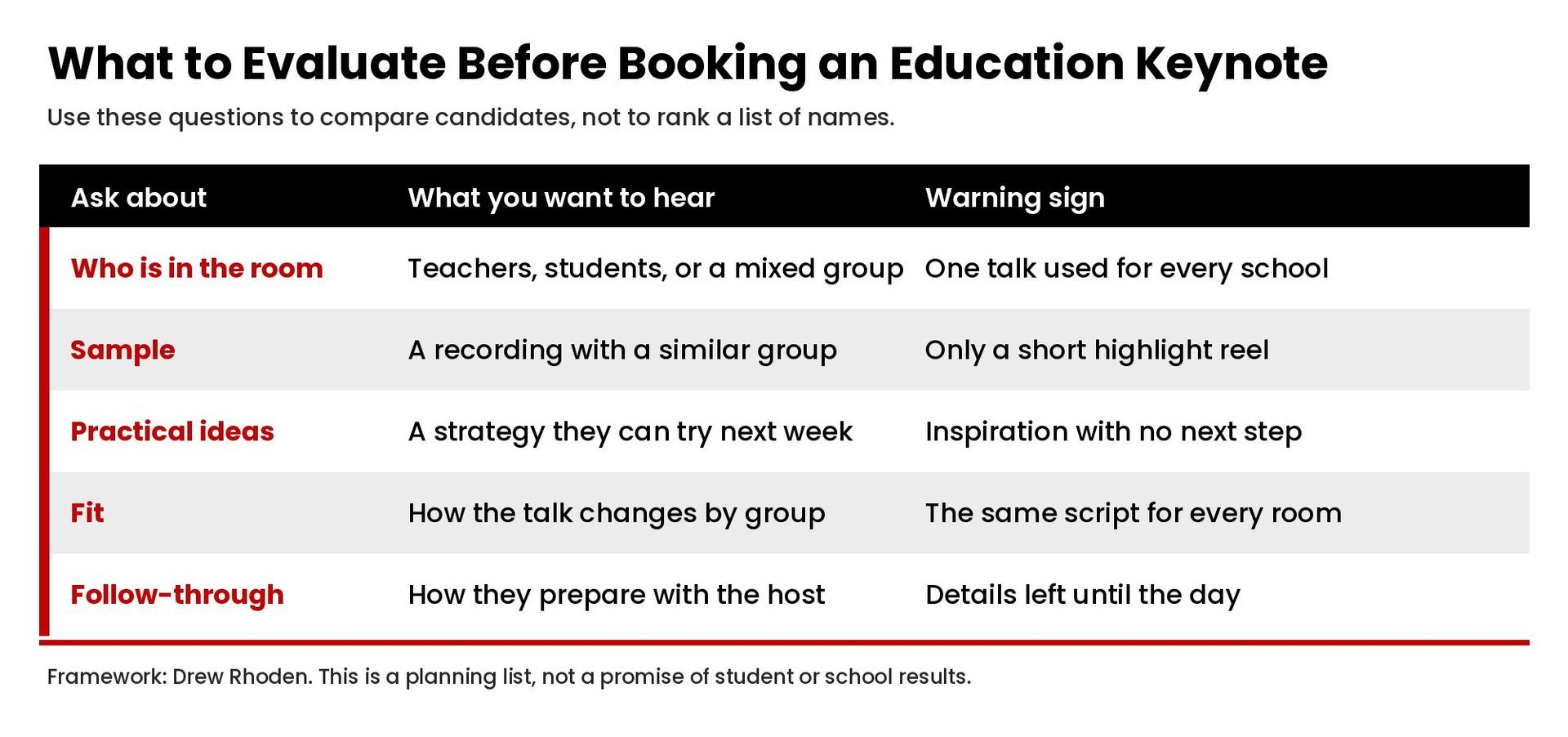
A keynote speaker for educators should also be able to work with your constraints: the length of the session, the size of the room, and whether the event is in person or virtual. Ask how they prepare, what they need from the host, and how they handle questions. If you are interested in a candidate, spend time on a full recording, not only the first five minutes.
The Essential Role of a Keynote Speaker for Educators
The essential role is not to occupy the stage for the whole time. It is to give teachers, students, or other educators a way to think about their work after the talk ends. That may mean new ideas about instruction, a better understanding of school culture, or a reminder of why the work matters. It should not mean a promised outcome. Learning, attendance, and morale depend on many things a single keynote cannot control.
Topics That Belong in an Education Keynote
Some subjects travel well in this format because they are part of daily school life. Teaching methods, classroom practice, student engagement, and professional development are all fair ground if the speaker has real experience to draw on. Innovative teaching methods can be a strong topic when the talk is specific. A vague appeal to innovation, without examples or research, is less useful. Real innovation in the classroom is specific.
Inspire Students Without Empty Inspiration
Hosts often ask speakers to inspire students, especially at assemblies or student-facing programs. That request is understandable. Inspiration, by itself, is thin. A talk that can inspire students and still give them something to practice is stronger. The same is true for a faculty group: a keynote can inspire teachers and still be practical. Ask the speaker how they do both. If they can only describe inspiration, the next event may feel exciting and then be hard to build on.
Literacy, math, creativity, and curiosity can all sit inside a keynote if they are tied to the people in the room. A math-focused gathering needs a different talk than a back to school program for the whole staff. Kids in an elementary gym need a different pace than a high school or college group. Education speakers should be able to explain those differences, not use one talk for every school.
Artificial Intelligence, Technology, and Rapid Change
Artificial intelligence is now a common request in education. Treat it like any other topic. Ask whether the speaker can discuss classroom use, limits, and professional judgment, not only excitement about the future. Technology and rapid change affect teaching, but teachers still need ideas they can use with the resources they have. A useful session explores those constraints instead of talking past them.
Professional Development Days and the Keynote
Professional development days, including an in service day, work best when the keynote connects to the rest of the program. If later sessions will cover instruction, assessment, or team planning, the keynote should leave room for that work. It should not try to cover every lesson in the curriculum. The best keynote in that setting is the one that helps educators focus on a few ideas they can carry into the next session.
Why Best Speakers Lists Are a Weak Starting Point
Why Ranked Lists Rarely Settle the Booking
Search results are full of best speakers lists and pages that claim to name the best keynote in education. Those lists change, and they often describe a style rather than a fit. The best speakers for a business conference may be a poor fit for an in service day. The top names for a student assembly may not be the right education speakers for a faculty group. Evaluate the person against this room, this school or conference, and this goal.
A great experience in the room still depends on planning. Tell the speaker who will hear the talk, what success would look like in honest terms, and what you do not want. Success, in this context, is a clear message and a useful conversation, not a promised change in student results. Founder stories, personal life stories, and stories from outside education can help if they connect to instruction and learning. They are a weak substitute if they take over the hour.
Campuses that are also comparing student-facing talks can review what campuses should look for before booking motivational speakers for college students. That page has a different focus. This one stays on the education keynote.
How Education Speakers Approach Learning
Education speakers are not all alike. Some speakers come from classroom teaching. Some speakers come from school leadership, research, or other work with students. Some speakers work mostly with teachers in professional development. What matters is whether those speakers can connect their experience to learning in this school or this event.
Look at how speakers talk about learning. Strong education speakers describe learning as daily work, not as a slogan. They can discuss how students learn, how teachers support that learning, and how a school can keep learning moving after the session ends. Speakers who only talk about their own career often leave learning out of the talk. Speakers who stay with that work usually leave people with lessons they can use.
Ask speakers to explain, in plain language, how their talk will assist students or assist the adults who work with students. "Assist students" should mean a concrete idea, not a vague promise. The same speakers should be able to explain how teachers can take the idea forward into lessons, team meetings, or later professional development. Forward movement in learning is what hosts are usually after.
Many education speakers also work at creating an engaging hour. Engaging is useful. It is not enough if the talk never returns to classroom work and learning. Ask speakers how they keep the room engaging while still leaving time for thought. Watch whether they encourage questions, encourage curiosity, and encourage teachers to try a strategy rather than only to applaud.
Creativity, knowledge, and a clear message should show up in the sample. So should insights about school culture and about the life of students and teachers. If the speaker tells founder stories, ask how those stories serve learning. If the speaker talks about the future of education, ask what teachers can do now. Speakers who can do that, in this country or in work around the world, are easier to brief than speakers who stay in general praise.
Some speakers will look fantastic on a short clip and thin in a full session. Other speakers will look quieter in a clip and stronger over a full hour. Compare speakers in the format you are booking. Education speakers who have worked with many programs, and who can explore a topic without talking through every minute, are often the more reliable choice. The point is not to collect speakers. The point is to choose speakers whose work on learning matches the people who will hear the talk.
After You Book the Next Event
Once you have a speaker, put who will attend, the length, the goal, and the logistics in writing. Give the speaker enough context about the school, the students, and the teachers to prepare a talk for this room. Then let them do the work. Hosts who try to script every line often flatten the talk. Stay available for questions, and review the plan if the program changes.
Education keynote speaker bookings work better when the host and the speaker share a simple standard: the talk should respect the audience, develop a few ideas, and leave people with something they can use. Speakers who meet that standard, whether they are speaking to students, teachers, or mixed groups of educators, make the next event easier to build on. Educators also look for a connection they can take back into daily life. That connection may be a message about how students learn, or a message about how educators can move work forward in their teams. Speakers who can inspire teachers, inspire a staff meeting, and still inspire careful work on strategies are more useful than speakers who only raise the energy in the room. Ask for two or three strategies and a few insights, not a pile of slogans. Many education speakers can describe energy. Fewer speakers can describe those insights clearly.
The future of a school program is built in ordinary days, not in one hour. Speakers can still talk about the future if they also talk about the world teachers work in, the world students live in, and the wider world of professional development. A founder can be a strong education speaker when the founder story serves that world rather than replacing it. Some educators want help creating a shared plan and creating space for questions after the talk. That is a fair request. Speakers should also be able to speak about innovation without losing sight of classroom limits.
If you want to discuss an education keynote for your school, district, or conference, contact Drew Rhoden or call (888) 209-4055.
share this
Related Articles
Related Articles