





NIL for High School Athletes: What Families and Schools Should Understand
Name, image, and likeness, often shortened to NIL, is the idea that a student-athlete may be paid for the use of their identity in a commercial or promotional setting. An NIL deal, as the NCAA currently describes it, is an agreement in which a person is compensated with money, products, or services for allowing a company, brand, or person to use their name, image, or likeness, such as social posts, appearances, or endorsements.
For high school athletes and other student athletes still in secondary school, that definition is only the starting point. High school NIL is not one national rulebook. State high school associations set the rules that affect high school eligibility, and those rules are not the same in every state or every sport. Families, coaches, athletic administrators, and booster groups should read the current guidance from the association that governs their school, and should treat this article as general information, not legal advice and not a prediction of any particular outcome.
This article explains what an NIL deal is, why the state's rules matter at the high school level, and how the University Interscholastic League currently describes Texas high school NIL in its 2026-27 NIL Information(updated July 15, 2025). It also notes, at a high level, what the NCAA's Name, Image and Likeness page says for high school prospects who later plan to play Division I college sports. It does not rank teams, estimate payouts, or tell any family whether a deal should be signed.

What NIL Means for Student-Athletes
In ordinary language, a student-athlete's name, image, and likeness are the parts of their identity that a brand might want to use. The NCAA's current public page lists examples that include social media posts or content for a brand, autograph signings, camps or clinics the athlete hosts, appearances in commercials or promotional events, and endorsement or sponsorship agreements.
Those examples describe a kind of activity. They do not, by themselves, tell a high school family whether the activity is permitted under their state's high school association, a school policy, or later college rules. A thing can be an NIL deal in the commercial sense and still be restricted, delayed, or off-limits for a student who wants to keep high school eligibility.
College athletes and college sports have their own NCAA rules, campus policies, and state law. That system is changing, and this article does not attempt to summarize revenue sharing, conference policy, or how much any university or team pays. When a question is about college eligibility, the NCAA page and the school's compliance office are the places to start. When the question is about high school eligibility, the starting point is the state high school association.
NIL Rules for High School Athletes Vary by State
Can high school athletes make NIL money? The honest answer is that it depends on the state's rules. The NCAA has long told families that, because rules vary by state, a prospective student-athlete should consult their state high school athletics association about high school eligibility. That remains the sound first step in any part of the country.
Some families hear about NIL deals in college sports and assume the same path is open, in the same form, at the high school level. It is not safe to assume that. A deal that would be discussed in a college setting may still conflict with amateurism or NIL guidelines issued by a state association. Old rules about amateur status have not simply disappeared because college NIL is in the news.
Parents, students, and school staff should also be careful about pressure around money, recruiting, or a supposed need to sign contracts quickly. The same caution applies to student athletes and their families in every sport UIL or another association oversees. This article will not tell you that a deal is a good idea, a bad idea, or a required next step. It will tell you where official guidance currently lives and what that guidance, in Texas, currently says.
Texas UIL Guidance for 2026-27
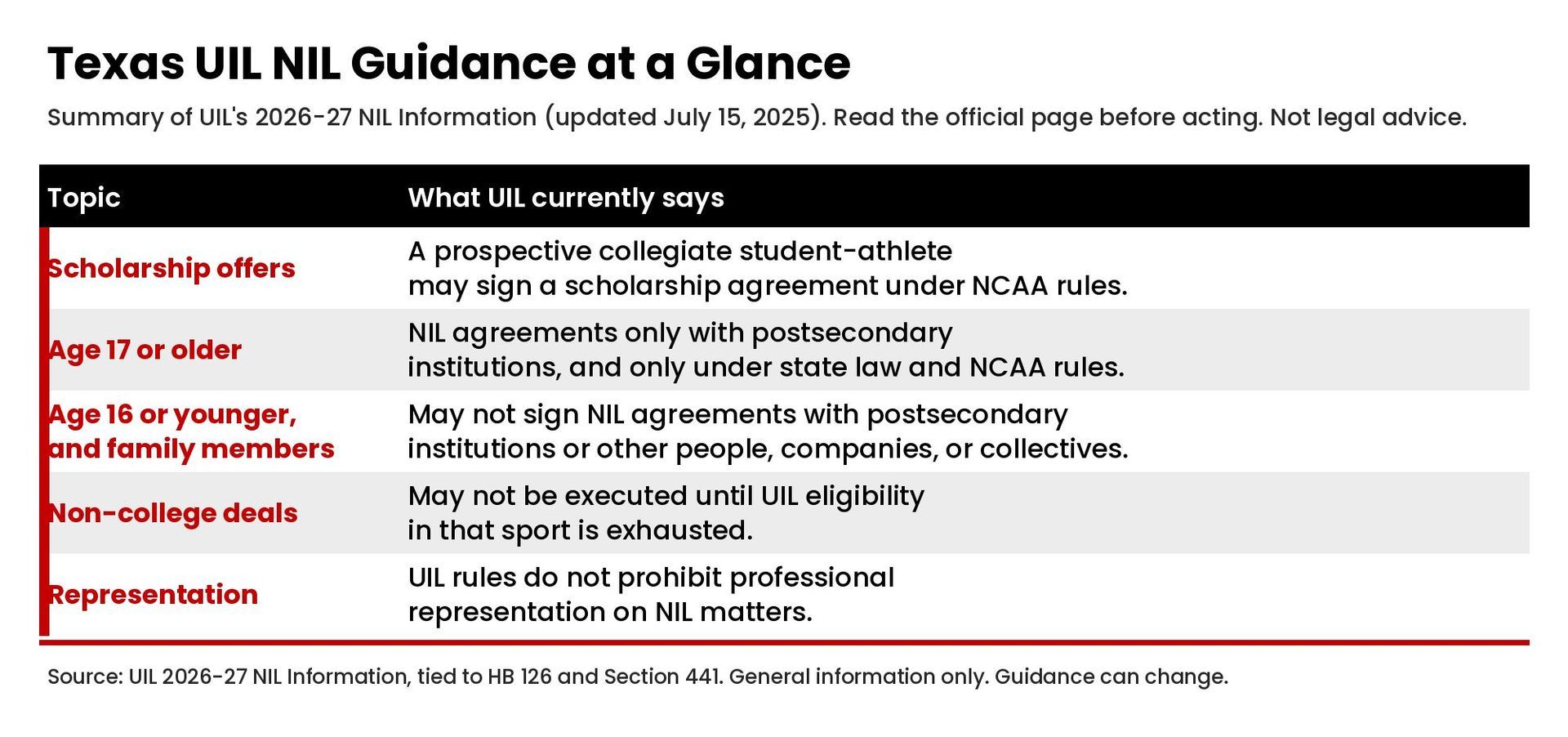
For Texas public-school programs that compete under the University Interscholastic League, the current official page is UIL's 2026-27 NIL Information, issued as guidance related to recent state legislation (HB 126) and tied to Section 441, Amateur Athletic Status. The page was updated July 15, 2025. What follows is a plain-language summary of that page, not a substitute for reading it and not a reading of the statute itself.
UIL states that prospective collegiate student-athletes may sign a scholarship agreement that contains the conditions of a scholarship with a postsecondary institution, pursuant to NCAA rules.
UIL also states that prospective collegiate student-athletes aged 17 or older may sign name, image, and likeness agreements only with postsecondary institutions, in accordance with applicable state laws and NCAA rules.
UIL states that prospective collegiate student-athletes aged 16 or younger, or family members of the prospective student-athlete, whether related by blood or through marriage, may not sign name, image, and likeness agreements with postsecondary institutions or with other individuals, corporate entities, collectives, or organizations, in accordance with applicable state laws and NCAA rules.
UIL states that any NIL agreement signed with any entity other than a postsecondary institution may not be executed until the prospective student-athlete has exhausted UIL eligibility in the applicable sport. Those agreements, UIL adds, must also comply with applicable state laws and NCAA rules.
UIL rules do not prohibit a prospective student-athlete from obtaining professional representation to assist with matters relating to NIL.
Several points are easy to miss and are worth restating in everyday terms:
- Texas high school NIL, as UIL currently describes it, is not an open market in which any brand, collective, or individual can sign a student while that student still has UIL eligibility in the sport.
- For a student who is 17 or older, UIL currently describes a narrow path: NIL agreements only with postsecondary institutions, and only in accordance with state law and NCAA rules.
- For a student who is 16 or younger, and for family members, UIL currently describes a prohibition on signing NIL agreements with postsecondary institutions and with other people and organizations.
- A deal with an entity other than a postsecondary institution, under this guidance, waits until UIL eligibility in that sport is exhausted.
- Having a lawyer or other professional representative is a different question from signing a deal. UIL says its rules do not prohibit obtaining that representation for NIL matters.
UIL noted this guidance on a dated official page, and association rules and regulations can change. Families and schools should read the live UIL page, not an article, before they act. Nothing here predicts how a particular contract, age, sport, or school fact pattern would be treated.
What College-Bound Students Should Also Know
A student can be subject to high school association rules now and NCAA rules later. Those are not the same set of NIL rules.
The NCAA's current Name, Image and Likeness page describes, among other things, what counts as an NIL deal and what the NCAA says is not allowed at the NCAA level, including pay-for-play, payment to attend or compete for a specific school, and compensation for athletics participation or achievement. The same page tells college athletes to review campus NIL policy and applicable state law and to talk with the compliance office or faculty athletics representative.
For high school prospects planning to play Division I, the same NCAA page currently describes a reporting threshold: all third-party NIL deals worth $600 or more since July 1, 2025, or starting the student's junior year of high school, whichever is later, including smaller payments from the same payer that add up to $600 or more. It says those deals are to be entered in NIL Go, the College Sports Commission's online platform, within 14 days after the student starts full-time classes or before the first Division I game, whichever comes first. The page also states that income from NIL activities is generally taxable and that students should keep records. That is tax information at a high level, not tax advice.
Those NCAA reporting details are about Division I college eligibility and compliance review. They do not replace Texas UIL guidance, and they do not answer whether a high school deal was permitted in the first place. A family that is looking at both high school eligibility and a later college career needs to keep both sets of rules in view and get advice from people qualified to give it.
This article does not walk through Division II, transfers, or every NCAA reporting category. The NCAA page is the primary source for those college questions.
What Families and Schools Should Understand
For parents and students, the useful questions are practical. What association governs the school? What does that association currently say about NIL deals? How old is the student? Is the other party a postsecondary institution or someone else? Has eligibility in the sport been exhausted? Who is being asked to sign, the student or a family member? Has anyone promised payment to attend a particular college, or payment simply to play? Those questions do not produce a score or a recommended deal. They help a family see which official rules may apply.
For athletic administrators, coaches, and booster groups, the useful work is education and process: point people to the current UIL or other state-association page, avoid treating hallway news as policy, and do not pressure students to sign. School staff should also be careful not to give legal advice they are not in a position to give. If a school is organizing a session for families, a sports speaker program or an education session for athletic administrators can help a room get aligned on the questions to ask. That is an education role, not a substitute for a school's own counsel or a family's own advisor.
The same is true for speakers for schools more generally. A clear conversation about NIL, amateur status, and the difference between high school and college rules can reduce confusion. It cannot and should not steer a student into a contract or promise a result.
Frequently Asked Questions
What is a NIL deal in high school?
It is an agreement to be compensated for use of the student's name, image, or likeness. Whether a high school athlete may enter that agreement, and with whom, depends on the state's high school association and other applicable law. In Texas, families should start with UIL's current NIL Information page, summarized above.
Can high school athletes make NIL money?
Sometimes, under the rules that apply to that student. It is not a yes-or-no answer for the entire country, and it is not a yes-or-no answer that this article can give for a particular child. In Texas, UIL currently describes tight limits on who may sign, at what age, and with whom, and it delays execution of agreements with entities other than postsecondary institutions until UIL eligibility in the sport is exhausted.
What are the NIL rules in the NCAA?
The NCAA maintains a current Name, Image and Likeness page that defines an NIL deal, describes activities that are and are not allowed under NCAA rules, and explains Division I reporting for certain prospects and athletes. Those are college rules. They sit alongside, and do not replace, state high school association rules.
Can schools directly pay athletes now?
This article does not describe college revenue-sharing models or school payment programs, and it does not answer that question for college sports. For Texas high school programs under UIL, the official guidance quoted above is about NIL agreements and amateur status, not about a school payroll for athletes.
How much NIL money do college athletes or Texas football programs get?
This article does not report or estimate those figures. Official payout questions belong to the institutions, conferences, and disclosures that publish them, not to a general explainer for families and schools.
What are the new NIL rules for 2026?
There is no single "2026 rulebook" that this article can announce. For Texas high school, the current official source described here is UIL's 2026-27 NIL Information, updated July 15, 2025. For NCAA Division I reporting details, the current official source is the NCAA's NIL page. Both should be re-read, because guidance can be updated.
Talk About an Education Session
If you are planning a session for parents, coaches, athletic staff, or a booster group and want a clear, educational conversation about high school NIL and the questions families should ask, contact me or call (888) 209-4055. You can also review my sports speaker and speakers for schools pages. This article is general information about published UIL and NCAA guidance. It is not legal advice, and it does not promise any legal, eligibility, or financial result.
share this
Related Articles
Related Articles