




Speaker Bio: How to Write One, With Examples and Templates
A speaker bio is a short professional biography that introduces a speaker to an event audience. It explains who you are, what expertise you bring, and why the audience should listen to you on this topic. Event organizers use speaker bios on websites, programs, promotional materials, and in the introduction read right before you take the stage.
As a speaker, I have learned that the difference between a strong speaker bio and a weak one is rarely the speaker's resume. It is whether the bio is written for the audience. This guide walks through what to include, how long a speaker bio should be, how to write one step by step, examples you can adapt, and the mistakes that cost speakers credibility.

What Is a Speaker Bio?
A speaker bio is a brief summary of your professional background, written in the third person, that helps an event audience understand your credibility and connect with your message. A good speaker bio does three things:
- Establishes credibility. It shows the experience, results, and credentials that make you worth hearing.
- Connects to the event. It shows why your expertise is relevant to this audience and this topic.
- Gives the audience a reason to care. It hints at the value they will take away from your talk.
A speaker bio is not a resume. A resume lists everything. A bio selects the few details that matter most for the event and presents them in a readable story.
Why Does a Strong Speaker Bio Matter?
A strong speaker bio matters before, during, and after an event:
- Booking. Event organizers often review speaker bios when deciding who to invite. A clear bio makes it easier for them to picture you on the agenda.
- Promotion. Organizers use your bio on the event website, in emails, on social media, and in printed programs. It is often the first thing potential attendees read about you.
- The introduction. The host or moderator usually reads a version of your bio aloud. A bio that is easy to say sets you up to start strong.
- Your speaking career. Over time, a consistent bio across your website, LinkedIn, and media kit builds recognition as a thought leader in your field.
If you moderate or host sessions, you will also read other speakers' bios aloud. Our panel moderator guide covers how to introduce panelists without reading their full resumes.
What Should You Include in a Speaker Bio?
Most strong speaker bios include the same core elements. Choose the details that matter for each event.
Your name and current role
Start with your full name and your current title or role, such as founder, senior director, consultant, or president. If your title is unfamiliar, describe what you do in plain language.
Your expertise and focus
State the topics you speak about and the problems you help people solve. Keep it specific: "leadership and decision-making for growing companies" is clearer than "business."
Credibility markers
Include two or three proof points that support your expertise:
- Years of experience or notable roles
- Results for clients or organizations, stated accurately
- Awards, recognitions, or publications
- Relevant education, such as a master's degree or professional license
- Notable companies, programs, or events you have worked with
Only include achievements you can verify. Event organizers and audiences notice inflated claims.
Connection to the audience
Tie your experience to the people in the room. For a leadership audience, highlight how you have led teams. For a student audience, highlight the path you took and what you learned.
A personal detail
A short personal line, such as a hobby, a place you are from, or something you are passionate about, makes you human and gives the audience something to remember.
A call to action or website
For web and program versions, end with where people can learn more, such as your website or a resource related to your talk.
How Long Should a Speaker Bio Be?
The right length depends on where the bio will appear. Keep three versions ready:
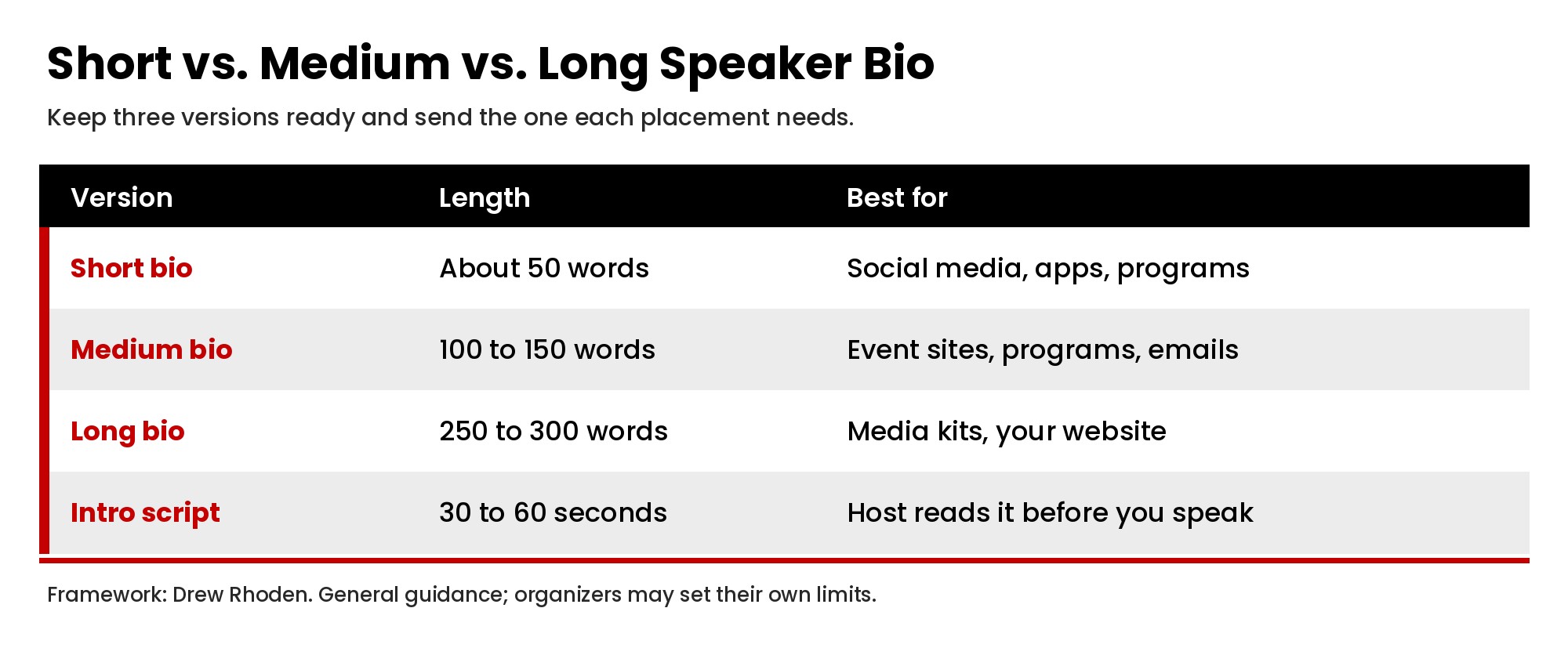
- Short bio (about 50 words). One to three sentences for social media, event apps, and tight program layouts.
- Medium bio (about 100 to 150 words). The most requested version. Use it for event websites, programs, and emails.
- Long bio (about 250 to 300 words). For media kits, your own website, and organizers who want more background.
Many organizers also ask for a separate introduction script that the host reads aloud. Keep that version short, conversational, and easy to say.
How Do You Write a Speaker Bio Step by Step?
1. Start with the audience
Before you write, ask who will read or hear this bio and what they care about. A bio for a corporate leadership summit should not read the same as a bio for a college orientation.
2. Write in the third person
Speaker bios are almost always written in the third person ("Jordan leads...") because the organizer or host presents them. Your own website can use the first person if that fits your voice.
3. Lead with your strongest, most relevant point
The first sentence should answer: who is this person and why are they speaking here? Put your current role and core expertise there.
4. Add two or three proof points
Select the credibility markers that best support the topic. More is not better. Three strong points beat ten weak ones.
5. Connect to the talk
Describe what your session covers or what the audience will gain, in one sentence.
6. Close with something human
Add a personal detail or a line about your mission. It makes the bio memorable.
7. Edit for clarity and length
Cut jargon, filler, and adjectives such as "world-class" that you cannot back up. Read the bio aloud. If you stumble, the host will too.
8. Update it regularly
Review your speaker bio every few months and customize it for each event. A new role, award, or program should replace older details.
What Do Good Speaker Bio Examples Look Like?
Here are speaker bio examples you can adapt. The first two use fictional names to show structure.
Short bio example (business speaker):
Jordan Ellis is the founder of a regional operations consulting firm and helps growing companies build management systems that scale. Jordan speaks on leadership, delegation, and decision-making for founders.
Medium bio example (healthcare leader):
Dr. Maya Chen is a senior director of clinical operations who leads a global team focused on patient experience and process improvement. Over 15 years, she has helped hospitals redesign workflows that reduce wait times and improve staff engagement. Maya holds a master's degree in health administration and speaks on change management, team leadership, and innovation in healthcare. Outside of work, she mentors early-career women in healthcare leadership.
My own medium bio:
Drew Rhoden, Esq. is an attorney, entrepreneur, and the founder of the Masterly companies. A former college football coach turned attorney, Drew speaks to business leaders, educators, and students about leadership, discipline, and building a career and company with intention. He earned his J.D. from American University Washington College of Law, an M.S. in sports management from West Virginia University, and a B.S. in sports management from Hampton University.
Notice that each example names the role, states the focus, adds credibility, and ends with something specific. You can read more about my background on my about page.
Is There a Speaker Bio Template You Can Use?
Yes. Use this simple speaker bio template as a starting point, then customize it for each event:
[Full name] is a [title or role] at [company or organization], where [he/she/they] [leads, advises, or helps whom] with [focus area]. With [number] years of experience in [field], [first name] has [one or two specific accomplishments or outcomes]. [First name] speaks on [two or three topics] and is known for [what makes your approach different]. [He/She/They] holds [relevant credential or degree]. Outside of work, [first name] [personal detail].
Here is how to adapt the template for different speakers:
- Consultant or advisor. Lead with the problems you solve for clients and the outcomes you help them create, then add the services or programs you are known for.
- Corporate leader. Lead with your title and the size or scope of your team, such as leading a global team or serving as a senior director or president.
- Founder. Lead with the company you built, its growth, and the idea behind it.
- Educator or trainer. Lead with the courses, programs, or resources you created and the people you serve.
- Creative or arts professional. Lead with your work, exhibitions, or projects, and what you encourage audiences to try.
Templates create a structure, but your personality is what makes a bio memorable. Write the first draft from the template, then rewrite it in your own voice.
How Can You Make Your Speaker Bio Stand Out?
Dozens of speakers may appear on the same event program. A few techniques help yours stand out:
- Lead with a clear position. State the one idea or point of view you are known for. An innovative or unexpected angle gives organizers a reason to choose you.
- Use specific numbers. "Has trained managers at more than 40 companies" is stronger than "has trained many managers," provided the number is accurate.
- Show momentum. Mention a recent milestone, such as launching a new program or book, to show your work is current.
- Ask for feedback. Share your bio with a few colleagues or friends and ask what stands out. If they cannot repeat your focus, simplify it.
- Match the event's interest. Read the event's theme and adjust which accomplishments you feature.
- Point to proof. Link to videos of past talks, testimonials, or press so organizers can see you in action.
What Mistakes Should You Avoid in a Speaker Bio?
- Writing a resume. Listing every role and degree buries what matters.
- Being vague. "Passionate leader who inspires others" says nothing. Describe what you actually do and for whom.
- Overstating results. Inflated claims damage credibility when an audience member checks.
- Using one bio for every event. A bio that is not relevant to the audience feels generic.
- Making it hard to read aloud. Long sentences, acronyms, and lists of awards trip up the host.
- Letting it go stale. An outdated title or old company makes organizers question the rest.
- Forgetting the photo. Most organizers request a headshot with the bio. Send a current, professional one.
How Do Event Organizers Use Your Speaker Bio?
Understanding how organizers use your bio helps you write it. Organizers will typically:
- Post it on the event website and session page.
- Include it in promotional emails and social media posts.
- Print it in the program or display it in the event app.
- Give it to the host or moderator for your introduction.
- Share it with media and sponsors.
Make it easy for them. Send all three lengths, a headshot, your session title and description, and a short introduction script in one email. If you are an organizer evaluating speakers, my guide to what organizations should evaluate before booking a keynote speaker covers what to look for beyond the bio.
How Does Your Speaker Bio Fit With the Rest of Your Speaker Materials?
Your speaker bio works alongside other promotional materials: a headshot, a speaker one-sheet, session descriptions, videos of past talks, and testimonials. Keep the language consistent across them so organizers see the same clear message everywhere. Strong materials make it easier to connect with organizers, earn referrals, and grow your speaking career.
Your bio also sets expectations for the talk itself. If you want to make sure the message lands once you are on stage, my public speaking tips cover how to craft a message people still use after the event.
Frequently Asked Questions
Should a speaker bio be in first or third person?
Third person is standard for event materials because the organizer presents it. First person can work on your own website or social media.
How long should a speaker bio be?
Keep a short version of about 50 words, a medium version of 100 to 150 words, and a long version of about 250 to 300 words.
What is the difference between a speaker bio and a speaker introduction?
A speaker bio is written to be read. A speaker introduction is a shorter script written to be spoken aloud by the host right before you take the stage.
Should I include personal information in my speaker bio?
A brief personal detail helps the audience connect with you. Keep it short and appropriate for a professional event.
Book a Speaker Who Prepares
A strong speaker bio is one sign of a speaker who respects the audience and the organizer's time. If you are planning an event and want a speaker focused on leadership, discipline, and practical takeaways, visit my keynote speaker page or contact me to talk about your event.
share this
Related Articles
Related Articles