




Public Speaking Tips: How Leaders Craft a Message People Still Use After the Event
Picture a 2024 leadership offsite. Twelve sessions over two days. Catered lunch, branded notebooks, breakout rooms. One week later, the executive team surveys attendees. Most people remember exactly one session-the keynote address where the speaker gave them a single, specific framework they could apply the following Monday. The other eleven sessions? Gone.
This is the norm, not the exception. Leaders invest serious time and budget in public speaking, yet audiences consistently leave with a vague feeling of inspiration and zero lasting behavior change. That gap between applause and action is where most talks fail.
Here is why closing that gap matters: presentation skills enhance effective communication and persuasion. Mastering presentation skills can lead to career advancements-not just for professional speakers, but for any leader who needs teams that execute, clients that buy, and stakeholders who trust their direction.
The public speaking tips in this article are built around five principles you can apply to your next talk:
- Start with the audience, not your slides
- Clarify one central idea that earns its place in memory
- Build a simple keynote structure anyone can follow
- Rehearse like you mean it-standing up, out loud, on a timer
- Close with a specific action, not a vague "any questions?"
The goal is not performance theater. It is putting together a killer presentation that gives people something they can still use after the event.

Start With the Audience: Who Needs What, by When?
Imagine you are preparing a persuasive presentation for a Q4 sales kickoff. Now imagine preparing an investor update. Same speaker, completely different audience needs. The sales team wants tactical moves. The investors want strategic proof points. If you prepare the same talk for both, you fail both.
Presentation preparation starts with three questions: Who is in the room? What decision or behavior do you want from them in the next 30 days? How much time do you actually have?
Shift focus from yourself to the audience's needs. Concentrate on delivering a message rather than on self-consciousness. This reframe changes everything about what you prepare.
Audience Snapshot-write these five bullets before any keynote address:
- Role (engineers, executives, frontline managers)
- Familiarity with the subject (new, intermediate, expert)
- Emotional state (stressed, skeptical, excited)
- Decision or behavior you want within 30 days
- Time allotted (real time, not scheduled time)
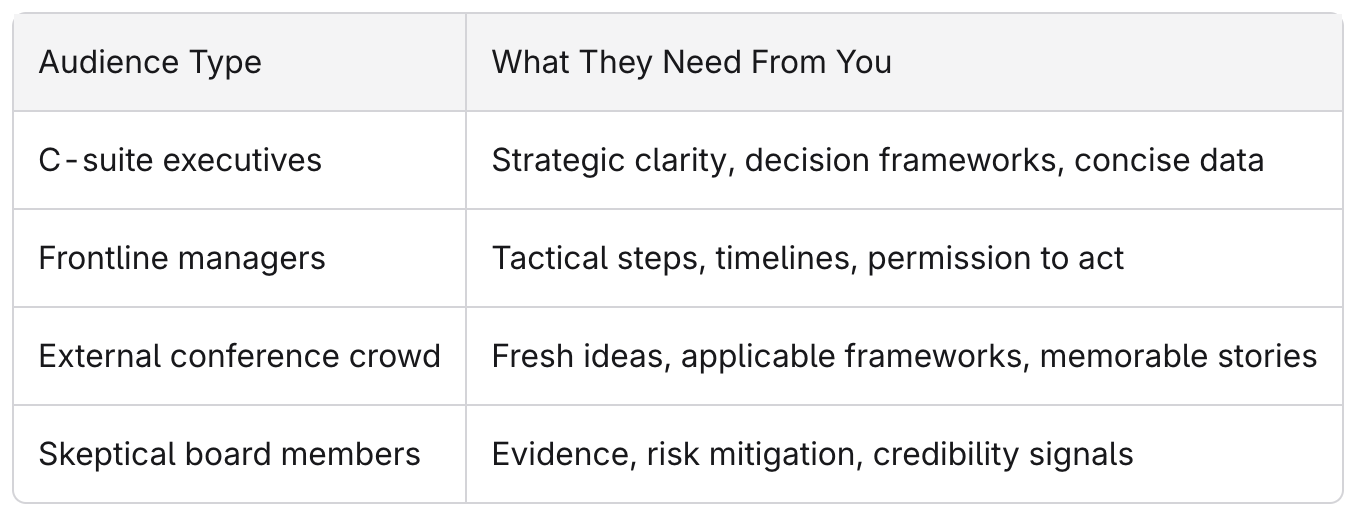
Different types of audiences demand different emphasis. Map yours before you write a single slide.
Clarify the Point: One Big Idea, Not 47 Little Ones
A muddled town hall with twelve priorities is a town hall nobody remembers. Contrast that with a focused keynote where the speaker delivered one sharp idea-"We will cut our response time from 72 hours to 24 by Q2"-and most people in the room could quote it a week later.
Effective presentations require clear organization of material, and that organization starts with one sentence. Nancy Duarte and other presenters call it different things, but the concept is the same: your central idea is a single line that states your point and what changes if the audience acts on it.
Create an outline to organize your speech content around that idea. Every story, every slide, every data point either supports the Big Idea or gets cut.
Pressure-test your Big Idea with this checklist:
- Can you say it in one sentence without pausing to think?
- Does it name a specific change or outcome?
- Would a listener be able to repeat it to a colleague tomorrow?
- Does it filter what belongs in the talk and what does not?
Strong example: "If every manager conducts a 15-minute weekly check-in, we reduce attrition by 20% this year." Weak example: "We need to focus on culture and people and innovation."
Design a Simple Keynote Structure People Can Follow
Once your Big Idea is set, organize your material to attain your speech's purpose using a simple three-part backbone. Here is one that works for leaders, not academics:
Problem – Path – Practice
- Problem (roughly 5 minutes of a 30-minute keynote address): Name the pain. Use one story or one surprising number. Grab attention within the first 30 seconds of your speech.
- Path (roughly 15 minutes): Walk through your solution. Layer in data, one or two examples, and a moment of audience interaction.
- Practice (roughly 7 minutes): Show what the audience does next. Make it concrete-who, what, by when.
- Buffer (3 minutes): Flex time for tech delays, transitions, or a brief Q&A.
This structure flexes across different types of talks. An all-hands update compresses the Path section. A persuasive presentation to a board may expand the data in Path and shorten Practice. An external conference keynote might lead with a longer story in Problem.
Use signposting to guide listeners: "Here is the challenge we are solving," "Now let me show you the path forward," "Here is what I am asking you to do by Friday." These transitions improve audience engagement and give note-takers a framework to follow.

Make It Concrete: Stories, Data, and Examples That Stick
In 2023, a product recall briefing became a case study inside one organization-not because of the crisis itself, but because the leader opened with one vivid customer story and supported it with a single clear chart. People remembered both a year later.
Research in neuromarketing shows that combining emotional storytelling with cognitive data yields both immediate attitude shift and longer retention. Adult learners in corporate settings retain concepts best when paired with a short story, a specific number, and a clear visual.
Start your speech with a surprising statistic or story to anchor the audience's attention. Starting with a surprising statistic can captivate the audience in ways a bullet-point slide never will. Using humor can significantly grab attention when it fits the moment, though it should serve the message, not replace it.
Here is how to balance stories and data across scenarios:
- Sales kickoff: Lead with a customer win story, follow with pipeline numbers
- Culture talk: Open with an interesting anecdote from a team member, support with engagement survey data
- Investor update: Lead with market data, humanize with one customer example
- Industry conference: Open with a counterintuitive trend, illustrate with a real case
Each example should involve concrete objects-"Q3 pipeline meeting in Chicago," "2025 product roadmap slide"-not vague placeholders. Specificity is what makes a point stick.
Plan Your Time: How Much Time You Really Have (and How to Cut)
You are told you have 30 minutes. Then you lose 5 to tech delays, 3 to a long introduction, and 2 to late arrivals. You actually have 20 minutes. This happens constantly.
- For a 20-minute keynote, plan roughly 16 minutes of content and 4 minutes of flex
- Allocate time: opening hook (2 min), core message and examples (10 min), action step (3 min), buffer (5 min total including transitions)
- If time shrinks on the day, cut a supporting story or a secondary example-never cut the Big Idea or the action step
- Understanding how much time you truly have determines whether you include interaction, a live demo, or extra stories
Rehearse out loud with a timer at least twice. This is the only reliable way to know whether your content fits your window. Start speaking slower than you think necessary to maintain clarity-most speakers rush when presenting under pressure, and pace is the first casualty.
Rehearsal That Actually Builds Speaking Confidence
Silent reading through slides is not rehearsal. Standing up, speaking out loud, and clicking through your presentation software with a remote-that is rehearsal.
Practice your speech out loud multiple times. Practice improves delivery and reduces nervousness. A randomized controlled trial of academic conference talks found that speakers who received structured preparation advice improved their effectiveness ratings by 0.22 standard deviations.
A simple 3-rehearsal plan:
- Run 1 (messy draft): Map content to structure, find gaps and redundancies. Do this in your office or at home-anywhere you can stand and speak freely.
- Run 2 (timed): Refine transitions and timing. Practice in an empty conference room. Practice under slightly stressful conditions to become comfortable speaking.
- Run 3 (polish): Focus on eye contact, vocal variety, and cutting filler words. Record yourself to review pacing and body language on video-your phone is enough.
Practicing in front of a mirror can improve delivery when you cannot record video. Feedback from peers can enhance public speaking skills; even one trusted colleague watching your final run-through is worth more than five solo practices.
Aim for a useful delivery instead of a perfect speech. Practicing a speech can increase confidence for introverts especially. Gradually build confidence by starting with smaller groups before high-stakes events. Rehearsal directly reduces stage fright and makes delivery feel like second nature rather than a performance.

Managing Nerves: Turning Stage Fright Into Useful Energy
Elevated heart rate, shaky hands, dry mouth-most people experience these before presenting. The feeling is adrenaline, not failure, and you can learn to steer it rather than eliminate it.
Use deep breathing exercises to calm nerves before speaking. Taking deep breaths can help calm stage fright-try a 4-count inhale, 4-count hold, 6-count exhale. Visualize a successful presentation before going on stage. Imagining worst-case scenarios can also help reduce anxiety by making the unknown feel manageable.
Arrive early to familiarize yourself with the venue. Walk the stage or the front of the room. Test the mic if there is one.
Pre-stage checklist (print this or screenshot it):
- 4-4-6 breathing pattern, repeated 5 times
- Quick vocal warm-up (lip trills, humming for 30 seconds)
- Shake out arms and legs to release tension
- Re-read your Big Idea and opening line
- Focus on audience outcome, not personal performance
- Plant feet, make deliberate eye contact with 3–4 people in the first 60 seconds
Coaching or guided practice can help reframe nervousness faster than trying to tough it out alone, but even these small rituals make a
measurable difference for speakers who present only a few times per year.
Delivery Details: Voice, Eye Contact, and Fewer Filler Words
Once your content is set, delivery choices multiply or drain your impact. Know your material thoroughly to build confidence so you can focus on how you speak, not what you are trying to remember.
Maintain eye contact to connect with your audience. A simple pattern works: hold natural eye contact with one person for a full sentence, then move to someone else. In a large crowd, pick individuals in different sections. In a small group, cycle through everyone.
Use silence effectively by taking pauses during your speech. Use effective pauses to enhance your speech delivery-especially after a key statement. A computational analysis of 1,239 TED talks found that clarity and structural coherence are stronger predictors of engagement than topic, speaker fame, or talk length.
Micro-tactics for your next public speaking opportunity:
- Speak slowly at the beginning-slower than feels natural-then vary pace throughout
- Drop your volume slightly before a key line, then deliver it at full voice
- Use gestures to emphasize your message effectively; keep hands visible, not locked at your sides
- Avoid filler words to enhance speech flow and confidence; replace "um" and "uh" with a brief pause
- Try a 60-second drill: describe your morning routine without any verbal fillers
- Stand still when making your most important point; walk during transitions
- Vary sentence length-short sentences after a long explanation create emphasis
- If your voice goes flat, imagine you are explaining the idea to one specific person who cares about the outcome
Audience Engagement Without Gimmicks
Engaging the audience increases their interest and retention. But audience engagement is not about forced icebreakers or trivia games-it is about usable interaction tied directly to your message.
Involving the audience increases their engagement during presentations. Engaging the audience can be achieved by asking questions that connect to the central idea, not questions designed to fill time.
How to add 1–2 interaction moments to a 20–40 minute talk:
- Internal town hall: "Raise your hand if your team has tried this in the last quarter." Follow with, "Good-here is what the data says about why it worked or did not."
- External conference: "Take 10 seconds and write down one barrier to implementing what I just described."
- Virtual webcast: Use a single-question poll at the midpoint, then reference results live.
- Hybrid leadership meeting: Pose a reflection question and give 15 seconds of silence-remote listeners need processing time too.
These moments combat the mid-talk attention dip that memory research at Leiden University identifies as the weakest point for retention. They also move a talk from a motivational speech toward an actionable presentation.
Close With Action: How to End So People Actually Do Something
A weak ending can leave the audience uninspired. "Thanks, any questions?" is the most common close in public speaking-and the least effective. Conclude with a strong statement that audiences will remember: name what to do, who should do it, and how success will be measured.
Include a call to action in your closing remarks. A study on presentation retention found that people recall roughly 4 out of 20 messages after 48 hours-but the final message is disproportionately sticky due to the recency effect. Use that real estate wisely.
Example closings for leaders:
- Behavior change: "Every manager in this room-schedule your first 15-minute check-in by Friday. Your directors will track completion next Wednesday."
- Client action: "Send us your Q1 data by March 10 so we can model the plan before your board meeting on March 25."
- Strategic alignment: "If you support this direction, I need your written feedback by end of day Thursday. Silence is not agreement."
Final slide design:
- One phrase-your Big Idea restated
- One date or metric tied to the next step
- No new content, no bullet lists, no "Thank You" filler
- Leave this slide up during Q&A so the action stays visible
An effective close makes it easy to send a post-event follow-up email that reinforces the same action, increasing business impact well beyond the room.

When to Bring in a Coach or Outside Speaker
For internal team updates and small project briefings, DIY improvement is usually enough. Apply the speaking tips in this article, rehearse properly, and you will succeed.
But high-stakes moments-annual meetings, strategy rollouts, major client events-sometimes justify expert support. Public speaking is a learnable ability, but the combination of message design, rehearsal discipline, and polished delivery under pressure is where a seasoned keynote speaker creates outsized value.
- If the event has 200+ attendees and a six-figure budget, the message deserves the same investment as the venue
- If you are presenting only once or twice a year, a coach compresses months of self-study into a few focused sessions
- If the outcome involves a strategic decision or culture shift, an outside perspective can sharpen both the plan and the delivery
Invite Drew Rhoden to speak at your next event or schedule a strategic conversation about your upcoming presentation. The focus is always the same: crafting a message people can use after the event, not celebrity-style performance coaching.
FAQs: Quick Answers Leaders Actually Ask
How much time should I spend on presentation preparation for a 30-minute keynote? Plan for 8–12 hours total across research, writing, slide creation, and rehearsal. If the event has more than 200 attendees or a major business decision rides on the outcome, invest closer to the higher end.
What is the ideal length for a keynote address? Most conference keynotes run 18–25 minutes of content plus Q&A. For internal events, 15–20 minutes with clear structure tends to hold the audience's attention better than a 45-minute marathon.
How do I handle tough questions during Q&A? Listen fully before responding. Restate the question so the room hears it, then answer concisely. If you do not know, say so and commit to a follow-up by a specific date. Bluffing destroys credibility.
What if the AV fails? Prepare to deliver your talk without slides. If you know your material thoroughly, you can explain your Big Idea and walk through your structure using only your voice and the whiteboard. Arrive early to familiarize yourself with the venue and test every piece of equipment.
Can I use note cards during a presentation? Yes. Brief note cards with keywords-not full sentences-keep you on track without killing eye contact. They are far better than reading from a script or turning to look at your own slides.
How do I build confidence if public speaking is not natural for me? Practice improves delivery and reduces nervousness regardless of personality type. Start with smaller groups and work up. Record yourself, review the video, and focus on one improvement per session-not perfection.
Leaders who want help tailoring these public speaking tips to a specific event or organization can reach out for a strategic conversation about what their audience needs to hear-and remember.
share this
Related Articles
Related Articles