




Strategic Thinking: How Founders Make Better Decisions When Every Option Has Tradeoffs
Every founder knows the feeling. Three Slack threads need your answer by noon. Your VP of Sales wants to chase enterprise deals. Your product lead is pushing to stay product-led. Your investor just sent an article about a competitor's pivot, with a one-line note: "Thoughts?"
You have forty-five minutes before your next call, and every option in front of you has a downside.
This is where strategic thinking separates founders who build lasting companies from those who exhaust themselves reacting to whatever feels loudest. Strategic thinking is a cognitive process focused on long-term goals. It combines analysis, foresight, prioritization, and trade-offs into a repeatable way of making decisions. It shifts your focus from reactive problem-solving to proactive future shaping, especially in the first five years when the stakes of each choice are highest.
The business value is straightforward: better founder decisions, fewer painful reversals, clearer business priorities, and stronger long-term direction. Organizations that think strategically can better navigate market disruptions. This article is written from a founder and advisor perspective, not an academic or consulting one. Expect examples, a concrete framework, and practical habits you can use this week.
Strategic Thinking vs. Strategic Planning
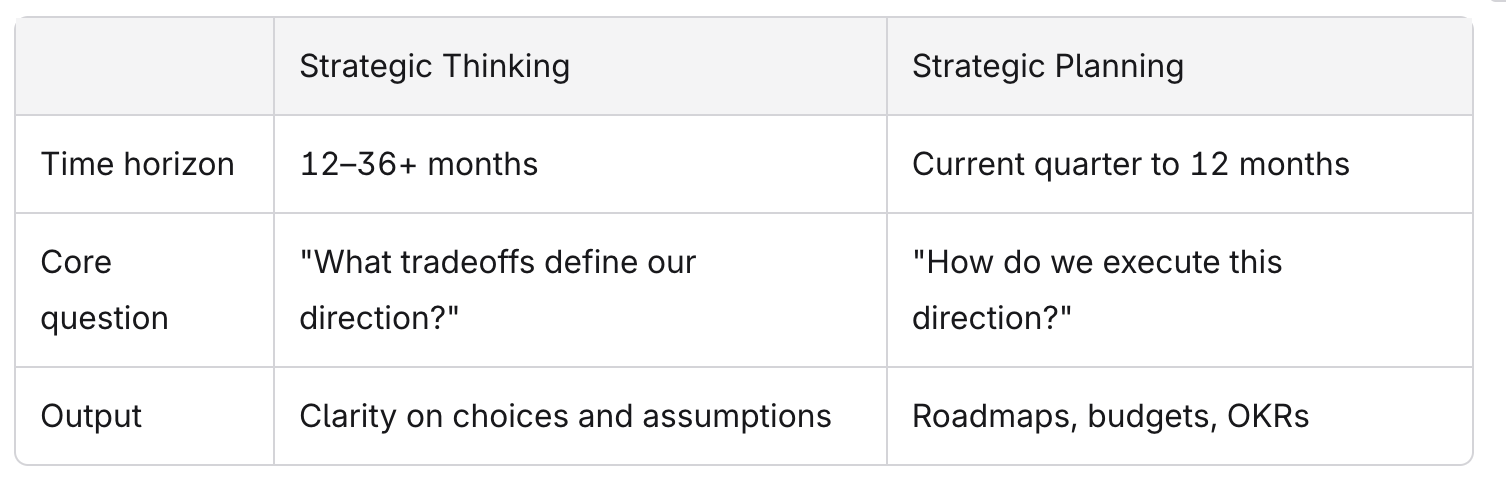
Here is the distinction that matters most. Strategic thinking is how you frame choices and tradeoffs. Strategic planning is how you turn a chosen direction into a roadmap and operating plan. Henry Mintzberg stated strategic thinking is about synthesis, not analysis. He emphasized strategic thinking's role in strategy formation, arguing that you cannot plan your way to insight. Strategic planning realizes and supports strategies that emerge from strategic thinking, and provides inputs for strategy implementation.
Consider a SaaS founder in 2026 deciding whether to move upmarket toward enterprise or stay with a product-led growth motion. The thinking part is weighing the tradeoffs: enterprise means longer sales cycles and heavier support, but higher contract values. PLG means faster feedback loops but thinner margins at scale. That is strategic thinking. The planning part comes after you choose: building the sales team, adjusting pricing tiers, setting OKRs. Strategic thinking seeks innovation and new futures. Planning organizes the work to get there.
Founders often confuse the two. They jump straight into OKRs, roadmaps, and budgets before doing the deeper thinking. The cost? They lock in assumptions that may be wrong, waste months of energy, and find themselves executing a plan that was never tested against a real tradeoff. This article focuses on building a strategic mindset, not selling strategic planning consulting or generic business systems services.
The Founder's Strategic Mindset: A Practical Definition
A strategic mindset is the habit of zooming out, spotting patterns, and choosing intentionally among imperfect options. It is not a personality trait. It is a learnable practice. Strategic thinking focuses on long-term opportunities to achieve goals, and it aligns daily actions with overarching organizational goals. Mental agility involves viewing situations from multiple perspectives, which is exactly what separates a strategic founder from a reactive operator.
The core elements of this mindset include long-term thinking, comfort with tradeoffs, systems awareness, and leadership judgment under uncertainty. Strategic thinking skills include analytical, communication, and problem-solving skills, all of which develop through deliberate use.
Imagine a founder in late 2025 who receives an acquisition offer at a 4x revenue multiple. The reactive response is either immediate excitement or immediate fear. The strategic response is different: she maps the tradeoff between a guaranteed exit and the possibility of a much larger outcome in 24 months, considers how the acquisition would affect her team's trajectory, and asks what assumptions about her market would need to be true for the independent path to win. She decides to continue independently, not because the offer was bad, but because her long-term thesis on market direction hadn't been disproven yet.
Strategic thinkers are not people with better instincts. They are people with better questions and the discipline to sit with uncertainty long enough to answer them.
Separating Urgent Problems from Strategic Decisions
Most founders mislabel decisions. Everything feels urgent and strategic at the same time. The fix is a simple diagnostic you can run weekly. Ask three questions about any decision consuming your energy: Is this reversible? Is this truly long term? Does this change the shape of the business?
Strategic decisions require evaluating future consequences and potential trade-offs. A one-off unhappy customer is tactical. Changing your ideal customer profile is strategic. Enhanced decision-making speed occurs when clear strategic frameworks are in place. Organizing priorities by importance helps you focus on what actually matters. Setting business priorities helps achieve your company vision rather than chasing every fire.

Use a simple matrix: Impact (high or low) on one axis, Reversibility (easy or hard to undo) on the other. High impact and hard to reverse is where your strategic thinking energy belongs. Walk through three scenarios. Hiring a VP of Engineering: high impact, hard to reverse. That is strategic. Sunsetting a product line: high impact, hard to reverse. Strategic. Moving to usage-based pricing from flat-rate: high impact, moderately reversible. Worth strategic attention but with less risk if you test it. An unhappy customer wanting a discount: low impact, easily reversible. Handle it and move on.
The goal is to label decisions correctly each week so you spend your best thinking on the choices that actually shape your company's future.
How Strategic Thinkers Frame Tradeoffs Instead of Chasing Win-Wins
Most meaningful founder decisions are tradeoffs, not puzzles with a clean answer. More focus versus more optionality. Growth versus runway. Speed versus control. Competitive advantage is derived from finding uncontested market space, which means choosing where you will and will not compete. It involves recognizing and responding to emerging market opportunities, and that requires understanding market trends and competitive shifts.
Efficient resource allocation directs resources to high-value projects, but only after you have named the tradeoff clearly. Here is a concise framing method:
- Name the options explicitly. For example: "Serve SMB only" vs. "Serve SMB and mid-market."
- Name the upsides and risks of each. SMB-only means faster iteration and tighter customer base, but a smaller addressable market. Adding mid-market means more money per deal, but longer sales cycles and split focus.
- Ask: "What am I willing to give up to get what I want long term?"
- Choose the tradeoff that best supports your clear direction.
A 2026 B2B founder chose to drop her mid-market pipeline entirely and focus on SMB customers after mapping the tradeoff. She lost 30% of near-term pipeline value but doubled down on the segment where her product had the strongest retention. Twelve months later, net revenue retention in that segment was 140%.
Strategic thinking rejects magical "no tradeoff" answers. It chooses the tradeoff and commits.
A Simple Strategic Thinking Framework for Founder Decisions
Here is a four-step framework you can use for any significant decision. Think of it as Context, Options, Consequences, Commit.
Step 1: Context. Gather the relevant facts: market signals, your current metrics, team capacity, competitive position. Asking strategic questions can improve your strategic thinking skills. Observing and reflecting on situations enhances your ability to see what is actually happening versus what you assume.
Step 2: Options. List the real options, including "do nothing" and "delay six months." Most founders skip these and fixate on a binary choice.
Step 3: Consequences. Map each option's likely consequences across 12 to 36 months. Hypothesis testing uses small experiments to test market behavior predictions. Post-analysis often reveals new insights that refine strategic direction. Future focus anticipates industry and customer needs three to five years ahead.
Step 4: Commit. Choose, communicate your reasoning to your team, and set a review date.
Example: A founder in 2025 debates expanding to Europe versus deepening the U.S. market. Context: U.S. retention is strong but growth is slowing. Options: expand now, delay 12 months, or partner with a European reseller. Consequences: direct expansion requires $2M and a local team; delay risks a competitor claiming the market; a reseller limits control but tests demand cheaply. She chooses the reseller for six months, with a trigger to go direct if demand crosses a threshold.
Once familiar, this process takes 60 to 90 minutes for most decisions. It is not a heavyweight exercise. It is a thinking habit.

Core Strategic Thinking Competencies for Founders
Five competencies show up repeatedly in founders who make consistently strong decisions.
Pattern recognition helps spot trends and operational bottlenecks. In practice, this means reading cohort retention data monthly and noticing when a customer segment starts churning before the revenue impact shows up.
Scenario thinking is the ability to imagine multiple futures and stress-test your strategy against each. A quarterly "red team" session where someone argues against your current direction builds this muscle.
Systems thinking evaluates how different parts of an organization influence one another. Hiring decisions affect product velocity, which affects customer satisfaction, which affects revenue. Seeing these connections prevents isolated choices from creating cascading problems.
Stakeholder empathy means understanding what your investors, customers, and employees actually need, not just what they say. Political savvy recognizes stakeholder dynamics essential for buy-in. You cannot lead a strategy no one follows.
Numerical reasoning is not about being a data scientist. It is about knowing which three numbers matter most this quarter and what movement in those numbers would change your course of action. Measurable goals increase the likelihood of achieving business priorities.
These competencies connect to leadership judgment: the ability to balance advice from investors, team members, and customers without
being paralyzed by conflicting input.
Long-Term Thinking Without Ignoring This Quarter
The tension is real. Investors want quarterly progress. Your burn rate demands near-term revenue. But real strategy unfolds over three to seven years. The answer is not to ignore short-term pressure. It is to use a long-term narrative to guide what you pursue and what you say no to this quarter.
Tracking results shows the benefits of setting business priorities over time. Collaborating with team members clarifies business priorities because shared goals reduce confusion. Improved organizational alignment occurs when employees understand their roles in broader goals.
Here is a practical tool: write a "north star" statement of where your company is headed in 36 months, then define three non-negotiable principles that act as a filter. For example: "We never take custom development work that pulls resources from the core product." "We maintain 70%+ gross margin even if it means slower growth." These principles let you answer most short-term questions without a full strategic review.
A founder under margin pressure in 2025 was tempted to take a large custom project worth $400K. It would have required diverting two senior engineers for four months. She ran it through her filter, said no, and kept the team focused on a platform feature that drove $1.2M in new ARR over the next year.
Putting Strategic Thinking Into Your Weekly and Quarterly Rhythms
Strategic thinking that only happens at annual offsites is not strategic thinking. It is a vacation with Post-it notes. The goal is to embed it into your operating rhythm.
Weekly: Block one hour as your "strategic hour." Review your core metrics, re-check one assumption you are making about your market or customers, and journal on one question: "What tradeoff am I avoiding right now?" Management focuses on planning and organizing tasks, and effective managers ensure employees meet expectations and deadlines, but this hour is explicitly not about managing. It is about thinking.
Quarterly: Re-articulate your strategy in a one-page narrative. Highlight three to five major tradeoffs you made. Reassess the biggest risks and opportunities on the horizon. Share this with your leadership team.
Team involvement: Gradually bring your leadership team into tradeoff conversations. Management is about control while leadership is about collaboration. When your senior leaders develop their own strategic mindset, they stop escalating every decision to you. They start making better calls independently.

A sustainable rhythm looks like this: one hour weekly, one half-day quarterly, one full day annually. That is roughly 60 hours a year of dedicated strategic thinking. It compounds.
Common Strategic Thinking Traps
Founders Fall Into
The Shiny Object Trap
Chasing every new idea, market, or feature request because it feels like progress. In 2025 and 2026, this often looks like adding AI capabilities to a product because competitors announced them, without validating whether your customers actually want or will pay for them.
Antidote: Return to your north star and ask whether this new direction supports your long-term thesis or distracts from it.
The Single Data Point Trap
Pivoting strategy because one large customer churned or one prospect said your pricing was too high. Leaders create a shared vision and motivate teams, but a single signal should not override a pattern.
Antidote: Check whether the signal represents a trend or an outlier before changing course.
The Investor-as-Commander Trap
Treating investor feedback as a command rather than one input among many. Leadership involves influencing and inspiring others, not outsourcing your judgment to your board.
Antidote: Name the tradeoff the investor's suggestion implies and decide whether it aligns with your direction.
The Perpetual Optionality Trap
Avoiding decisions to keep every possibility open. Serving SMB, mid-market, and enterprise simultaneously because you cannot bear to cut any segment. This drains resources and energy without building real position in any market.
Antidote: Use the framework. Force yourself to commit and set a review date.
The Effort-Equals-Impact Trap
Equating activity with progress. Shipping features, hiring aggressively, running meetings constantly without checking whether any of it moves the numbers that matter. Both management and leadership are essential for achieving goals, but effort without direction is just motion.
Antidote: Revisit your core metrics weekly and ask whether your current effort is producing measurable results.
When to Bring in a Strategic Advisor or Outside Perspective
Some inflection points benefit from external strategic thinking support: considering a major financing round, entering a new market, rethinking your business model, or navigating a leadership transition. A strong strategic advisor does not hand you a 200-slide deck. They help you frame tradeoffs, test assumptions, and sharpen your founder decisions.
Signals that you may be too close to the problem include cycling on the same decision for weeks, hearing conflicting advice from stakeholders you trust equally, and feeling defensive when someone questions your current path. Research from HEC Paris suggests founders benefit from treating strategic choices as experiments, and an outside perspective often reveals which experiments matter most.
Drew Rhoden works with founders as both a strategic keynote speaker and an advisor, focusing specifically on founder decisions, leadership judgment, and long-term thinking. If you are at one of these inflection points and want a conversation about direction, not a generic consulting engagement, that is exactly what his advisory work is built for.
Next Steps: Build Your Strategic Thinking Muscle
Here is what to take away. Strategic thinking is not strategic planning. Separating urgent from strategic prevents burnout and wasted resources. Framing tradeoffs explicitly beats chasing impossible win-wins. And embedding strategic thinking into your weekly and quarterly rhythms turns it from an occasional exercise into a compounding advantage.
Choose one decision you are facing right now. Run it through the Context, Options, Consequences, Commit framework. See what changes.
If you want to go deeper, explore booking Drew Rhoden for a strategic keynote at your next founder gathering, a leadership offsite, or a one-on-one strategic advisory conversation. Strategic thinking is a lifelong, compounding skill. The best time to sharpen it was five years ago. The second best time is today.

Frequently Asked Questions About Strategic Thinking for Founders
How is strategic thinking different from just being visionary as a founder? Vision is about imagining a future state. Strategic thinking is the process of choosing among imperfect paths to get there. You can have a compelling vision and still make poor strategic decisions if you skip the tradeoff analysis and assumption testing that strategic thinkers practice consistently.
Can strategic thinking be learned if I am more of a builder or operator? Yes. Strategic thinking is a practice, not a personality type. Builders often develop it fastest because they already understand systems. Start by asking one strategic question per week: "What assumption am I making that, if wrong, would change everything?" Research on founder success traits confirms that strategic innovativeness is a learnable dimension, not a fixed trait.
How often should I revisit my strategy in a fast-changing market? Weekly check-ins on assumptions, quarterly narrative reviews, and one deeper annual reassessment. According to Wilbur Labs data, 81% of founders pivot at least once, and 42% wish they had pivoted sooner. Frequent, lightweight reviews help you catch the signals early.
What is the first step if my team is stuck in short-term firefighting? Label your decisions. Use the Impact vs. Reversibility matrix to sort what is genuinely strategic from what is merely loud. Then protect one hour a week for your team to discuss only strategic items, with no tactical updates allowed.
Do I need a formal strategic planning process to be a strategic thinker? No. A formal planning process is useful for execution, but strategic thinking happens before and outside of planning. You need the ability to frame choices, name tradeoffs, and commit to a direction. A one-page narrative and three guiding principles will serve most early-stage founders better than a 50-page strategic plan.
When should a founder bring in an external strategic advisor? When you are at a genuine inflection point, cycling on a decision without resolution, or receiving conflicting stakeholder pressure. Harvard Business School and Harvard Business Review have both published extensively on the value of outside perspective during critical thinking moments. A good advisor helps you see what you cannot see from inside the company, particularly the tradeoffs you have been avoiding.
share this
Related Articles
Related Articles