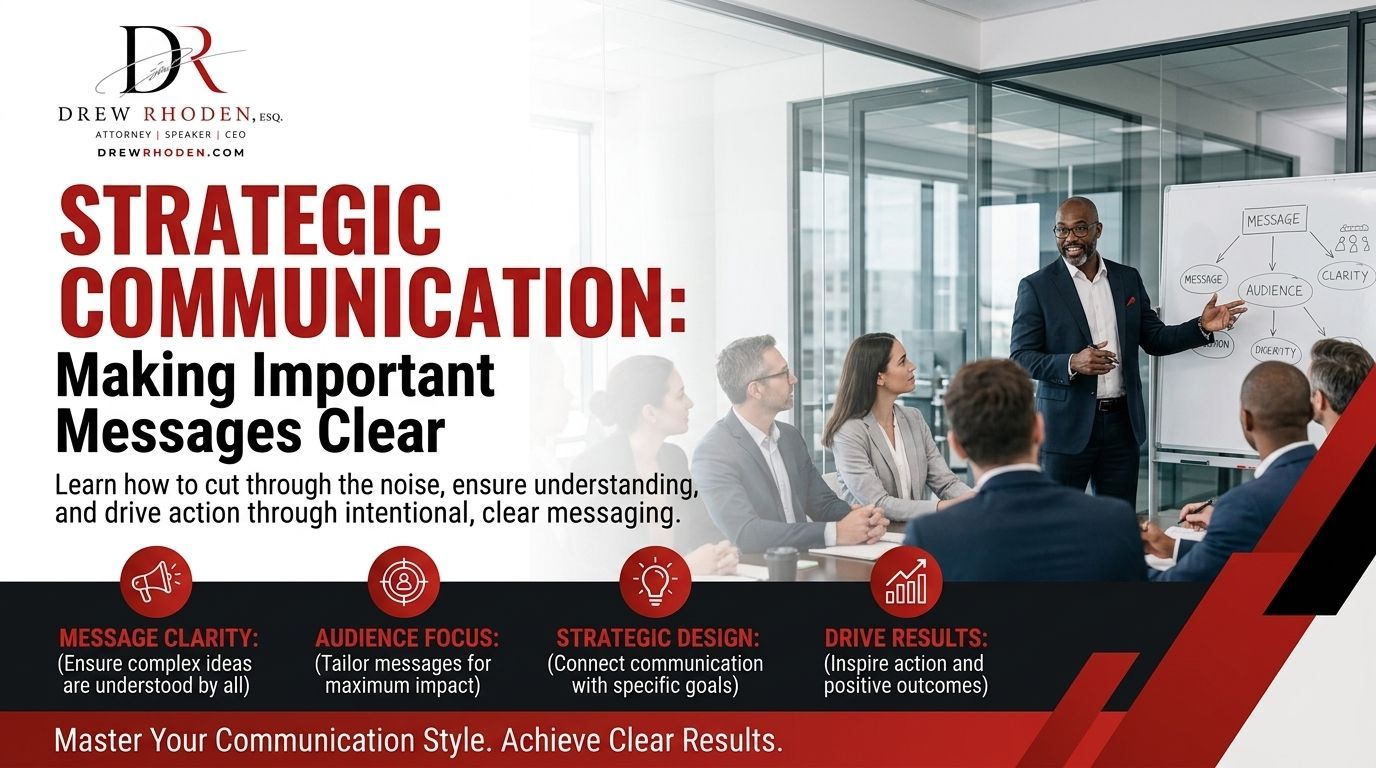





Executive Presence: What Leaders Communicate Before They Say a Word"
Two leaders walk into the same quarterly review. Both have the same data, the same recommendation, the same five minutes on the clock. One opens with a clear conclusion, pauses to let it land, and answers the CEO's follow-up with calm precision. The other opens a dense slide deck, talks fast, and loses the room before reaching the point. Same idea. Different outcome. The difference is executive presence.
Executive presence is the ability to project confidence and authenticity under pressure - the visible combination of credibility, composure, and leadership communication that makes people trust you with decisions that matter. It signals authority and credibility in leadership roles, and research suggests it accounts for roughly 26% of promotion decisions. It is crucial for advancing into senior leadership roles, not because it replaces competence, but because confidence is key to projecting authority and leadership in moments where competence alone isn't enough.
This article breaks executive presence into its working parts - credibility, composure, communication, emotional intelligence, clarity, and personal brand - and gives you repeatable practices to develop each one. The core idea: presence is less about image and more about how you think, prepare, decide, and communicate when stakes are high and ambiguity is everywhere.

What Is Executive Presence in Today's Executive-Level Environment?
Executive presence blends three overlapping areas: leadership presence (how you influence and own outcomes), professional presence (how you carry yourself), and executive communication (how you speak, write, listen, and decide). It combines leadership capabilities signaling authority and credibility. A useful working definition: it's how you show up when the stakes, visibility, and ambiguity are high.
Outdated stereotypes - the perfect suit, the booming voice, the relentless extroversion - are giving way to nuanced expectations shaped by hybrid work, distributed teams, and diverse cultural norms. What counts as strong presence in a large board meeting looks different from what works on a cross-cultural video call.
Presence starts before you speak. Nonverbal cues such as steady eye contact and good posture are important. The way you enter a room, frame your camera, breathe before responding, or hold stillness while listening - these signals shape perception before your first sentence. Appearance includes grooming and body language that project professionalism, and communication skills include body language and tone of voice alongside words.
Consider a real scenario: a senior director joined a tense project review where two teams were openly disagreeing. Instead of diving into slides, she opened with the conclusion, named one risk, and asked two clarifying questions. The room shifted. People stopped interrupting. Decision-makers felt safe raising concerns. Leaders with executive presence communicate with clarity and intention - and that changes the behavior of everyone around them.
Here's what executive presence is - and what it isn't:
- It is credibility under ambiguity, composure under pressure, and voice clarity that earns trust.
- It is not perfection - flawless speech, constant charisma, or dominating the room.
- It is a set of observable, coachable behaviors - not a personality trait reserved for extroverts.
- It is not purely about appearance or physical style.
- It is context-sensitive - what works in a town hall is different from a one-on-one.
- It is not static - it evolves through feedback, self awareness, and intentional practice.
The Business Value: How Executive Presence Drives Results
In the volatile environment of 2024–2026 - geopolitical risk, tech disruption, hybrid work at scale - leaders with strong presence build alignment faster and move work through organizations with less friction. Executive presence enhances organizational success and team performance because it makes the invisible mechanics of trust and clarity visible.
Leaders with executive presence inspire trust and motivate others. They inspire trust and motivate teams not through grand speeches, but through consistent behavior that makes stakeholders across finance, operations, product, and sales feel confident committing resources. Clear communication ensures alignment and reduces confusion, which is exactly what matrixed organizations need most.
The ripple effect is real. One leader's composure cascades into calmer teams, clearer priorities, and higher-quality execution. When people feel psychologically safe, they take smarter risks, surface problems earlier, and spend less time in defensive meetings.
In one documented case, a high-potential middle manager at a global chemical company worked with external coaches to build presence across cultures. After several months of focused coaching, observers reported measurable improvements in meeting influence, messaging clarity, and cross-cultural impact - the leader moved from roughly 2 to 5 on a 10-point presence scale. The organization's HR team considered that investment sufficient to prepare the leader for larger roles.
The Core Components of Executive Presence
Executive presence is a learnable capability, not just a natural trait. It breaks down into several components that reinforce each other. Here is a simple framework worth remembering:
- Credibility - the foundation that makes people believe your judgment when information is incomplete.
- Composure - visible emotional self-control when plans shift, conflict flares, or bad news arrives in real time.
- Communication - the structure, style, and listening behavior that make complex ideas land.
- Emotional intelligence - the ability to read the room, build strong relationships, and adapt to what others need.
- Clarity and decision making - simplifying ambiguity so others know what matters, what's next, and why.
These components reinforce each other: stronger communication skills support composure; composure reinforces credibility; credibility enables influence. The Bates ExPI™ framework organizes presence into 15 facets across Character, Substance, and Style - a validated model used across thousands of leaders. The simpler version above gives you an actionable starting point.

Credibility: The Foundation of Leadership Presence
Credibility stems from expertise and consistent follow-through. It's what makes people believe your judgment even when data is incomplete and stakes are high. Leaders with integrity build trust and credibility - not by being right every time, but by being transparent about what they know, what they don't, and how they'll find out.
Clear communication enhances a leader's credibility. Here are the concrete behaviors that build it:
- Preparation: send core materials before meetings, anticipate likely questions, and arrive with one or two key metrics ready. This signals competence before you open your mouth.
- Follow-through: consistent follow-through on commitments builds trust. Do what you say you will do. When plans change, own the shift publicly.
- Decision transparency: share the trade-offs behind your recommendations. Explain how you weighed options rather than presenting conclusions as edicts.
- Admitting uncertainty: saying "I don't know yet - here's how I'll find out" strengthens credibility far more than projecting false certainty.
Credibility accelerates leadership development and leadership potential because senior leaders and sponsors are more willing to back ideas from someone whose word they trust. Visibility in hybrid environments is essential for demonstrating leadership presence - predictable updates, written recaps, and high-quality async communication become the currency of credibility when you can't rely on hallway interactions.
Composure: Staying Steady When Everyone Else Reacts
Composure is the visible ability to remain calm when plans derail, conflict surfaces, or bad news lands in front of senior executives. Gravitas involves remaining calm during crises and demonstrating sound judgment. Gravitas reflects the steadiness people seek in leadership - the sense that this person will not unravel when things get hard.
Here's how composure shows up, both on screen and in person:
- Breathing: slow, deliberate breaths before responding. This is invisible to others but transforms your tone and pace.
- Tone and pace: keeping your voice even, avoiding filler words, and resisting the urge to speed up under pressure.
- Body language and facial expressions: open posture, relaxed shoulders, steady eye contact. On video, a stable camera frame and minimal reactive gestures.
Specific behaviors that help you maintain composure in high stakes situations:
- Pause briefly before answering. Silence is not weakness - it's control.
- Ask clarifying questions instead of launching into a defense: "Help me understand which assumption you're working from."
- Name the issue without assigning blame: "I see we diverged on assumptions. Let's map them together."
Managing your presence under pressure can influence how others perceive you. Exuding calmness and confidence can inspire trust in high-pressure situations. This connects directly to emotional intelligence - recognizing your own triggers, interpreting tension in others, and choosing responses that de-escalate rather than amplify.
The ripple effect of composure during layoffs, restructurings, or stressful situations is significant. Teams led by composed leaders stay in problem-solving mode rather than blame mode. Morale holds. Rumors slow down. People focus on what they can control rather than what they can't.
Communication Skills: Saying Less, Meaning More
Communication is the most visible layer of executive presence - what people latch onto first in meetings, town halls, and written updates. Clear communication is vital for effective leadership, and it takes many forms: spoken, written, visual, and nonverbal. Effective communication reduces confusion and enhances productivity across every channel.

Structure: Use simple frameworks to communicate effectively. Problem → options → recommendation works in almost every executive level context. Lead with the point. Senior stakeholders skip detail unless the headline is clear. Leaders with executive presence communicate their vision clearly by starting with what matters most, not building up to it. You should be able to state your recommendation in one sentence before expanding.
Style: Clear, plain language over jargon. Measured pace - not so slow you lose attention, not so fast you lose clarity. Confident but not domineering tone. Intentional pauses to let complex ideas land. Your communication style shapes how people receive your message as much as the words themselves.
Listening: Listening effectively is crucial for demonstrating executive presence. Active listening and asking thoughtful questions enhance executive presence more than any amount of eloquent speaking. Summarize what you've heard - "What I'm hearing is…" - to show you're tracking. Ask follow-ups that probe rather than rebut. Effective leaders connect their messages to the audience's interests and needs, and that requires actually hearing what those interests are. Influential leaders focus on ensuring their message lands effectively, which means adjusting in real time based on audience reactions.
Clear communication is a vital aspect of executive presence. Practice tools like recording presentations or video calls and reviewing them, or rehearsing opening lines before tough conversations, steadily enhance leadership communication over weeks and months.
Emotional Intelligence and Building Relationships
Emotional intelligence - self awareness, self-management, social awareness, relationship management - is the infrastructure underneath executive presence. Emotional intelligence enhances a leader's executive presence because it determines whether your composure is genuine or just performance, whether your listening is real or theatrical.
Emotional intelligence helps leaders understand team dynamics and adapt accordingly. Leaders who connect with teams foster motivation and trust at a level that no memo or all-hands can replicate. Emotional intelligence strengthens relationships and trust across levels, functions, and geographies.
Concrete relationship-building behaviors that set effective leadership apart:
- Regular skip-level conversations - meeting people two levels down to hear unfiltered perspectives.
- Thoughtful follow-ups after tough meetings. The emotional freight lingers; leaders who acknowledge it build loyalty.
- Recognizing contributions publicly, especially from people who often go unnoticed. This signals concern and authenticity.
- Adapting communication across cultures and time zones - turning down intensity where indirect communication is the norm, allowing leaders to inspire confidence rather than overwhelm.
Building strong relationships is essential for executive presence, and leaders with strong executive presence build strong relationships as a natural output of these behaviors. In diverse global teams, emotional intelligence helps leaders inspire trust across communication styles, helping leaders refine how they show up for individual leaders and cross functional leaders alike.
Clarity, Decision Making, and the Ripple Effect of Your Choices
Clarity is both a thinking skill and a communication outcome. It's what happens when you simplify ambiguity so others know what matters now, what comes next, and why. Senior executives judge leadership potential by how you frame decisions, explain trade-offs, and set direction under uncertainty.
Executive presence develops gradually through experience and feedback - and nowhere is that development more visible than in decision making. Here's a micro-process you can apply in any real meeting:
- Summarize the issue: "Here's the problem we're solving."
- State what you know and what you don't.
- Name the decision: "I recommend we move forward with option C, and here's why."
- Invite targeted input - by name - from specific stakeholders.
- Confirm the decision, immediate next steps, owners, and how success will be measured.
The ripple effect of decisive, well-communicated choices: reduced rework, higher confidence across teams, faster alignment, and less hidden resistance. When people understand the criteria and direction, they gain support for execution more quickly, mistakes get caught earlier, and accountability rises. This is where presence and results converge.
Shaping Your Personal Brand as a Leader
Your personal brand is the consistent story other people tell about what you're like to work with and what they can count on you for. Presence and brand are inseparable - they show up across every channel: meetings, email, Slack, LinkedIn, and public speaking.
A practical exercise: identify 2–3 leadership adjectives you want to be known for - calm, prepared, decisive, for example - and use them as a litmus test before high-stakes moments. "Does this email reflect 'decisive'?" If not, revise.

Digital presence matters too. Post concisely and thoughtfully. Share expertise with real examples. Avoid posting when emotionally triggered. Your online behavior should match your in-person professionalism - this is where many opportunities emerge for visibility, stretch assignments, and invitations to executive level conversations.
A well-managed personal brand tied to authentic presence opens doors to new challenges, leadership programs, and speaking roles that accelerate personal development and career growth.
Developing Executive Presence Day to Day
Presence is not built in a workshop. It is shaped through daily, intentional practice - small experiments repeated across months, not days. Here are habits that develop new skills and expand your comfort zone:
- Prepare 10 minutes before every meeting: identify your key message, anticipate one objection, and script your opening line.
- Record yourself on video calls and review: where did you remain calm? Where did you rush or lose focus?
- Ask a trusted colleague: "When I'm under pressure, what do you notice about my own behavior and presence?" Track one specific change per week.
- Speak up first once a week - even in virtual settings - to set tone and practice self assurance.
- Volunteer to lead a cross-functional update or present a decision to senior leaders.
- End each day with brief reflection notes: when did you show the presence you wanted? When didn't you? What will you try differently tomorrow?
Coaching leaders through this kind of practice is what separates organizations that talk about leadership capabilities from those that actually build them. The goal is not perfection - it's consistency and awareness, allowing leaders to reshape how others experience their presence over time.
Leveraging Support, Learning, and Conversations About Presence
Executive presence is a long-term leadership development path. It requires more than a single coaching session or a well being initiative - it demands ongoing support structures and honest feedback loops.
Types of support that accelerate growth:
- Peer circles where leaders observe each other and exchange candid feedback.
- Mentoring relationships with someone whose presence you admire within your organization.
- Targeted communication practice: speech coaching, video rehearsal, or even acting training to enhance vocal variety and stage presence.
- Leadership conversations where presence is discussed as part of performance reviews - tied to impact, alignment, and culture, not just deliverables.
For organizations seeking to elevate leadership communication and presence, Drew Rhoden partners with leadership retreats, speaking events, and internal learning programs focused on composure under pressure, credible decision communication, and clarity in hybrid environments. If helping leaders refine how they show up in high-stakes moments matters to your organization, that conversation is worth starting.
Your next step: identify one upcoming meeting or presentation where a modest upgrade in how you show up could change the outcome. Prepare for it with the practices in this article. Start there.

FAQ: Executive Presence, Leadership Presence, and Professional Presence
Is executive presence just for executives?
No. Presence matters at every level, but the stakes and visibility rise as you move up. Individual leaders at the director or team-lead level who demonstrate credibility, clarity, and composure early set themselves up for smoother transitions into senior leadership. It's about inspiring belief in your ability to handle what's ahead - regardless of title.
How is executive presence different from professional presence?
Professional presence focuses on dependability, polish, and meeting baseline norms. Executive presence adds strategic framing, the ability to influence decisions under ambiguity, and the capacity to inspire trust across broader organizational boundaries. Think of professional presence as the foundation; executive presence is the structure built on top.
Can introverts build strong executive presence?
Yes. Presence is about behavior, not personality type. Introverted leaders often excel through deep listening, thoughtful preparation, concise communication, and authentic relationship building. A strong presence can take many forms, and introversion is not a barrier - it's frequently an advantage.
What undermines executive presence the fastest?
Reactive tone under stress, over-confidence without supporting data, dominating conversations while failing to listen, lack of clarity on decision criteria, and visibly breaking commitments. These behaviors erode trust faster than almost anything else. Organizations that want innovation and success need leaders who avoid letting presence backfire into arrogance or unapproachability.
How long does it take to change how people perceive my presence?
It depends on consistency. Measurable shifts in perception can begin within 8–12 weeks of focused weekly practice. Deeper, identity-level change typically requires 6–12 months of applied work, feedback, and reflection. Shared goals between a leader and their coach or mentor accelerate the timeline.
How does executive presence relate to communication skills and emotional intelligence?
Communication is the outer face of presence - how structure, clarity, and listening show up. Emotional intelligence is the engine underneath - what drives composure, connection, and authenticity. Presence without emotional intelligence is brittle. Communication without it may land technically but miss impact. Together, they build gravitas and credibility that make effective leadership possible.
Reflect on one relationship or recurring meeting where a modest upgrade in presence could have an outsized ripple effect. That's your starting point.
share this
Related Articles
Related Articles