



Strategic Leadership: How Founders Set Direction Without Becoming the Bottleneck
The Founder Bottleneck Problem
Picture a growth-stage SaaS company in 2026. The product team has a pricing change ready to ship. The sales team needs a decision on whether to pursue a new vertical. The head of engineering is waiting on roadmap clarity before committing resources. All three decisions sit idle because only one person can approve them: the founder.
This is not a time-management problem. It is a strategic leadership problem. When every decision that feels "important" routes through a single person, the entire organization slows to the speed of that person's calendar. Strategic leaders focus on long-term goals and vision, but when they also absorb every operational and tactical decision, they become the very constraint they are trying to eliminate.
The business impact is real. Slow executive decision making lets competitors move first. Missed opportunities accumulate. Founders burn out from cognitive overload. Senior leaders feel disempowered, lose morale, and eventually leave. Organizations without strategic leaders who build scalable decision systems risk failure in changing environments.
We have seen this pattern across dozens of growth-stage companies. The rest of this article is a practical guide for founders and CEOs who want to set clear direction, define decision principles, assign ownership, and build the cadence that lets the company move without constant founder intervention. This is not a generic leadership skills talk. It is a founder-specific playbook for leading strategically without becoming the bottleneck.

What Is Strategic Leadership for Founders?
Strategic leadership for founders is the ability to set a clear long-term direction, create alignment across your leadership team, and enable others to make effective strategic decisions without you in the room. It is future-focused and long-term oriented. Strategic leaders align people and organizations with long-term goals rather than personally approving every move.
This is not about being the "visionary genius" who delivers a compelling vision from a stage. It is about architecting how decisions get made at scale. Effective strategic leadership integrates both analytical and human dimensions, combining data-driven trade-offs with an understanding of team dynamics, culture, and motivation.
Strategic leadership involves significant organizational change initiatives. Strategic leaders consider the interdependence of organizational areas, recognizing that a pricing decision affects sales, product, and customer success simultaneously. A 2024 study of 241 Italian startups found that delegation of strategic decisions remains remarkably low, with founders retaining authority across most of 19 strategic decision domains. The average delegation score was just 1.605 on a centralization scale, meaning most important choices stayed with the CEO.
Strategic leadership helps organizations achieve long-term goals by creating a shared leadership strategy and a common vocabulary and toolset for making decisions. Effective strategic leaders influence others to embrace a collective vision so the business can act with coherence even when the founder is not present. For growth-stage companies of 50 to 500 people, the risk is rarely a lack of ideas. It is the lack of a system for turning those ideas into focused, aligned action.
Operational vs. Strategic Leaders: Who Owns What?
Confusion between operational and strategic leadership roles is one of the fastest ways to make the founder the default decision maker for everything "important." Operational leaders manage day-to-day functions and short-term targets. Strategic leaders decide which bets matter for the next 18 to 36 months. These are fundamentally different jobs, and conflating them creates chaos.
Here is a simple way to think about the split:
- Operational leaders drive today's performance: hitting quarterly revenue targets, maintaining SLAs, managing current customer relationships, optimizing existing processes. Operational leadership does not typically drive significant change; it ensures the current system runs well.
- Strategic leaders set the direction for tomorrow: choosing which customer segments, markets, and products the company will invest in or exit. Strategic leaders drive significant organizational change by making the hard trade-offs that shape the company's future.
A concrete example: your VP of Sales is focused on this quarter's pipeline and closing deals in existing verticals. Meanwhile, the founder as strategic leader should be deciding which markets and deal types the company will stop pursuing and which new segments deserve investment. When that line is blurred, the VP escalates every borderline deal to the founder, and the founder gets pulled into execution.
The shift many leaders need to make is from "heroic problem solver" who handles every fire to "designer of the leadership system" that empowers others to solve problems within a clear strategy. That transition is the essence of executive decision making at the founder level.
A Simple Framework: Direction, Principles, Ownership, Cadence
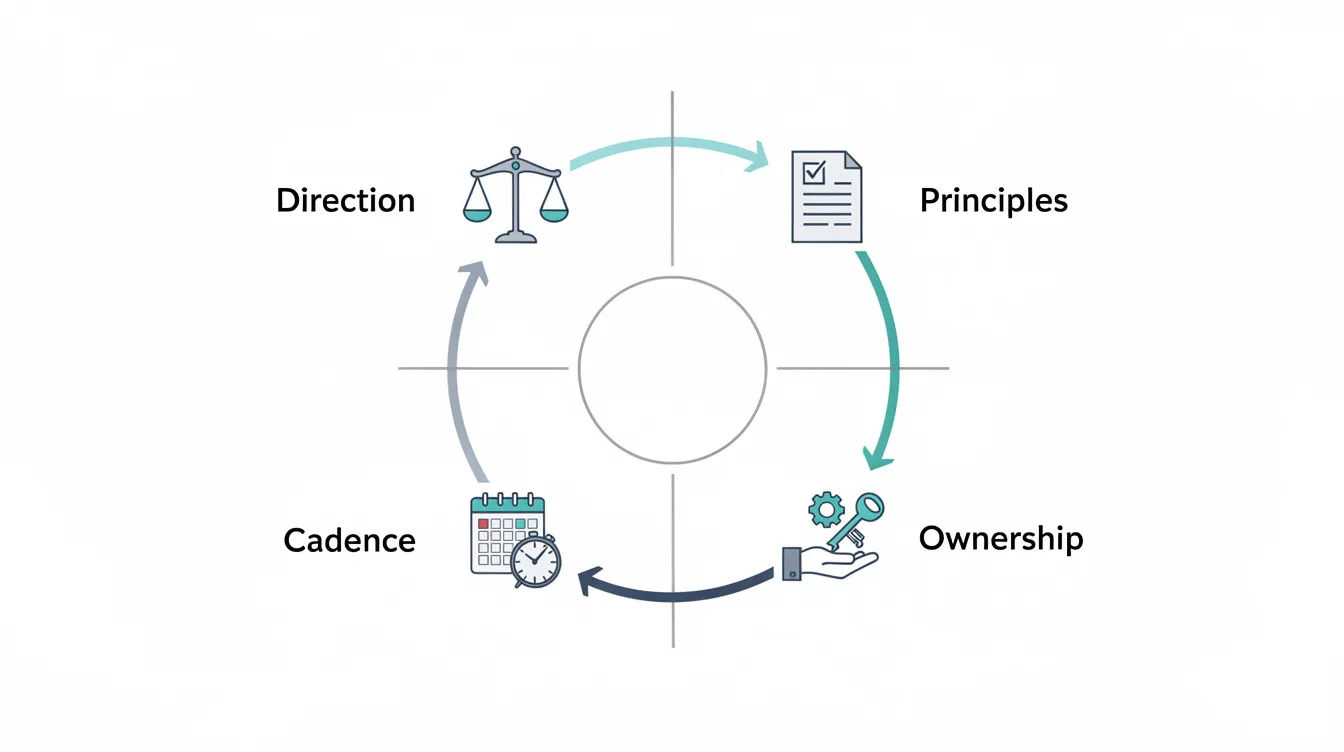
We use a four-part framework with founders who want to lead strategically without becoming the bottleneck. Each element addresses a different failure mode in how companies handle strategy.
Direction is how you define and communicate a concrete overall strategy over the next 12 to 36 months: which markets, customers, and products you will pursue and which you will not. This is more specific than a one-line vision statement. It is a set of hard choices.
Principles are the 5 to 7 decision rules your leaders can apply without asking you. These turn your implicit judgment into explicit guidance, so leadership priorities stay consistent even when you are not in the room.
Ownership means assigning clear decision rights for major strategic domains: who decides, who is consulted, who is informed. Without this, "important" decisions default to the founder every time.
Cadence is the recurring rhythm of meetings and communication that keeps direction and principles alive. Without cadence, strategy becomes a one-time offsite artifact that gathers dust.
The rest of this article unpacks each element with examples and prompts you can use immediately.
Direction: From Vague Vision to Concrete Strategic Choices
"Be the best in our industry" is not direction. It is a slogan. Your team cannot use it to make a single real decision. Effective strategic leadership starts with hard trade-offs: which customers you will focus on in 2026 to 2028, which products you will stop building, which markets you will delay entering.
Anticipation is a core quality of effective strategic leadership. Direction requires looking ahead and making bets before the market forces your hand. Here is how to make it concrete:
- Run a strategic leadership exercise with your executive team. Define "what we will win at" in one sentence. Then list 3 to 5 explicit "we will NOT" statements. Example: "We will win mid-market healthcare providers in North America" AND "We will not chase custom one-off enterprise deals."
- Force specificity. If your direction statement could apply to any competitor in your space, it is not specific enough.
- Acknowledge that this step often surfaces misalignment within the leadership team. That is exactly what it should do. Leaders recognize where they disagree, and you resolve those disagreements now instead of letting them fester as contradictory decisions downstream.
- Adaptability allows leaders to change course in response to unexpected challenges, but you cannot adapt a direction you never articulated. Leaders must adapt strategies to changing circumstances for success, but adaptation requires a starting point.
- Once direction is clear, dozens of borderline decisions instantly disappear from the founder's queue. Your leaders now know what fits the strategy and what does not.
Decision Principles: How Strategic Leaders Scale Their Judgment
Decision principles are concise rules of thumb that help leaders make consistent choices when data is incomplete and the founder is not present. They are the mechanism through which effective strategic leadership turns implicit founder judgment into explicit guidance leaders can apply independently.
Strategic leaders must act decisively despite ambiguity and complexity. Principles give them a framework for doing so. Research on CEO decision-making in high-uncertainty environments found that the most effective leaders use a small set of guiding principles rather than trying to analyze every variable from scratch.
Here are sample principles for a growth-stage technology company:
- Optimize for long-term customer lifetime value over short-term revenue. If a deal looks profitable this quarter but creates churn risk, decline it.
- Bias to ship small, testable changes every two weeks. Avoid large, monolithic releases that delay learning.
- Do not build bespoke features unless they are reusable for at least 20% of our customers. Custom work must serve the broader business strategy.
- When in doubt, protect the existing customer base before chasing new logos. Retention drives compounding growth.
- Default to transparency with the team. Share the reasoning behind decisions, not just the outcome.
To develop these, review 5 to 10 strategic decisions from the past 12 months. Extract the patterns. What worked? What failed? The best principles come from real experience, not brainstorming in a vacuum. Strategic leaders encourage diverse points of view in decision-making during this process, and effective strategic leaders engage diverse perspectives for problem solving so the principles reflect the full picture.
Revisit your principles at least annually as markets and leadership priorities evolve. A study of 350 funded founders confirmed that strategic decisions require fundamentally different cognitive approaches than operational ones, with domain experience and analytical orientation explaining nearly 50% of variance in decision style. Your principles should reflect that distinction.
Ownership: Clarifying Who Decides What (So the Founder Doesn't Have To)
Many founders become bottlenecks not because they want to control everything, but because decision rights were never explicitly assigned.
Everyone assumes "if it is important, the founder decides." Research by Noam Wasserman across more than 6,000 U.S. startups found that every additional level of founder control corresponded to a 17 to 22% reduction in pre-money valuation. Holding on too tightly has a measurable cost.
A strategic leader maps 8 to 10 recurring decision domains and assigns clear ownership:
- Roadmap prioritization: Head of Product owns prioritization within agreed strategic themes. Founder is consulted only for changes that alter those themes.
- Pricing changes under 15%: Head of Revenue owns the decision. Founder is informed after the fact.
- Hiring directors and above: Hiring manager owns the process. Founder has veto only for C-suite hires.
- Entering new geographies: Founder owns the decision. Business unit leads are consulted with data and recommendations.
Talent optimization places the right people in suitable roles to lead initiatives, which is what ownership mapping achieves at the structural level. Self-confidence is a key quality of strategic leaders, and it grows when leaders have genuine authority, not just accountability without power.
Avoid pseudo-ownership where leaders are responsible for outcomes but have no actual authority to decide. This erodes confidence, slows decision making, and recreates the bottleneck. Research on founder decision rights shows that firms with clear, transparent decision structures produce higher firm value. Write simple decision charters and share them in leadership onboarding.
Cadence and Communication: Keeping Strategy Alive in the Organization
Effective strategic leaders do not rely on one annual offsite to keep strategy alive. They build a communication cadence that makes direction and decision principles part of the organization's operating rhythm. Strategic leadership is crucial for navigating complex organizational changes, and that navigation requires ongoing conversation, not a single presentation.
Here is what a strong cadence looks like:
- Monthly 90-minute strategic leadership meeting for the executive team. Start with one slide of strategic direction, revisit decision principles, then tackle 2 to 3 high-impact decisions using those principles.
- Quarterly half-day leadership development session for directors and above. Review recent decisions, test whether they aligned with principles, surface upcoming decisions that need strategic judgment.
- Annual company-wide strategy update. Share direction, celebrate aligned wins, and address what changed and why.
- Written strategy memos distributed after each major decision, explaining the reasoning. This builds effective communication habits and gives managers two levels down real clarity.
- Q&A sessions open to all employees so the strategy reaches operators, not just senior leaders.
Strategic leaders possess strong communication and listening skills, and cadence is how those skills translate into organizational behavior. Strategic leaders encourage interdepartmental collaboration for innovation through these forums, ensuring that ideas and concerns flow across business units rather than staying siloed. This rhythm moves the "we/they line" downward: more leaders feel part of "we who shape strategy" rather than recipients of top-down mandates.
Developing Strategic Leaders Around You (Without Generic Leadership Programs)
Most leadership programs miss the mark for growth-stage companies because they teach abstract competencies rather than the specific strategic needs of the business. The goal is not to send everyone to a course. It is to build a bench of effective strategic leaders who can carry and adapt the strategy.
A strategy support team can champion the strategy process from within. Middle managers need training to effectively participate in strategy development, but that training should be tied directly to your company's direction and decision principles, not generic case studies.
Here are concrete development mechanisms:
- Strategic project ownership. Assign a high-potential product manager as the strategy champion for a new region. Give them clear expectations, a decision charter, and scheduled check-ins.
- Cross-functional task forces. Create time-bound groups to solve specific strategic problems, mixing perspectives from engineering, sales, and operations.
- Shadowing. Invite emerging leaders into key customer or investor meetings so they see how strategic trade-offs play out in real conversations.
- Targeted advisory or coaching. Bring in outside perspective for specific leadership roles rather than blanket programs.
Learning agility treats failures as opportunities for growth and revision, which means these development experiences should include structured reflection. Integrity involves acting ethically to set a standard across the organization, and leaders in development need to see that modeled. Emotional intelligence helps leaders understand team dynamics and manage resistance, a skill best developed through real strategic work rather than classroom exercises.
The Discovery Process: Understanding Your Current Leadership System
Founders often misread their real leadership culture. They believe strategy is clear because they said it at an offsite six months ago. They assume decision rights are understood because they mentioned them once. A lightweight discovery process reveals the gap between intention and reality.
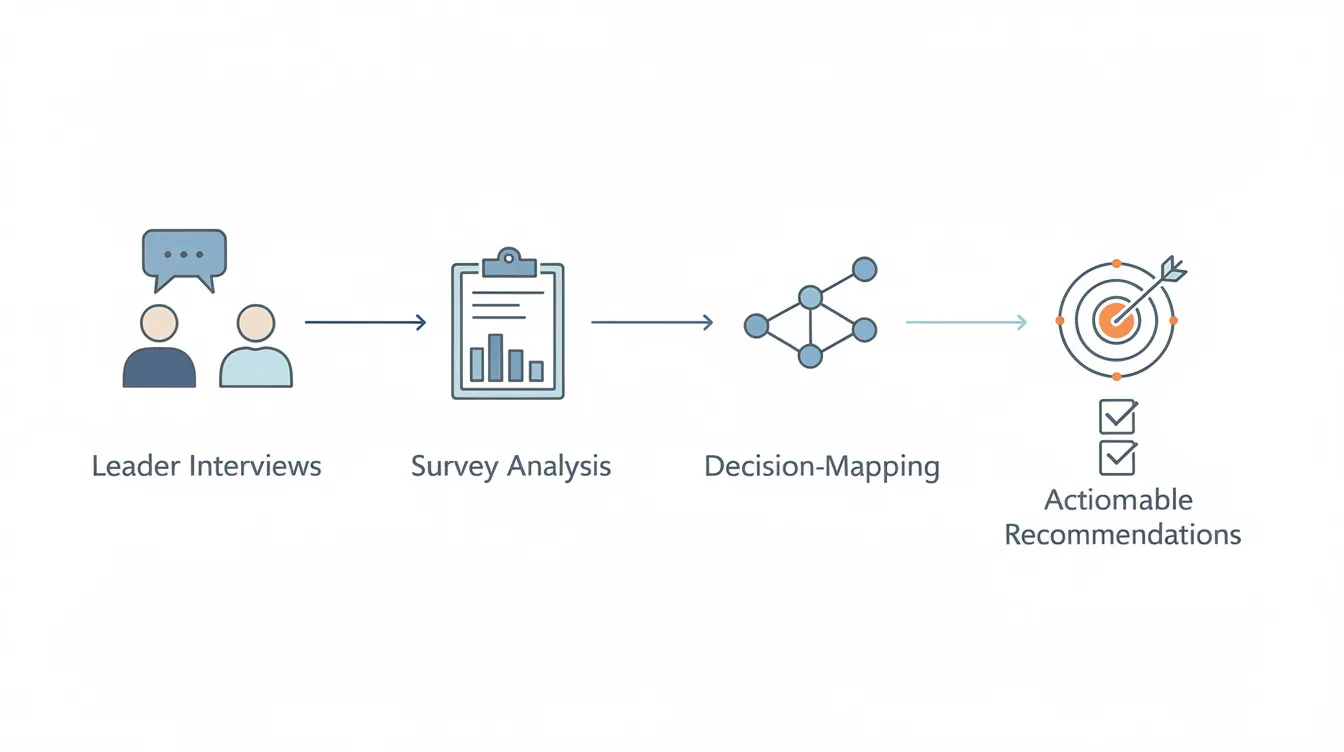
Here is how we approach it: over 4 to 6 weeks, conduct interviews with 10 to 20 leaders across levels, run an anonymous survey on strategic clarity, and review documentation of recent strategic decisions. This is not a long consultancy project. It is a focused effort to surface patterns and blockers.
What to look for:
- Where decisions actually get made versus where founders think they get made.
- How clear the strategy is to managers two levels down.
- Whether leadership priorities are understood or whether people are guessing.
- How often the founder overrides decisions and what triggers those overrides.
Outputs should include a clear map of decision bottlenecks, a draft set of leadership priorities, and specific recommendations for delegation and communication improvements. This discovery phase is the precursor to any serious shift in how the founder leads or how the company structures its leadership programs.
Common Pitfalls: How Strategic Leaders Accidentally Create Bottlenecks
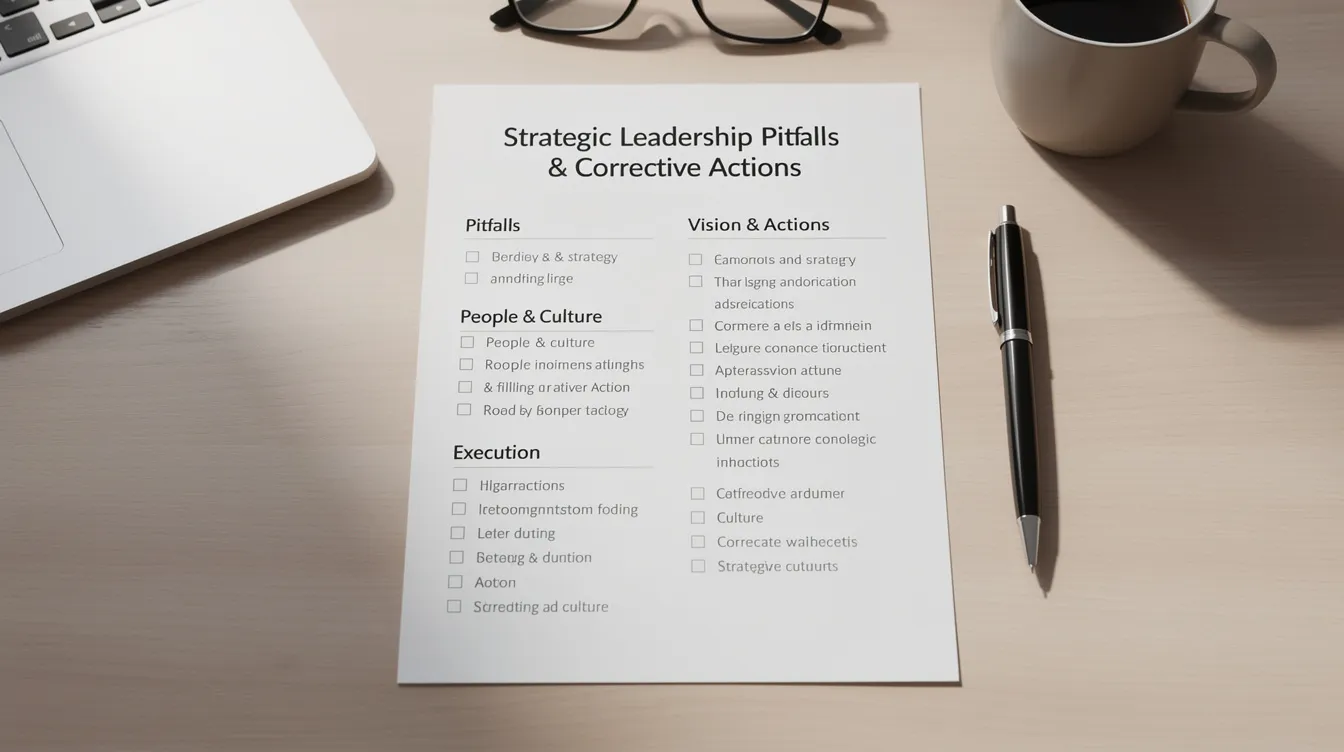
Even well-intentioned founders fall into patterns that undermine the systems they are trying to build. Here are the most common ones:
- Vision-as-slogan. The founder repeats an inspiring phrase but never turns it into concrete priorities or decision rules. Correction: translate the big picture vision into specific "we will / we will not" statements.
- Invisible strategy. Real strategy lives only in the founder's head or a pitch deck for investors, leaving managers guessing. Correction: write it down, share it broadly, and revisit it in every strategic forum.
- Delegation without guardrails. Responsibilities are handed off but without clear decision principles, so leaders either freeze or create chaos with inconsistent choices. Correction: pair every delegation with explicit principles and an escalation threshold.
- Founder override reflex. The founder frequently reverses team decisions in public, undermining ownership and eroding trust. Correction: turn overrides into coaching conversations anchored in shared principles, conducted privately.
- Endless strategic resets. Constant pivots or changing priorities without clear rationale erode trust in leadership and weaken execution. Correction: commit to direction for a defined period and communicate changes with full context.
- Ignoring the organizational culture. Imposing new ideas and processes without understanding how the team currently operates. Correction: use the discovery process before redesigning the system.
FAQ: Practical Questions Founders Ask About Strategic Leadership
How do I know I have become the bottleneck? Measure the lead time on decisions waiting for your input. Count the number of escalations reaching you per week. If more than half of strategic decisions require your direct approval and your team regularly waits more than 48 hours, you are the constraint.
Can I be both strategic leader and operational leader in a small company? Yes, but unsustainably. Below 30 people, founders often wear both hats. As complexity rises past 50 people, the cognitive load becomes unmanageable. Research confirms that founders use fundamentally different decision styles in strategic versus operational contexts, and trying to do both degrades performance in each.
How many decision principles do we actually need? Five to seven is the practical range. Fewer than five leaves too many gaps. More than seven dilutes clarity and becomes impossible for team members to remember. Start with five, test them against real decisions for a quarter, then refine.
What if my current leaders are not ready for more ownership? Assign controlled decision domains with clear guardrails and feedback loops. Use development mechanisms like shadowing and stretch assignments. Build trust incrementally. Delegation research shows that perceived capability and willingness to grow are the strongest predictors of successful handoffs.
Should I invest in leadership programs or targeted strategic advisory work? For growth-stage companies, targeted advisory work usually delivers faster results because it addresses your specific decision system, not generic competencies. Leadership development programs work best after you have established clear direction and principles that the program can reinforce. In today's complex environment, continuous learning matters, but it should be connected to your real business strategy and competitive advantage.
How do Steve Jobs-style founders reconcile strong opinions with delegation? Even founders known for individual leadership intensity built technology, process, and leadership systems around them. The key is distinguishing between strategic domains where the founder's judgment is genuinely irreplaceable and domains where capable leaders can perform equally well with clear principles.
Working With Drew: Strategic Partnership, Speaking & Advisory
Drew works with founders and leadership teams through keynotes on strategic leadership, closed-door advisory sessions, and longer-term strategic partnership engagements. The focus is always on building strategic leaders around the founder by clarifying direction, decision principles, leadership priorities, and ownership structures.
Every engagement begins with understanding the company's stage, organizational culture, and the specific leadership challenges uncovered through an initial discovery process. This is not generic training. It is a tailored approach to helping founders develop the leadership system their company needs to scale.
If you are a founder or senior leader who recognizes that your company's growth depends on distributing strategic decision making, the next step is a conversation. Reach out through the contact page to explore whether Drew's advisory, speaking, or strategic partnership work is the right fit for your team.

share this
Related Articles
Related Articles