




Executive Leadership: What Changes When Decisions Affect the Whole Organization
The Moment Leadership Becomes Enterprise-Wide
It was the second month of the new fiscal year when the decision landed on her desk. The product line that had launched the company fifteen years ago was no longer viable. Margins had eroded, customer sentiment had shifted, and engineering resources were being pulled from higher-growth initiatives to keep the legacy product alive. As the newly appointed CEO of a $300M industrial services firm, she knew the call was hers. What she didn't fully appreciate yet was how one decision would ripple across every corner of the organization - finance would need to restate projections, operations would restructure two facilities, culture would absorb the shock of role eliminations, and the sales team would lose the product they knew best.
That moment - when a single strategic choice touches finance, operations, people, customers, and culture simultaneously - is where executive leadership begins. It is not defined by title or tenure. It is defined by the scope and consequence of the decisions a person is expected to make. Effective executive leaders steer organizations through complexity and inspire teams not by having all the answers, but by making choices that account for the entire organization rather than a single function or department.
This article focuses on what changes when leaders step into enterprise-wide roles. It covers executive decision making, leadership accountability, enterprise leadership mindset, and the communication disciplines that separate executives who create organizational success from those who simply occupy the office. This is not a guide to generic leadership skills or executive coaching. It is about the specific work of leading when every decision you make affects the whole system.
From Functional Leader to Enterprise Leader: What Actually Changes
A VP of Sales optimizes pipeline velocity, win rates, and quota attainment. A Head of Engineering manages release cadence, technical debt, and talent retention. Each is a leader, and often a very good one. But neither is responsible for the trade-offs between those two functions - or for what happens when optimizing one damages the other.
Executive leadership begins at the point where a leader's decisions cut across functions and affect the entire organization. Michael D. Watkins, in his research at IMD, describes this transition as a series of "seismic shifts" - from specialist to generalist, from analyst to integrator, from tactician to strategist, and from supporting cast to lead role.
Here are the concrete shifts that define the move:
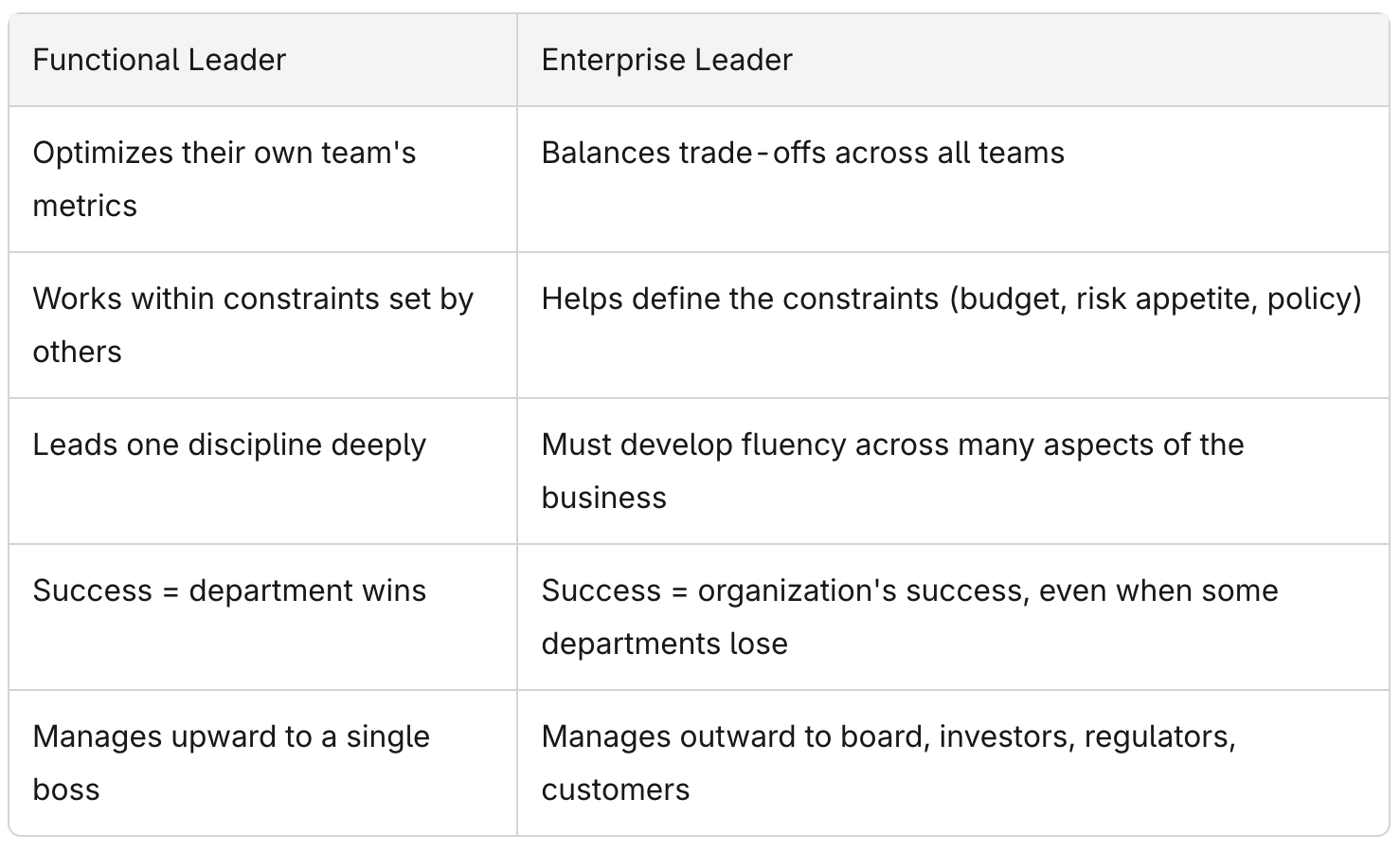
Consider a 2024 decision to consolidate regional offices. For a VP of Sales, closing one region might reduce costs and improve margin in that territory - a local win. But for a CEO, that same decision creates second-order effects: customer satisfaction falls in the affected region, logistics costs shift to other offices, cultural morale drops across the company, and regulatory issues emerge in the jurisdiction being exited.
What looked like a smart departmental call becomes an enterprise loss without a broader lens.
Research on what is called the "Edge Readiness Gap" found that approximately 40% of senior executives promoted into enterprise roles are pushed out, fail, or resign within 18 months. Key failure patterns include clinging to a former functional identity, inability to adapt under uncertainty, gaps in cultural authority, and weak navigation of external stakeholders. Functional excellence alone does not predict enterprise readiness.
Executive Leadership vs. Management: A Different Job, Not a Bigger One
One of the most common misconceptions is that executive leadership is simply management at a larger scale. It is not. It is a qualitatively different role.
Management focuses on planning and organizing tasks, staffing, and controlling execution of existing processes. Leadership involves influencing and inspiring others toward outcomes that don't yet exist. Both matter, but they are not the same job. Management is about efficiency; leadership is about effectiveness. Effective managers ensure employees meet performance expectations within established systems. Leaders create a shared vision and motivate teams to pursue it - often through ambiguity and change.
At the executive level, this distinction sharpens further. Executive leadership differentiates between operational execution and defining organizational purpose. A CEO or division president isn't primarily a "doer" in any function. Their job is to set direction, manage enterprise-wide trade-offs, attend to systemic health, and calibrate risk posture - all while integrating both effective leadership and management without becoming the bottleneck in any single area.
A multi-country study of over 1,100 CEOs found that executives who spent more time on leader-type activities (cross-functional coordination, external engagement, strategic alignment) achieved approximately 7% higher sales growth and better labor productivity than those who spent most of their time on managerial activities like one-on-one status meetings and operational oversight.

The Core Outcomes of Executive Leadership: Direction, Alignment, Commitment
Leadership involves three essential elements: direction, alignment, and commitment. These are not abstract concepts - they are the measurable outcomes that define whether executive leadership is working.
Effective executive leadership combines strategic thinking and strong interpersonal competence to produce these outcomes. Executive leadership establishes a compelling vision and leads significant organizational change. Executive leaders shape culture and build alignment around organizational priorities. Effective leadership requires clarity in direction, alignment, and commitment.
Direction. Direction is a shared agreement on organizational goals. At the enterprise level, this means translating strategy into three to five clear, testable organizational priorities for a specific time horizon - say, 2026 through 2028. Direction is not a 40-slide deck. It's a concise answer to: "Where are we going, and why?" When senior executives provide this clarity, every manager and team in the organization can orient their work toward the same future.
Alignment. Alignment ensures each person understands their role in achieving goals. For executives, alignment means removing cross-functional friction rather than just pushing harder. When sales targets conflict with delivery capacity, the executive's job is not to demand both sides "figure it out." It is to surface the constraint, make a trade-off, and communicate why. Alignment is a system design problem, not a motivation problem.
Commitment.
Commitment fosters a sense of mutual responsibility for group success. Executives earn buy-in from managers and teams through effective communication, not by relying on title or authority alone. When people understand the reasoning behind a decision - including what was considered and what was sacrificed - commitment increases even when the decision is unpopular.
Executive Decision Making: Raising the Quality of Every Choice
Decision-making for executives involves high ambiguity and tolerance for uncertainty. Unlike team-level decisions, executive choices often carry longer time horizons, higher stakes, and consequences that are difficult to reverse. A McKinsey survey found that only about 20% of organizations believe they excel at decision making, and just 37% report that their decisions are both high quality and fast.
Understanding the problem is crucial for effective decision-making. Decisive problem-solving requires making informed choices with incomplete information. Gathering information improves executive decision-making ability, but at the enterprise level, perfect information is never available. The executive's job is to decide well with what exists.
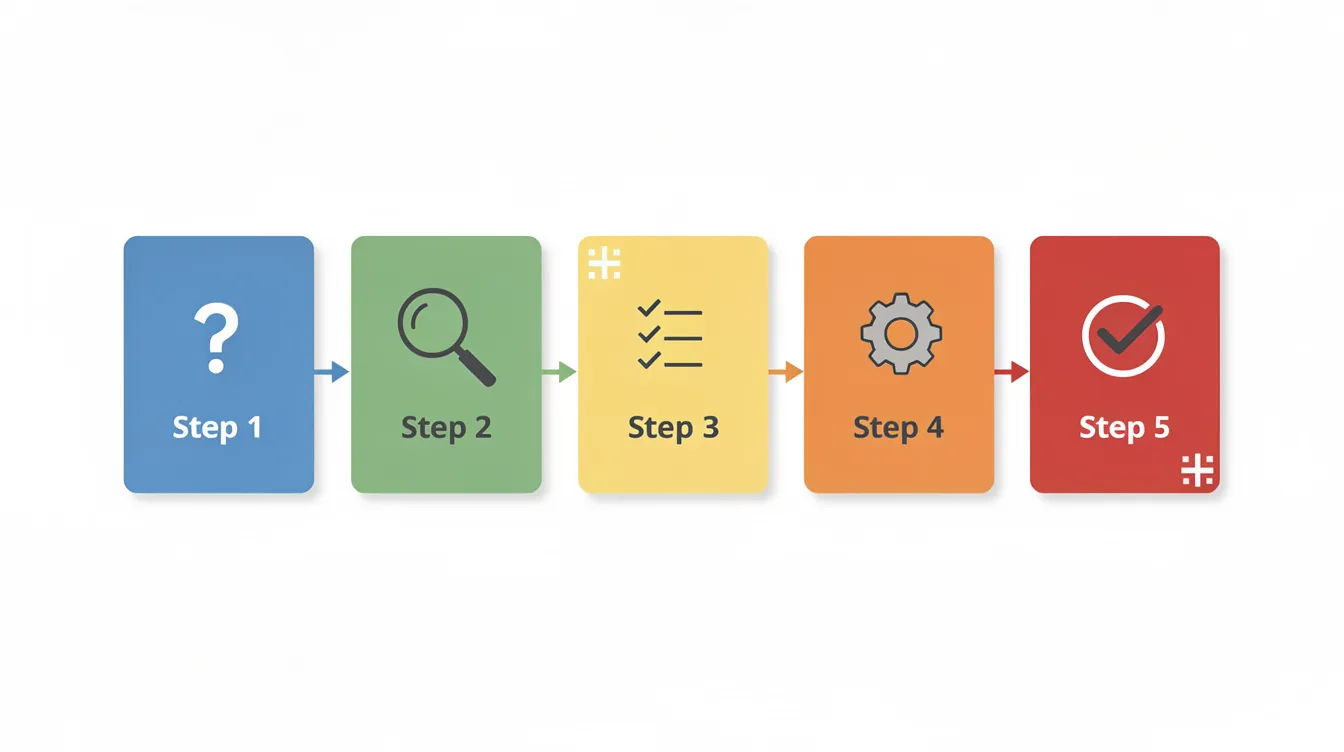
Here is a simple framework for executive decision making:
- Clarify the problem. Define the actual enterprise-level problem, not the symptom a single function is reporting.
- Define enterprise impact. Map who and what will be affected - finance, operations, people, customers, culture, regulatory exposure.
- Surface options. Generate at least three credible paths, including "do nothing."
- Test assumptions. Identify the two or three assumptions that, if wrong, would change the decision entirely.
- Decide and communicate. Make the call, then invest real time in explaining the why - not just the what.
Involving key leaders ensures buy-in for decisions made. Commitment to decisions builds staff confidence and motivation. When executives make a call and then communicate the reasoning transparently, the organization moves faster - even if not everyone agrees.
Scenario: A $150M SaaS company is evaluating entry into a new vertical market in 2027. The VP of Product sees an opportunity; the CFO sees a cash drain during the investment period; the CRO worries about diluting the sales team's focus. The executive team uses the framework above to clarify that the real problem is revenue concentration risk, not simply growth ambition. They map enterprise impact, test the assumption that existing customers will tolerate a temporary dip in product velocity, and decide to enter - with a defined 18-month investment window and monthly decision gates. The communication plan includes why this matters for the organization's long-term resilience, what will be de-prioritized, and how success will be measured.
Leadership Accountability at the Top: Owning Enterprise Outcomes
Leadership accountability at the executive level means owning both the quality of decisions and the health of the system that produces results. Leaders must set clear expectations for accountability - not just for revenue or EBITDA, but for culture, behavior, and how teams work together. Accountability is tied to company goals and values, not just financial targets.
Leaders should demonstrate accountability through actions, not memos. When a 2023 initiative fails - say, a technology platform migration that missed deadlines and burned budget - accountability does not mean finding someone to blame. It means the executive team publicly owns the outcome, conducts a rigorous review, improves governance for the next initiative, and communicates what changed. That is the difference between blame and accountability.
Recognizing accountability reinforces positive behavior in leaders. When executives praise teams and individuals who own their outcomes - including failures - it signals that accountability is a valued behavior, not a punishment mechanism.
Executive Accountability Checklist:
- Have I defined what success looks like for this initiative in measurable terms?
- Have I communicated who is responsible for each outcome?
- Am I reviewing progress at a cadence that allows course correction?
- Do I own the outcome publicly, regardless of which team executed?
- Have I adjusted processes based on what we learned from the last failure?
- Am I modeling accountability in my own behavior and decisions?
- Executive Priorities: Choosing What the Organization Will Not Do
Executive priorities are fundamentally about exclusion. Every organization has more good ideas than it can execute well. The executive's job is to choose the few that matter most and protect them by saying "no" to the rest. Strategic vision involves anticipating future industry trends and charting a long-term course. Executive leadership embraces calculated disruption and structural transformation when the market demands it.
To set priorities that hold, executives should identify three to five non-negotiable priorities for a 12- to 18-month horizon and link each one to a measurable enterprise outcome. Then they must be explicit about what will be de-prioritized.
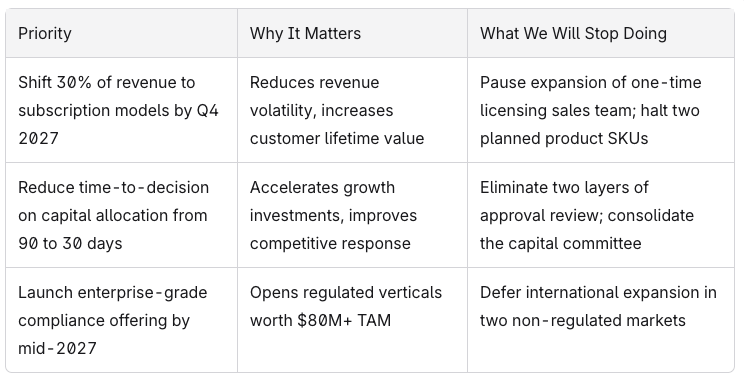
When leaders communicate what the organization will stop doing, it gives teams permission to focus. Without that clarity, people hedge, spread resources thin, and nothing moves at full speed.
Leadership Communication: From Information Sharing to Sense-Making
At the executive level, leadership communication is less about status updates and more about sense-making. Effective communication improves teamwork and problem solving because it connects what is happening to why it matters. Effective communication requires understanding emotions and intentions - not just transmitting data.
Executives must communicate effectively across diverse audiences: board members want strategic framing; senior executives want decision context; middle managers want clarity on what changes for their teams; frontline employees want honesty about what it means for their work.
Strong executive communication weaves together strategy, risk, progress, and trade-offs in a consistent narrative over months and years. It is not a single town hall or email. It is a discipline.
Recurring executive communication rituals that work:
- Quarterly town halls that connect priorities to progress and upcoming trade-offs
- Monthly senior team reviews focused on decisions, not status
- Bi-weekly manager briefings that equip middle managers with talking points
- Post-decision communications within 48 hours of any major enterprise choice
- Annual strategy narratives that set the frame for the year ahead

Building Advanced Communication Skills for Senior Executives
Concrete communication skills distinguish strong senior executives from those who struggle to effectively communicate across the organization. These skills go beyond presentation polish. They include framing complex issues simply, distilling dense data into a verbal message that people can repeat, and handling challenge openly rather than defensively.
Active listening helps build stronger connections with others. Executives who listen - genuinely, without formulating their response while the other person speaks - earn credibility and surface better information. Non-verbal cues can clarify the intent behind verbal messages. Facial expressions, eye contact, and physical movement all reinforce or undermine what an executive says. Effective executives demonstrate high levels of emotional intelligence, which helps them manage personal emotions and build trust even in difficult conversations. Stress can hinder effective communication and lead to misunderstandings, so executives must recognize when pressure is distorting their tone or clarity.
Using clear expectations and repeated messaging helps align direct reports. Leaders model behavior by communicating what "good" looks like for performance, decision rights, and how the team operates.
Consider a mid-size technology company where a new COO communicated a restructuring plan through a single email. The email was factually accurate but lacked context, empathy, or a clear explanation of why. Within two weeks, three senior leaders had begun quiet job searches, and middle managers were telling their teams conflicting stories. When the COO shifted to a series of small-group sessions, a detailed FAQ, and a follow-up survey, confusion dropped and engagement recovered within 60 days.
Dos and Don'ts for Executive Communication:
- Do explain the reasoning behind decisions, not just the outcome
- Do repeat key messages across multiple channels and weeks
- Do invite questions and address concerns honestly
- Don't assume one announcement is sufficient
- Don't delegate all communication to HR or corporate comms
- Don't avoid difficult topics - silence creates its own narrative
Enterprise Leadership Mindset: Thinking in Systems, Not Silos
Enterprise leadership means seeing the organization as an interconnected system of people, processes, capital, and customers. Executive leadership focuses on long-term vision and organizational culture, not just quarterly results.
Resilience enables leaders to maintain effectiveness through setbacks and pressure. When an enterprise leader considers a 2025 hiring freeze, they don't just calculate headcount savings. They trace the second- and third-order effects: slower customer response times erode satisfaction scores; reduced R&D capacity delays innovation timelines by six months; remaining employees absorb extra work, driving attrition up. Each of these effects compounds the others.
Thinking in systems requires longer time horizons and a willingness to track system-level metrics alongside department-level KPIs. It means asking not just "What will this decision achieve?" but "What will this decision set in motion?" That deeper understanding of cause and effect is what separates enterprise leaders from functional ones. When senior executives develop this sense of interconnection, they make fewer decisions that optimize one part of the business at the expense of the whole.
Structuring an Executive Team for Better Decisions
The executive or senior leadership team is the primary forum for enterprise decision making and alignment. Its design determines whether the organization makes decisions quickly and well - or slowly and poorly.
Key design choices matter:
- Who sits on the team: Only leaders with enterprise-level accountability. If the team is too large, it becomes a status-sharing forum. If too small, it lacks the perspectives needed for trade-off decisions.
- Meeting cadence: Monthly for strategic and cross-functional decisions; weekly only if the business context demands it. Avoid weekly meetings that devolve into operational updates.
- Agenda discipline: At least 70% of agenda time should focus on decisions and trade-offs, not information sharing. Reports should be pre-read material.
Example: Monthly Executive Team Meeting Agenda
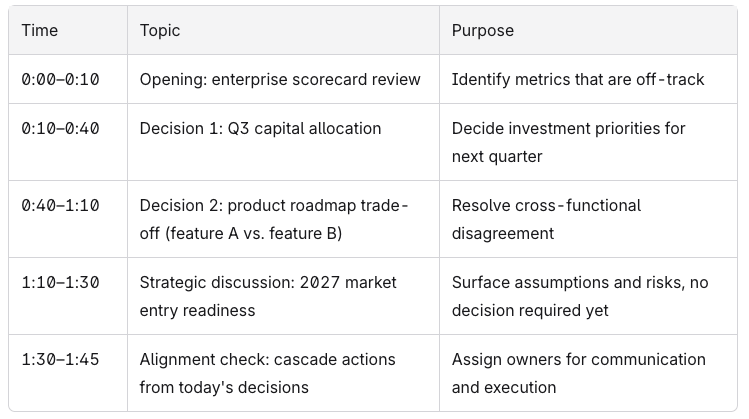
This structure forces the team to use its time on the highest-leverage problems rather than reviewing slides that could be read in advance.
Creating Clear Decision Rights and Governance
Decision rights define who decides, who must be consulted, who is accountable, and who needs to be informed. When these are ambiguous, organizations slow down, duplicate effort, and erode leadership accountability.
- A simple RACI-style framework works at the executive level:
- R (Responsible): The person or team doing the work
- A (Accountable): The single executive who owns the outcome
- C (Consulted): Leaders whose input is required before a decision
- I (Informed): People who need to know the outcome but don't have a vote
Aligning goals with superiors is essential for successful decisions. When the CEO and CFO both believe they own capital allocation decisions, the process stalls. When product roadmap ownership lives in a gray zone between the CTO and the Chief Product Officer, every feature debate escalates unnecessarily. Clear decision rights prevent these bottlenecks.
For example, a company planning 2026–2027 investments might define it this way: the CFO is accountable for the total capital budget; each business unit leader is accountable for allocation within their unit; the CEO is consulted on any investment above $2M; and the board is informed quarterly.
Embedding Accountability Through Clear Expectations and Metrics
Leadership accountability becomes real when it is tied to specific, measurable goals. Measurable goals are essential for holding leaders accountable. Executives should set clear expectations for how metrics will be used - not as weapons, but as tools for learning and course correction.
Peer accountability fosters a sense of shared responsibility among the executive team. When leaders hold each other to account, not just their direct reports, the culture of accountability strengthens across all groups.
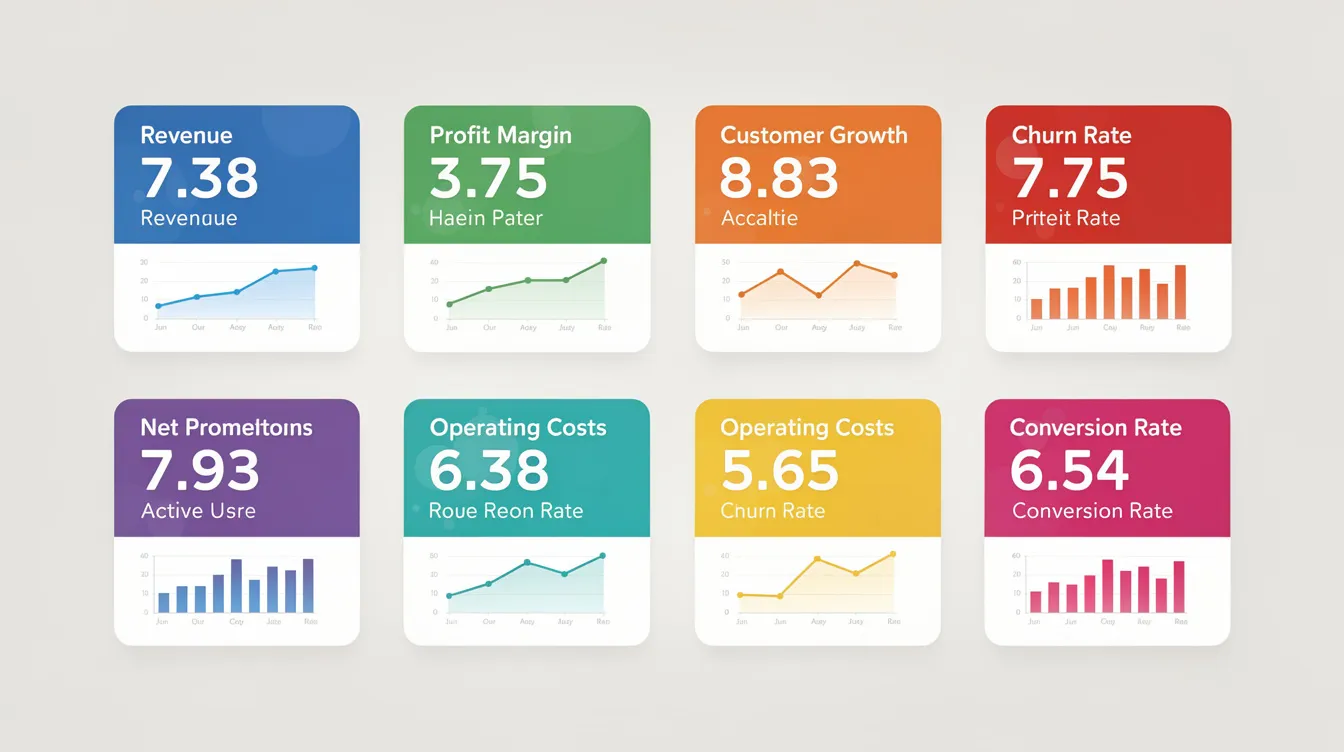
Enterprise health metrics an executive team might track:
- Revenue growth rate and composition (recurring vs. one-time)
- Customer retention and net promoter score
- Employee engagement and voluntary attrition
- Time-to-decision on cross-functional priorities
- Innovation pipeline (new products or services as % of revenue)
- Operating margin trend
- Leadership bench strength (succession readiness by role)
- Compliance and risk incidents
These metrics should be reviewed monthly in a dashboard format with narrative explanations - not just numbers. The narrative answers: "Why did this move? What are we doing about it?"
Scaling Effective Communication Across the Organization
One of the hardest challenges in executive leadership is cascading messages so they preserve meaning through layers. When an executive announces a 2025 acquisition, the board hears strategic rationale. The senior team hears integration responsibilities. Middle managers hear "my team might change." Frontline employees hear "am I keeping my job?"
Executives must recognize that middle managers are the amplifiers of leadership communication. Supporting them with scripts, FAQs, and training makes the difference between a message that lands and one that distorts.
90-day communication plan after a major executive decision:
- Week 1: Executive announcement to senior leadership team with full context; FAQ document drafted
- Week 2: Manager toolkit distributed (talking points, anticipated questions, escalation path for concerns)
- Week 3–4: Town halls or small-group sessions led by executives, open Q&A
- Month 2: Follow-up survey to gauge understanding and concerns; executive team reviews feedback
- Month 3: Progress update tied to original rationale; adjust messaging based on what employees need to hear
This process ensures that the narrative stays coherent as it moves through the organization. It also builds trust, because employees see that their concerns were heard and addressed.
Developing the Next Generation of Executive Leaders
Current senior executives carry a responsibility that extends beyond their own tenure: preparing successors who can lead at the enterprise level. Leadership development at this stage is about judgment, communication, and responsibility - not just technical expertise.
Boards and investors in 2026 increasingly scrutinize succession depth. A company with a strong leadership bench is worth more - and more resilient - than one dependent on a single executive.
Experiences that build enterprise leadership capability:
- Leading a cross-functional initiative with P&L accountability (not just advisory input)
- Serving as interim leader of an unfamiliar function for six to twelve months
- Owning a major external relationship (key customer, regulator, board committee)
- Managing a crisis or turnaround where trade-offs are visible and consequential
- Presenting enterprise strategy to the board with full accountability for the recommendation
These stretch roles develop the ability to think in systems, communicate effectively across audiences, and make decisions under ambiguity - all hallmarks of enterprise leadership. A program designed around these experiences produces leaders who are ready to step up, not just leaders who have been employed long enough to earn a promotion.
Common Traps New Executives Fall Into
Even talented business leaders stumble when they first step into enterprise roles. Here are the most common traps and a practical antidote for each:
- Staying too operational. The new executive spends 80% of their time in the weeds of their former function, reviewing code or sitting in sales calls. Antidote: Block 50% of your calendar for enterprise-level work in the first 30 days and delegate operational reviews to your direct reports.
- Favoring a home function. The former VP of Marketing, now COO, consistently steers resources and attention toward marketing initiatives. Antidote: Ask each functional leader to present their top constraint to you in week two. Make your first visible decision in a function that is not your home base.
- Avoiding tough calls. A new division president delays a necessary restructuring because the relationships involved are uncomfortable. Antidote: Set a decision deadline for one hard call within your first 60 days and tell your team the deadline exists.
- Over-communicating detail. The new CTO sends 2,000-word emails about every technical decision to the full executive team. Antidote: Limit executive communications to the "so what" - three sentences on the decision, three on the impact, one on next steps.
- Under-communicating direction. The new CEO assumes the strategy is obvious because they've internalized it. No one else has. Antidote: Repeat your three priorities in every meeting, every week, for the first 90 days. If you're tired of saying it, you're just getting started.
- Trying to know everything. The new executive asks for deep briefings on every department before making any decision, creating paralysis. Antidote: Identify the three decisions that matter most this quarter and focus your learning there.
Practical Checklists for Executive Decision Making and Communication
Executive Decision Making Checklist
- Is the problem clearly defined at the enterprise level, not just the department level?
- Have I identified who is affected across functions, customers, and partners?
- Do I have at least three credible options, including "do nothing"?
- What are the two assumptions that, if wrong, change the decision entirely?
- Have I consulted the leaders whose input is essential (not just convenient)?
- Is the time horizon appropriate - am I solving for this quarter or for 2028?
- What are the top two risks, and do I have a mitigation plan?
- Have I defined how we will know if this decision is working within 90 days?
- Who owns execution, and is that person clear on their accountability?
- Have I allocated time to communicate the decision within 48 hours?
Leadership Communication Checklist (Major Decisions)
- Who are my audiences, and what does each group need to hear?
- What is the core message in one sentence?
- What channels will I use (town hall, email, manager toolkit, one-on-one)?
- What is the timing - and does the sequence respect who should hear first?
- What questions will people ask, and do I have honest answers?
- Have I equipped middle managers to amplify the message accurately?
- Is there a feedback loop (survey, open forum, office hours) within two weeks?
- How will I reinforce the message in weeks three, four, and beyond?
- Have I addressed what will change and what will stay the same?
- Am I prepared to say "I don't know yet" where that is the honest answer?
Real-World Example: Reframing a Strategic Decision at the Executive Level
A $200M B2B professional services firm entered 2025 with a problem: its two largest service lines were growing at different rates, and the faster-growing line was cannibalizing talent from the mature one. Client satisfaction in the mature line had declined for three consecutive quarters.
The initial frame. The executive team first treated this as a talent problem. The CHRO proposed aggressive hiring and retention bonuses for the mature service line. The CFO pushed back on cost. The debate stalled for two months.
The reframe. During a facilitated offsite, the CEO asked a different question: "Is the mature service line still central to our strategy for 2027, or are we holding onto it out of identity?" The room went quiet. After two hours of honest discussion, the team realized the answer was nuanced - the mature line was still profitable but no longer a growth engine. The real decision was about portfolio strategy, not headcount.
The new approach. The executive team redefined their priorities: harvest the mature line for cash flow, invest aggressively in the growth line, and develop a third offering that combined capabilities from both. They restructured executive priorities around this strategy, assigned clear accountability for each line, and launched a 90-day communication cascade to explain the shift to the organization.
The result. Within nine months, client satisfaction in the mature line stabilized (because expectations were reset), the growth line accelerated hiring without internal competition for talent, and the third offering entered pilot with two anchor clients. The shift was not painless - several leaders in the mature line left - but the organization moved with more clarity and commitment than it had in years.
Working With External Advisors
to Strengthen Executive Leadership
There are moments when senior leadership benefits from external support: after rapid growth, before a major transaction, during succession transitions, or amid strategic confusion. The goal is not to outsource leadership. It is to enhance executive decision making, communication, and accountability systems with perspectives that insiders cannot always provide.
When choosing a strategic advisor or speaker, look for:
- Direct experience with enterprise leadership challenges, not just functional consulting
- A track record of working with senior executives and founders, not only middle management
- The ability to challenge assumptions respectfully and push the team toward clarity
- Comfort with ambiguity - because the problems worth external help rarely have clean answers
- Relevance to the specific moment: growth, transition, crisis, or innovation
External advisors work best when engaged around a concrete need - clarifying 2027 executive priorities, aligning the senior leadership team after a structural change, or improving leadership communication following a merger.
Invite Drew Rhoden for Executive Leadership Conversations
Drew Rhoden works with founders and senior executives navigating the transition to enterprise leadership. His engagements include executive offsite facilitation, strategic advisory sessions, and focused talks on executive decision making, leadership accountability, and building organizations that scale.
If you are facing a specific challenge - clarifying your 2027 priorities, aligning your senior leadership team, or strengthening communication after a major organizational change - schedule a conversation. The most productive engagements start with a concrete question, not a generic request.
FAQ: Executive Leadership, Decision Making, and Enterprise Responsibility
What is the difference between executive leadership and senior management? Executive leadership focuses on setting direction, managing trade-offs across the entire organization, shaping culture, and owning enterprise outcomes. Senior management often focuses on executing within a defined scope. The distinction is not seniority - it is the breadth and consequence of decisions.
How long does it take to shift into an enterprise leadership mindset? Most research and practitioner experience suggest that the transition takes 12 to 24 months of deliberate effort. The first six months are typically the hardest, as leaders shed functional-identity persistence and develop comfort with ambiguity.
What does effective leadership communication look like in a crisis? In a crisis, executives must communicate early, honestly, and repeatedly. Share what you know, acknowledge what you don't, explain your decision-making process, and provide a timeline for updates. Silence is never neutral - it will be filled with speculation.
How do I communicate effectively when I'm not sure of the outcome yet? Say so. Executives earn trust by being transparent about uncertainty: "Here is what we know, here is what we're still evaluating, and here is when we'll update you." People can handle uncertainty far better than they can handle being kept in the dark.
How do I set clear expectations for my senior leadership team? Define three to five enterprise priorities and make each leader's role in delivering them explicit. Use regular reviews - monthly at minimum - to assess progress, surface obstacles, and recalibrate. Expectations that aren't revisited aren't real.
How can I develop my enterprise leadership skills faster? Seek experiences that force you outside your functional comfort zone: lead a cross-functional initiative, own a relationship with an external stakeholder, or take on a problem in an unfamiliar part of the business. A successful career at the executive level is built on breadth and judgment, not just depth.
What is the biggest mistake new executives make? Holding onto their former functional identity. They continue to solve problems in their old domain because it feels comfortable, and they neglect the enterprise-level work that only they can do. The antidote is deliberate calendar discipline and honest feedback from peers.
How does accountability differ from blame? Blame looks backward and assigns fault. Accountability looks forward and assigns ownership - including ownership of learning from failure. Leaders who create accountability cultures make it safe to surface problems early, which leads to better outcomes over decades of organizational life.
share this
Related Articles
Related Articles