



Leadership Skills: What Founders Need When the Business Outgrows Informal Management
At fifteen people, you can run a company on instinct. You overhear every conversation, weigh in on every product call, and personally onboard every customer. By the time you hit twenty, thirty, or forty employees, that approach quietly breaks. Handoffs get missed. Decisions stall because they all route through one person. Friction builds between teams that used to sit three feet apart.
This guide is for founders, co-founders, and early executives in fast-growing companies, typically software, SaaS, or product-led businesses between Seed and Series C, who feel the strain of informal management and need to upgrade deliberately. Effective leadership shapes the environment and drives productivity, which means the skills you built to get from zero to product-market fit are not the same skills that carry you from fifty to five hundred.
Without that upgrade, growth stalls even when market demand is strong. Turnover rises. Product quality slips. Standards become guesswork. The good news: leadership skills can be learned through practice and feedback. What follows is a practical walkthrough of the ones that matter most at this stage, including decision making, communication, delegation, setting standards, accountability, conflict management, critical thinking, and relationship building.
What Are Leadership Skills? (Founder-Centric Definition)
Leadership skills are repeatable behaviors that align people, resources, and decisions toward clear business outcomes. They are not abstract traits like "charisma" or "vision." They are concrete actions: how you run a meeting, how you define who owns a decision, how you set expectations for quality.
There is a meaningful difference between being a manager and being an effective leader. Early on, founders lead through influence, proximity, and sheer willpower. Strong leadership combines task management with people management, and that combination becomes essential as headcount scales. A founder at a 15-person company can personally resolve a customer escalation and realign the product roadmap in a single afternoon. At 80 people, that same behavior creates a bottleneck. The meaning of leadership shifts from "I do it" to "I build the system so the right person does it."
Common workplace leadership skills, communication, decision making, conflict management, have higher stakes in founder-led companies because the founder's behavior sets the ceiling for the entire organization. What you model, your managers copy. What you skip, they skip.
From Founder Heroics to Scalable Leadership
Every growth-stage founder knows the "hero" phase. You are in every Slack channel, every standup, every customer call. You fix bugs at midnight, negotiate vendor contracts at 7 a.m., and personally approve every hire. It works, until it does not.
Specific breaking points show up when:
- You have more than two or three product teams and cannot attend every sprint review.
- Your first middle managers are hired but still loop you into every decision.
- Cross-functional projects (product, engineering, marketing) no longer fit in a single Slack channel.
- Multiple time zones mean your availability is the constraint on decisions.
A 2026 audit of 214 high-growth founders found that 84% reported operational drag, delayed product shipping, slower customer onboarding, because approvals still rested with a single founder. The same research showed 78% of founders spent 15 or more hours per week on low-leverage, repetitive administrative tasks due to a lack of documented processes.
The key shift is from solving problems personally to building leadership skills in others. That means delegation, accountability, and standards become the work, not distractions from it.

Decision-Making Skills: From Gut Calls to Clear, Shared Choices
Early-stage decisions are fast and intuitive. You pick a pricing model in a conversation over coffee. You choose a tech stack based on what your co-founder knows best. That speed is an asset when the cost of being wrong is low and reversible.
As the company grows, the cost of unclear decisions rises. Research on critical decisions at the early stage of startups shows founders must navigate core people, product definition, market segment, and partnerships, domains where a wrong call can set back the company months.
Effective decision-making involves identifying a clear decision first. Then:
- Gather relevant information from the people closest to the problem.
- Identify two or three real alternatives (not just "do it" or "don't").
- Weigh evidence to evaluate alternatives before choosing.
- Choose, act, and communicate the decision.
- Review your decision's consequences after implementation.
This is not bureaucracy. It is a process that takes 30 minutes with discipline. A startup building autonomous driving systems, PerceptIn, adopted a structured decision process for system architecture: framing alternatives, weighing trade-offs, committing, and reviewing. The result was fewer costly redesigns and clearer alignment across engineering, product, and business teams.
Founder leadership responsibilities here are specific: name the decision owner, set a deadline, call out what input is needed, and avoid consensus traps where everyone delays seeking agreement rather than moving. Decisiveness maintains team confidence during high-pressure situations. Critical thinking enhances decision-making effectiveness, a point worth its own section below.
Communication Skills: Scaling Clarity Across a Larger Organization
Communication becomes a leverage point once teams are too big for everyone to overhear the founder in one room. At fifteen people, context is ambient. At sixty, it must be deliberately transmitted.
A meta-analysis of team communication found that quality of communication, meaning clarity, relevance, and timeliness, correlates far more strongly with performance than sheer frequency. Sending more messages does not help. Sending clearer ones does.
Models of communication in practice break down simply:
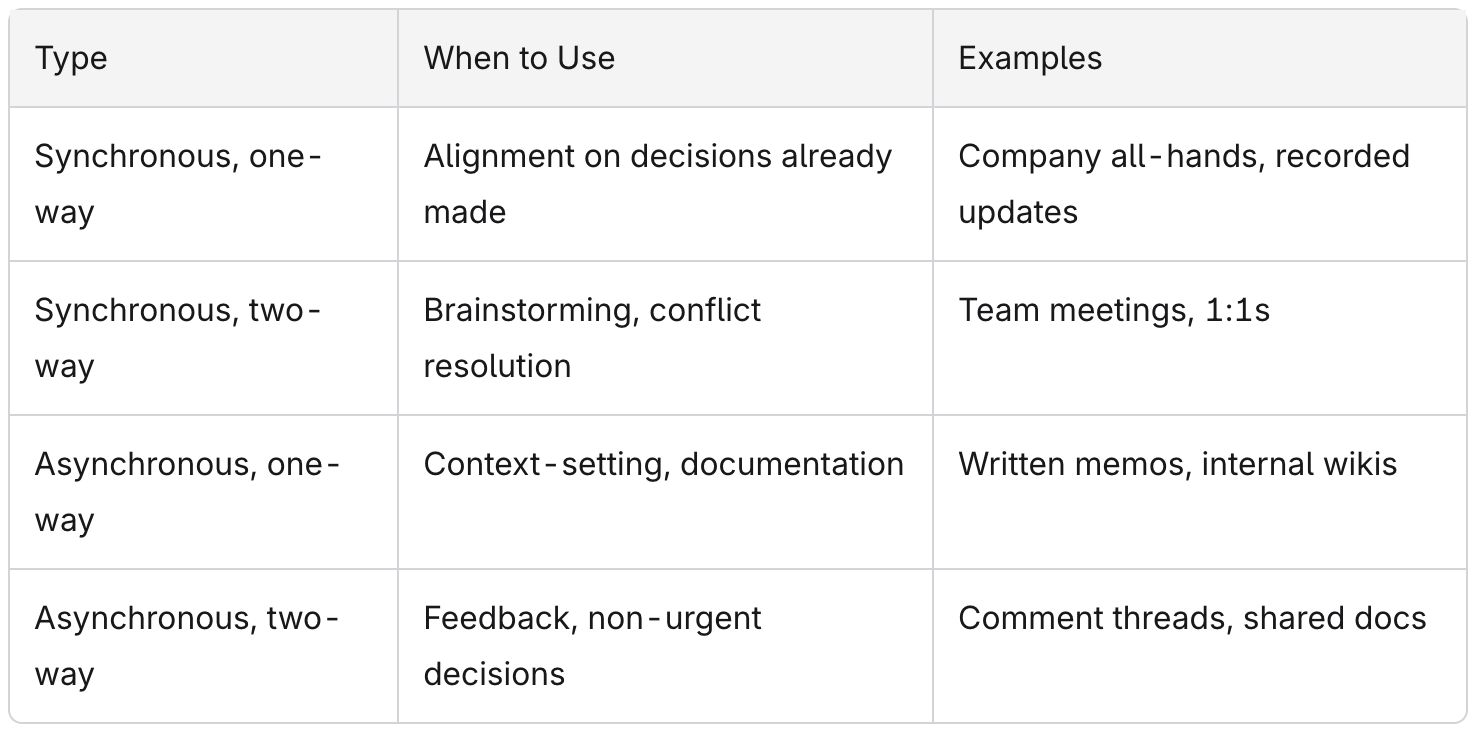
Clear communication reduces misunderstandings and improves coordination. Clear communication ensures everyone understands their role in achieving goals. Effective leaders use verbal communication skills alongside writing to set context ("here is why this matters"), repeat priorities weekly so they stick, use simple language free of jargon, and close the loop with feedback channels so teams know a decision was made, not just discussed.
Active listening involves paying full attention and understanding the speaker's perspective. This is a communication skill founders often skip because they are already forming a response. Slowing down to listen, especially in 1:1s, pays compounding returns in trust and better
information flow.
Delegation: Letting Go Without Losing Control
Delegation is the key upgrade when headcount passes 10 to 15 and the founder can no longer be the primary problem-solver. But handing off a task is not delegation. Handing off authority, with guardrails, is.
There are three failure modes:
- Abdication: "You handle it, I don't want to know." The delegate has no support, escalation is unclear, quality drifts.
- Micromanagement: You hand off the title but keep making every call, hollowing out the delegate's authority.
- Effective delegation: Clear outcomes, decision rights, timelines, check-in cadence, and defined escalation triggers.
The word "delegation" traces to mid-16th-century Latin, delegare, meaning to assign or entrust. The modern leadership relevance is the same: you are entrusting not just a task but a zone of judgment.
A case study from a founder named Margot illustrates this well. She built decision frameworks and an "Edge Case Library" of past precedents for her team. Within two weeks, permission-seeking dropped 91%. Edge-case escalations dropped significantly, saving roughly seven hours per month of founder time.
Proper delegation accelerates skill growth across teams. Delegation empowers individuals and prevents leaders from becoming bottlenecks.
The elements that make it work:
- Define the outcome, not the steps.
- Specify decision rights: what can they decide alone, what requires a check-in?
- Set a timeline and a review date.
- Clarify what must escalate (financial thresholds, customer-facing commitments, legal exposure).

Accountability: Building a Culture Where Promises Matter
Accountability is making and keeping commitments visible. It is not blame when things go wrong. It is the practice of knowing who owns what, by when, and what happens if it slips.
The word "accountability" evolved in the mid-18th century around responsibility and answerability. In modern organizations, it means a system where commitments are transparent and follow-through is the norm. Accountability creates a culture of trust among team members.
Research from Culture Amp with Inc. 5000 firms found that companies with strong accountability cultures had median three-year revenue growth of roughly 208%, while maintaining lower turnover than peers.
Simple accountability mechanisms leaders can set up:
- Clear owners: Every initiative, decision, or deliverable has one name next to it.
- Written decisions: After a meeting, the decision and owner are documented, not just discussed.
- Regular reviews: Weekly or biweekly check-ins on commitments, not to punish but to surface blockers early.
- Post-mortems without witch hunts: When a launch date is missed, the team documents the cause and the lesson. No one is looking for someone to blame.
Consider two scenarios. A startup misses a launch date. With strong accountability: the owner surfaces the delay a week early, the cause is documented, the team adjusts scope, and the lesson becomes a precedent. Without it: no one is sure who was responsible, the delay surfaces the day of launch, and the same issues repeat next quarter.
Standards: Defining "Good Enough" So Others Can Match It
Many founders carry high implicit standards in their head. They know what a good product demo looks like, what a fast customer response feels like, how a code review should be run. The problem is that no one else can see those standards until they are explicit.
The word "standard" originated as a banner, something visible that people could see and rally around. That metaphor works for organizations: your standards are the banners your team uses to know whether their work is on target.
Effective leaders define standards in many forms:
- Product quality: Test coverage thresholds, peer review requirements, design review checklists.
- Customer experience: Response time SLAs (e.g., "within 24 hours for non-critical issues"), escalation protocols.
- Communication norms: Written memos for decisions above a certain scope, meeting agendas required 24 hours in advance.
- Hiring benchmarks: Competency frameworks, structured interview rubrics, reference check practices.
Innovation is crucial for every company's success, and standards do not stifle it when designed well. Apple's innovation success began with customer-focused ideation, not chaos. Tim Cook is recognized for fostering innovation at Apple by pairing creativity with operational discipline. Leaders must harness creativity to remain competitive, and creative leaders encourage teams to showcase ingenuity, within clear guardrails that prevent quality from drifting. Strategic thinking aligns daily tasks with long-term goals, and standards are the connective tissue.
Make standards visible: checklists, templates, and "before/after" examples that show what good looks like versus what falls short.
Relationship Building: The Foundation of High-Performing Teams
At five people, you know everyone personally. You know their partner's name, their side project, what motivates them. At fifty, that knowledge does not scale unless you intentionally design trust-building across layers of the organization.
Building relationships fosters trust and psychological safety in teams. Psychological safety allows employees to raise concerns without fear. Empathy fosters trust and loyalty among team members. Emotional intelligence builds trust and fosters a positive workplace culture. These are not soft ideas. They translate directly to output.
The numbers are specific:
- Leaders who build relationships see a 21% productivity increase.
- 41% fewer quality defects occur in engaged teams.
- 37% less absenteeism is reported in highly engaged teams.
Effective relationship building requires understanding team members' aspirations, not just their current task list. Leadership behaviors that build relationships at scale include:
- Regular 1:1s with direct reports, and skip-level meetings with their teams.
- Visible recognition, public and specific, not generic praise.
- Genuine curiosity about people's strengths and career goals.
- Open communication channels where feedback flows up, not just down.
Good negotiations build better internal and external relationships. Negotiation is a key leadership skill for achieving organizational goals.
Whether it is negotiating scope with a partner team or terms with a vendor, the relationship skill is the same: understand the interests of all parties and seek outcomes that build trust rather than extract short-term wins. Negotiation involves two or more parties reaching an agreement, and effective negotiation requires understanding the interests of all parties. Negotiation can foster fairness and equality among participants.
Conflict Management: Keeping the Peace Without Avoiding Tension
Conflict management is a core leadership skill once there are multiple teams, overlapping responsibilities, and differing priorities. Managers spend at least 24% of their time managing conflict. Yet 60% of U.S. employees lack conflict management skills training, which means most of the conflict in your company is being handled by people who have never been taught how.
Conflict can involve customers, suppliers, and competitors, not just internal disagreements. Unresolved tension quietly erodes performance and drains the energy that should go toward shipping product.
Practical steps for founders and managers:
- Surface disagreements early. If two teams are clashing over roadmap priority, address it this week, not next month.
- Define the real problem. Often what looks like a personality conflict is actually unclear decision rights or overlapping authority.
- Establish shared goals. Remind both parties of the company-level outcome they are both working toward.
- Choose a resolution path: align (one side adjusts), compromise (both adjust), escalate (a decision-maker breaks the tie), or change constraints (add resources, shift timelines).
Effective conflict management can lead to stronger team bonds. When leaders frame conflict as a problem-solving opportunity rather than a personal battle, people learn to disagree productively and the company moves faster.
Critical Thinking and Judgment Under Pressure
Critical thinking is the most important skill for leaders navigating ambiguous, high-stakes decisions under time pressure. It is the ability to slow down just enough to think clearly when everything around you is moving fast.
Critical thinking involves analyzing information to understand issues. The critical thinking process includes gathering facts and posing questions. Critical thinkers rigorously question ideas and assumptions rather than accepting the first plausible answer.
A simple framework for founders:
- Frame the problem. What exactly are you deciding? What is out of scope?
- Explore options. What are the realistic alternatives? What would a smart person who disagrees with you suggest?
- Evaluate trade-offs. What do you gain and lose with each option? What is reversible versus irreversible?
- Decide and document. Make the call, write down the reasoning, and communicate it.
Critical thinking is essential for effective decision-making, especially in startup scenarios like pivots, major hires, or entering new markets. Strong analytical skills aid decision-making with incomplete information, which is the default state for any founder.
Research from HEC Paris suggests founders benefit from treating decisions like experiments: gathering information, making a call, observing outcomes, and iterating. This is not slow, cautious thinking. It is disciplined thinking at speed.
Motivation and Employee Engagement at Scale
Moving from "charisma and mission" to systematic practices that sustain motivation is one of the hardest transitions for founders. At ten people, your energy in the room is enough. At a hundred, it is not.
The data on employee engagement is pointed:
- 63% of employees complain about lack of appreciation.
- Employee engagement increases by 60% with appreciation from managers.
- 32% of employees prefer boosting morale as a motivational technique.
- Higher employee engagement leads to a 21% productivity increase.
Motivated employees are more self-confident and innovative. Empowerment encourages ownership and creativity among team members. Effective leadership directly impacts team performance by boosting morale.
Practices founders can implement within a quarter:
- Quarterly recognition rituals: Public shoutouts tied to specific contributions, not vague "great job" applause.
- Clear growth paths: Transparent promotion criteria so people know what a successful career trajectory looks like here.
- Honest feedback: Regular, specific feedback in 1:1s, not saved for annual reviews that no one finds useful.
- Meaningful work alignment: Connect each team's work to company outcomes so people see how their effort matters.
Adaptability and Learning: Staying Ahead as the Company Evolves
Adaptability is a key leadership skill in 2024 and beyond. Leaders must adapt to internal and external changes, from market shifts to new technologies to team composition changes.
Adaptability helps teams respond effectively to unexpected challenges. Adaptability helps leaders stay calm under pressure and pivot strategies. Adaptable leaders recover quickly from setbacks, and adaptability involves staying updated on changing technologies, including AI tools that are reshaping how companies operate.
Specific adaptive behaviors for founders:
- Update playbooks when they stop working. What got you from 20 to 50 people will not get you from 50 to 150.
- Revisit org design annually. Roles and reporting lines that made sense last year may be creating friction now.
- Experiment with new tools while maintaining core standards.
- When shifting to remote or hybrid work, adapt communication and decision-making rhythms: more written context, fewer synchronous meetings, clearer async norms.
Effective leaders develop a lifelong learning mentality. Professional development is not a course you take once. It is a stance toward your own leadership role that compounds over time.
Time Management and Prioritization for Founders
Leadership impact is constrained by how founders allocate their time once company complexity increases. If you are spending your week in back-to-back meetings and firefighting operational issues, you are not doing the leadership work that only you can do.
Common founder time traps:
- Too many meetings with no clear agenda or decision owner.
- Hands-on in every product, sales, or support decision.
- Constant firefighting on issues that should be handled by managers.
The operational drag research found founders spending 15 or more hours per week on low-leverage tasks. That is nearly two full workdays lost to work someone else could own.
Practical techniques:
- Weekly priority review: Every Monday, identify the three things only you can do this week.
- Time-blocking: Reserve two to three hours daily for deep work, strategy, and relationship building.
- Meeting standards: Every meeting needs an agenda, a decision owner, and a time limit.
- Delegate recurring operational decisions: If you have made the same type of decision three times, document the logic and hand it off.
When you manage your time well, you model the behavior for your managers, reinforcing organizational norms around focus and accountability.
Real-World Experience vs. Formal Leadership Training
Some founders learn leadership skills entirely through real world experience. They learn conflict management from a painful team blowup.
They learn delegation after burning out. They learn communication after a critical misalignment costs them a quarter.
Others invest in structured development: coaching, advisory relationships, selective programs. The research supports both. Studies on founder evolution include founder quotes about struggling with delegation and how they evolve alongside growth, but often wish they had learned faster.
The practical answer is to blend both. Real world experience is the lab. Structured support shortens the learning curve. A founder who lost a key hire due to poor feedback skills can refine that ability in weeks with the right framework, rather than repeating the mistake over several years.
Leadership skills can be learned through practice and feedback. The question is not whether to develop them, but how quickly you need to, given your company's growth rate.
Building a Founder Leadership Team: From Solo Leader to Shared Ownership
The shift from single-founder decision dominance to a leadership team culture is one of the most consequential transitions in a company's life. It is the difference between a company that depends on one person and a company that can succeed even when the founder steps away for a week.
Leadership skills for managers, delegation, accountability, communication, standards, must be intentionally developed in your early functional heads. They will not learn these skills by osmosis. A case study of a 60-person SaaS company found that after implementing a delegation matrix and governance frameworks, decision velocity improved 3x and founder interruptions (Slack pings) dropped roughly 60%.
How founders can coach their managers:
- Regular leadership 1:1s focused on how they are leading, not just what they are delivering.
- Shared expectations documented in writing.
- Reviewing real decisions together: what went well, what would you change?
- Giving them room to fail on low-stakes decisions so they build judgment for high-stakes ones.
The goal is creating leaders who create leaders, not adding managerial titles to individual contributors.

Simple Framework: The Leadership Skills Flywheel for Growth
The leadership skills covered above are not isolated. They form a flywheel where each skill reinforces the next:
Clarity → Communication → Delegation → Standards → Accountability → Feedback and Learning → back to Clarity
Each stage explained briefly:
- Clarity: Define the outcome you want and who owns it.
- Communication: Transmit that clarity to the right people in the right format.
- Delegation: Hand off authority with guardrails so others can execute.
- Standards: Make "good enough" visible so delegated work meets your bar.
- Accountability: Track commitments and surface gaps without blame.
- Feedback and Learning: Review outcomes, update playbooks, and improve the next cycle.
When practiced consistently by founders and managers, this flywheel accelerates. When any single piece is missing, the whole system drags. The nature of a flywheel is that early turns are hard, but momentum builds.

Practical 90-Day Plan to Strengthen Your Leadership Skills
Here is an actionable plan broken into three steps across 90 days. Each phase builds on the previous one.
Days 1–30: Observe and Diagnose
- Track every decision that comes to you for one week. Identify which ones someone else could own.
- Audit your calendar. How much time is deep work vs. meetings vs. firefighting?
- Ask three direct reports: "What slows you down most?" Write down patterns.
- Pick one core process (e.g., customer onboarding, code review) and document the current standard.
Days 31–60: Implement Two to Three Key Habits
- Assign decision owners for recurring decisions. Communicate the change in a team meeting.
- Start structured 1:1s with each direct report: 30 minutes, weekly, with a standing agenda (priorities, blockers, development).
- Write down standards for one additional process. Share it, get feedback, finalize it.
- Run your first post-mortem on a recent miss: no blame, just cause and lesson.
Days 61–90: Review and Adjust
- Measure progress: Are there fewer escalations? Faster decisions? Clearer cross-team collaboration?
- Hold a leadership team review: what is working in the new habits, what needs adjusting?
- Identify the next two processes to standardize and the next two decisions to delegate.
- Set your leadership development focus for the next quarter.
Signals you are on track:
- Fewer Slack pings asking for your approval.
- Managers making decisions you would have made, or better ones.
- Team members referencing standards without being reminded.
- Post-mortems that produce real changes, not just meeting notes.
FAQs: Common Questions Founders Ask About Leadership Skills
What leadership skills are most important for first-time founders?
Decision making, communication, and delegation. These three unlock everything else. If you can make thoughtful decisions clearly, communicate effectively across a growing team, and delegate with real authority, you have the foundation for every other leadership skill on this list.
How do I know it is time to change my leadership style?
When decisions that used to take a day now take a week. When you are the bottleneck in most cases. When your best people start leaving because they feel micromanaged or unsupported. These are signals, not failures. They mean the company has outgrown your current approach.
Can I stay hands-on in product and still delegate effectively?
Yes, but you must define where your hands-on involvement adds value and where it creates drag. Stay close to product strategy and customer insight. Delegate execution decisions to your product and engineering leads with clear standards and check-in points.
How do I develop leadership skills in my managers?
Invest time in leadership 1:1s, not just status updates. Review real decisions together. Give them increasing authority with defined guardrails. Developing leadership skills for managers is not a course, it is a conversation you have every week.
Is public speaking important for founder leadership?
Public speaking helps you communicate effectively to larger audiences, investors, all-hands meetings, industry events, and it forces you to organize your thinking. It is not essential for every founder, but the underlying skill of structured, clear communication is non-negotiable at scale.
How do I handle conflict between co-founders or senior leaders?
Surface the disagreement early. Define the real issue, not the symptoms. Seek to identify shared interests and goals. If alignment is not possible, escalate to a decision framework or bring in an external advisor. Avoiding the conversation is always more expensive than having it.
What is the difference between leadership skills and management skills?
Management skills are about process: planning, organizing, tracking. Leadership skills are about people and direction: making difficult decisions, setting standards, building relationships, and creating an environment where others can succeed. Most founders need both to lead well. In most cases, the distinction matters less than whether you are doing both consistently.
For deeper, company-specific challenges, consider seeking targeted advisory or speaking engagements designed for founders navigating these exact transitions.
How to Go Deeper: Advisory, Speaking, and Additional Information
Upgrading your leadership skills is not optional when the business outgrows informal management. It is the difference between a company that scales and one that plateaus despite strong demand.
If you are a founder navigating this transition, explore Drew Rhoden's speaking and strategic advisory for leadership and business-growth conversations tailored to growth-stage companies. These are not generic leadership programs. They are designed for founders who need to identify and close specific gaps in how they lead, communicate, delegate, and build accountability.
For additional information, including frameworks, tools, and other information on founder leadership, visit the relevant service and authority pages. No invented promises, no guaranteed outcomes, just practical knowledge from someone who understands the world founders operate in.
share this
Related Articles
Related Articles