





Small Business Tips: The Operating Habits I Would Prioritize Before Chasing More Growth
It's 2026 and I keep seeing the same pattern. A business owner hits $1M, $3M, maybe $10M in revenue, and the first instinct is to push harder-launch a new offer, run more paid ads, hire three people at once. Meanwhile, behind the scenes, cash flow is unpredictable, nobody knows who owns what process, and the founder is working until midnight answering Slack messages because nothing runs without them. The growth looks good on paper. The operations tell a different story.
I've learned-sometimes the hard way-that most small business tips out there skip the boring part. They jump to marketing, sales funnels, and customer acquisition cost optimization before the business can even deliver what it already sells without chaos. This article is my attempt to fix that. It's first-person founder advice, not a consulting pitch. I'm walking you through the operating habits I'd prioritize before adding a single ounce of new complexity. You'll walk away with a framework you can apply in the next 30–60 days to stabilize current operations, protect your money, and build the kind of foundation that makes sustainable growth possible instead of fragile. Managing a small business requires strategic planning and financial discipline-and it starts with what happens behind the curtain.

Stop the Bleeding First: Get Your Cash Flow and Commitments Under Control
I've watched a service company do $20M a year and still sweat payroll. Revenue was stable, but payments from customers arrived with wild variability. They delayed software renewals, burned cash on overlapping tools, and hired people without clear functional roles. Cash flow management is essential for small business success-more than top-line revenue, more than new customers, more than brand awareness.
According to JPMorgan Chase's 2026 "Facing Uncertainty" report, firms with irregular cash flows were far more likely to exit or stagnate than firms with predictable timing. It wasn't about having more capital. It was about regularity-knowing when money comes in and when it goes out.
Here's my entrepreneur advice: set a weekly 30-minute "money meeting" with yourself. Every week, same time:
- Review current bank balances
- List upcoming payables (payroll, rent, software renewals, tax estimates, contractor payments)
- Confirm expected receivables and when they're actually due
- Flag anything that creates a gap
Then build a simple 13-week cash flow forecast. Key line items: sales collected (not invoiced-collected), owner draw, recurring tools and expenses, contractor payments, and tax set-asides. This isn't a spreadsheet tutorial. It's a survival habit.
Small adjustments compound fast. Tighten payment terms from net-60 to net-30. Require deposits before work begins. Pause non-essential subscriptions. Separating business and personal finances simplifies tax filing and gives you a clearer picture of what the company actually needs. Understanding tax differences between structures can optimize your tax benefits as well. Establishing a cash reserve of three to six months of operating expenses protects you during slow periods. Regularly tracking cash flow prevents unexpected financial shortfalls.
Strict financial control isn't optional-it's foundational. And 52% of small businesses now use AI tools for financial management, which tells you the bar for visibility into your money is rising.
81% of SMB leaders feel optimistic about the future. But optimism without operational discipline is just hope wearing a suit.
Audit Your Current Operations Before You Add Anything New
Before you add another offer, hire another person, or sign up for another tool, schedule what I call an "operations audit day." Clear half a day.
Grab a whiteboard or open a digital canvas. Map out your daily operations end to end:
- Lead generation → How do leads find you?
- Sales → How do leads become clients?
- Onboarding → What happens after they say yes?
- Fulfillment / delivery → How do you deliver products or services?
- Customer support → How do you handle problems?
- Billing → When and how do invoices go out?
- Renewals / repeat business → How do you keep customers coming back?
Now look for friction. Where do things stall? Where does work pile up on one person? Where do clients complain? Regular operational audits help identify inefficiencies that gut feelings alone will miss.
Validate with data analytics, even simple ones: average response time to leads, invoice lag (days between delivery and billing), refund or rework rate, on-time product delivery percentages. In a case study from a $20M construction supply firm, an operations audit revealed $750,000 a year in material waste from poor inventory management alone. After introducing basic tracking, material usage dropped 30% in 30 days-with no slowdowns in production.
Optimized operations can increase productivity by up to 25%, and businesses with streamlined operations see 20% lower operational costs. Validating demand before scaling expenses avoids unnecessary financial burdens. Pick one or two bottlenecks. Fix those first. Then move on.

Build Systems, Not Heroics: Turn Tribal Knowledge Into Simple Checklists
Picture two weeks in the same company. Week one: the founder handles everything from memory. A client slips through the cracks, an invoice goes out late, a new hire doesn't know what to do on day two. Week two: five core processes are documented, followed, and owned by someone other than the founder. Invoices go out on time. The new hire has a checklist. The founder sleeps.
Business systems, in plain language, are a repeatable way of doing things that produces consistent results regardless of who runs the step by step process. You don't need a 50-page standard operating procedures manual. You need checklists.
Start with three to five "critical client flow" systems:
- Lead → Client: How does a prospect become a paying customer?
- Kickoff → Delivery: How does work actually get done?
- Invoice → Collection: How does money come in?
- Issue → Resolution: How do problems get handled?
- Delivery → Renewal: How do you keep clients?
Write each at checklist level-bullet-friendly, simple enough that any trained team member can follow. Build systems around roles, not individuals, so the business doesn't break when someone takes a week off.
Documenting processes ensures consistency as a business scales. Building systems before scaling prevents operational chaos. Automating tasks can significantly reduce manual errors when layered on top of these documented workflows.
Use AI Tools Intentionally: Automate Friction, Not Connection
Here's the 2026 snapshot: 76% of small businesses have used AI tools, but only 14% have fully integrated artificial intelligence into core operations. 52% of small businesses now use AI tools for operations and efficiency. The gap between "tried it" and "it's running my back end" is enormous.
I position AI as leverage for boring, repetitive tasks in your current operations-not as a replacement for leadership or connection. Automating routine tasks can significantly improve operational efficiency. Automating repetitive tasks saves time and reduces overhead.
Using AI can boost efficiency in customer service and marketing alike. 52% of small businesses now use AI tools for marketing, which tells you adoption is real but depth is shallow.
Here are concrete ways to use AI tools without creating chaos:
- Draft SOPs from call recordings: Feed transcripts into an LLM, get a first-pass checklist
- Summarize client emails: Flag issues, extract action items, reduce inbox time
- Auto-tag support tickets: Sort by topic, severity, response deadline
- Generate weekly reports: Pull performance data from your CRM into readable summaries
But don't over-automate the customer experience. Keep sales conversations, issue resolution, and key onboarding calls human. Real humans must remain reachable for customer inquiries. Customers notice when a bot replaces a person at a critical touchpoint.
On tool selection: choose fewer, integrated tools that support existing workflows. Chasing every new app creates tool sprawl, data silos, and training headaches. Pick one process to automate, test it, get a quick win, then expand.

Design Your Week Like a CEO, Not an Employee With 20 Bosses
Most business owners I know spend Monday through Friday ping-ponging between Slack, emergencies, emails, and late-night admin. There's no plan. There's only reaction. Work-life balance helps prevent burnout among business owners, but it also helps you make informed decisions instead of rushed ones.
Here's a simple weekly structure I'd recommend:
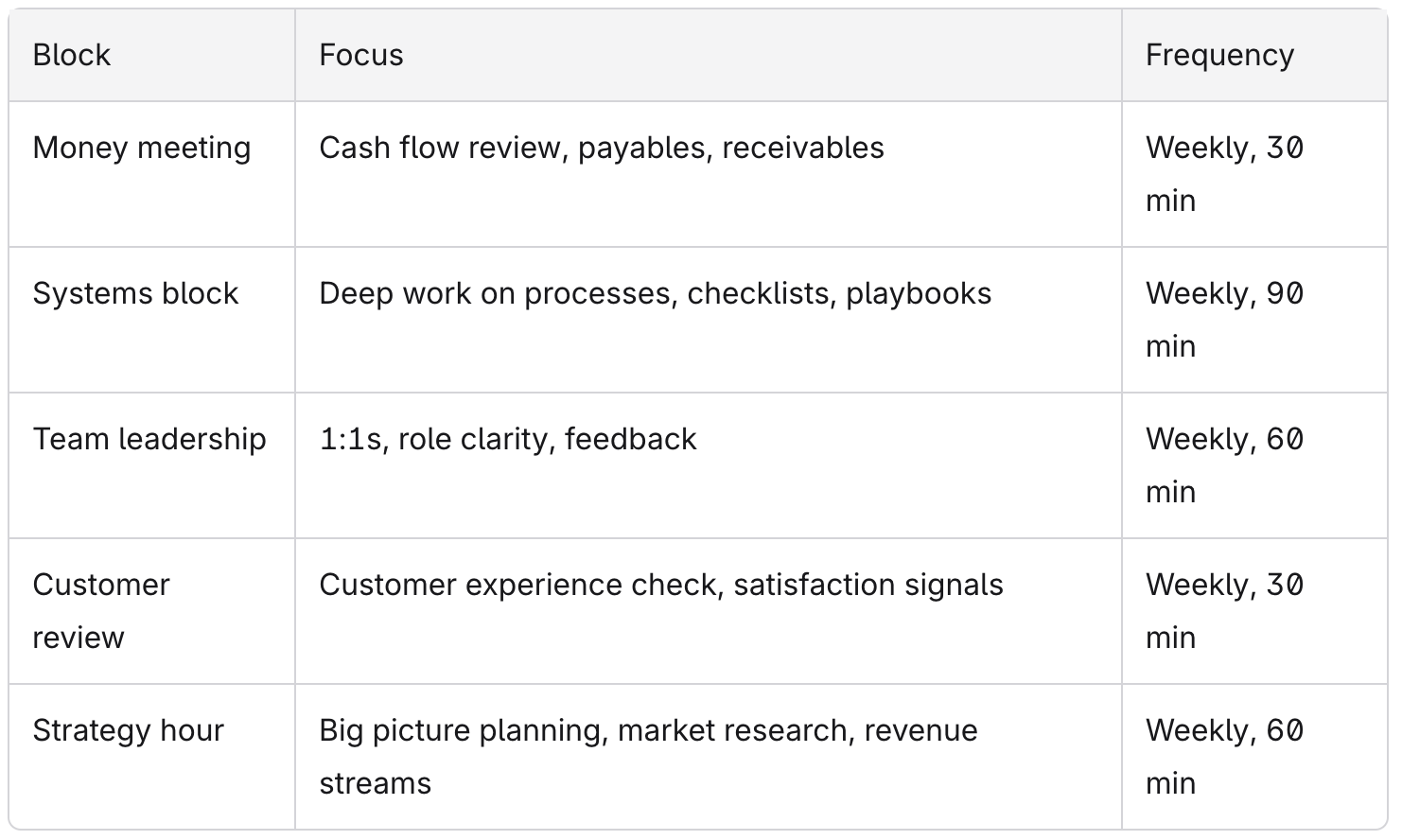
Create "no meeting" focus blocks. Batch manual tasks and low-value admin so they don't bleed into decision time. Treat these recurring operating habits-reviewing dashboards, updating playbooks, checking in with key people-as non-negotiable appointments. Delegating and outsourcing tasks can free up time for business owners to focus on strategy and leadership instead of firefighting.
When time is limited, cut the nice-to-haves: the optional networking call, the extra social media scroll, the meeting that could've been an email. Protect the blocks that keep your operations running.
Hire and Delegate Around Systems, Not Panic
I've seen it too many times: a founder is drowning, so they rush to hire someone-anyone-without a clear role definition. The new hire shows up and asks, "What do I do?" The founder says, "Help." Three weeks later, the hire is frustrated, the founder is doing more rework, and the company has spent money it didn't need to spend.
Hiring should be based on clear business needs and economic support, not panic. Hiring managers should define roles before filling them.
Here's the order:
- Define outcomes the role must produce
- Document the workflow that role will own (use your checklists)
- Post the job with specific application questions that filter out lazy applicants
- Onboard against the system: new hires shadow the process, follow checklists, then suggest improvements
Candidates should research your firm before the interview-that's a signal of fit. Hiring versatile professionals can be more efficient than specialists in early-stage growth. Great staff makes everything easier for business operations, but only when they know what "everything" means.
Delegate ownership, not just assign tasks. Empower a team member to maintain a specific system-billing, onboarding, fulfillment-and report on it weekly. A strong team isn't built by throwing bodies at problems. It's built by giving people clear systems and the authority to run them.
Measure What Matters: A Short List of Operating Metrics to Track Weekly
Most business owners I talk to can rattle off their follower count but can't tell me their average days to collect payment. Vanity metrics feel good. Operating metrics create a competitive advantage.
Here's a short list of what to track weekly:
- Revenue collected (not billed-collected)
- Leads created for core offers
- Conversion rate (lead → client)
- On-time delivery rate
- Customer satisfaction score or simple CSAT
- Days Sales Outstanding (DSO): how fast you collect
Research on working capital management in manufacturing and SMEs shows that reducing DSO and Days Inventory Outstanding correlates directly with stronger financial performance over subsequent quarters. Using analytics tools lets businesses understand customer behavior better. Identifying profitable customer segments can guide product and marketing strategies. Tracking key performance metrics helps identify growth limitations before they become crises. Mobile optimization is necessary for modern digital interactions with customers-and your metrics should reflect digital behavior too.
Keep your dashboard lightweight. Pull numbers from existing tools-invoices, CRM, calendar-into a simple shared doc. Every week, ask: based on these numbers, what do we stop, start, or improve? That's how data analytics drives daily operations instead of gathering dust.
Protect the Customer Experience While You Tighten the Back End
Here's the tension nobody warns you about: when you focus on fixing internal operations, communication to customers can slip. You're heads-down improving processes, and meanwhile a client is wondering why nobody's called them back.
Customer retention is more cost-effective than acquiring new customers. Acquiring new customers is generally more expensive than retaining existing ones. And 93% of consumers are likely to make repeat purchases with excellent service. Exceptional customer service fosters long-term customer relationships-so don't sacrifice it while you're rebuilding the engine.
Map the end-to-end customer experience alongside your internal processes. Identify high-visibility touchpoints and ringfence them:
- Onboarding calls → Always human, always on time
- Status updates → Templated but personalized ("Your project is 60% complete, here's what's next")
- Issue resolution → Prompt, friendly, and helpful-the hallmarks of outstanding customer service
- Self-service options like FAQs allow customers to troubleshoot alone for simple issues
A clear value proposition differentiates a brand from competitors, but it's the follow-through that builds customer lifetime value. Test any change to current operations with a small group of clients first. Roll out broadly only after you understand the impact on customer satisfaction and your customer base.

Operate for Sustainable Growth, Not a One-Time Spike
The big picture mindset shift is this: treat operating habits as assets, not chores. They're the driving force behind long term success-not a one-time revenue spike from a viral campaign.
Two paths sit in front of every founder. One is episodic: chase more offers, more platforms, more complexity until something breaks. The other is compounding: deepen existing systems, tighten what you already offer, protect cash flow, improve efficiency, and lead better.
Diversifying income sources reduces financial risk and increases profitability, but only when your core revenue streams are stable first. Fostering partnerships with other businesses can facilitate faster growth. Strategic partnerships can expand customer reach and referrals. Consistent investment in marketing is crucial for business growth, but content marketing should deliver real value, not just promotions.
Local SEO is critical for businesses with physical locations. The common examples of sustainable growth all share one trait: streamlined operations underneath.
Your founder priorities are decision quality, follow-through, clear business systems, and leadership routines that keep the company resilient. Continuous improvement isn't a buzzword-it's how you create greater efficiency quarter after quarter.
Pick one habit from this article-weekly cash flow review, an operations audit, a simple checklist build, a metrics review-and implement it in the next seven days. Set clear goals around it. That single step will do more for your business than any new marketing channel.
These are the same operating principles I apply when advising founders and leadership teams through growth transitions.
Work With Me: When You're Ready to Upgrade How Your Business Runs
If you saw yourself in this article-if you're a business owner with established revenue who's hitting an operational ceiling or feeling the strain of unstructured growth-I'd like to hear from you.
My advisory work focuses on clarifying founder priorities, mapping current operations, designing core business systems, and installing operating habits that actually stick. I also speak on these topics for leadership teams and conferences. Building a network with local business owners fosters collaboration and the kind of insights you can't get from a blog post alone.
This is best suited for small business owners who are past the startup phase and ready to run their company like a company.
Ready to talk? Reach out through my inquiry form or contact my team directly to start a conversation about where your operations stand today and where you want them to be.
FAQs: Practical Small Business Tips About Operations and Growth
What operating habits should a business owner fix before investing more in marketing or sales? First, ensure your cash flow is predictable on a weekly basis. Then document your core systems-lead response, delivery, billing-so your team can execute without you. Layer in a weekly metrics review so you can make informed decisions about where to spend. Without these, more marketing typically burns cash because capacity or follow-through fails. 81% of SMB leaders feel positive about the future, but that optimism needs a foundation.
How do I know if I should stabilize current operations or push for more business growth? If you're dealing with constant emergencies, late deliveries, cash crunches, unclear role overlaps, or high rework rates, growth will amplify those problems. Stabilize first. Reduce waste, improve efficiency, and cut costs where possible before layering new complexity on a shaky base.
Where should I start with business systems if my team is already busy? Start by mapping the critical client flow-lead to client to delivery to billing to renewal. Then pick three to five high-leverage processes and write simple one-page checklists. Don't try to systemize everything at once. Focus on what reduces errors and frees time immediately.
How can AI tools help small business owners without overwhelming the team? Use AI to handle repetitive tasks with clear inputs and outputs-email summaries, ticket tagging, report generation, reminders. Don't automate customer relationship moments or issue resolution. Pick one process, test it, get a quick win. 52% of small businesses now use AI tools for operations, so you're not early-you're right on time. For more articles and resources on applying these principles, explore the rest of this site.
share this
Related Articles
Related Articles