




Entrepreneur Mindset: Staying Clear When Growth Creates More Decisions, Not Fewer
Why Every New Level of Growth Feels Mentally Harder, Not Easier
Picture a SaaS founder in 2020 with three employees and a clear product vision. By 2024, the company has grown to 40 people, revenue is climbing, and customers keep signing up. On paper, everything is working. In reality, the founder's calendar is stacked with 30-plus meetings a week. Every new hire adds questions, every new customer adds edge cases, and midnight is reserved for re-making decisions that were supposedly finalized hours ago.
This is the paradox that business people rarely talk about: growth multiplies decisions instead of reducing them. The entrepreneur mindset required to start a successful business is not the same one required to scale it. An entrepreneurial mindset embraces change and adapts accordingly, but too many founders try to white-knuckle through complexity using the same approach that worked at five employees. Core traits of an entrepreneurial mindset include resilience, calculated risk-taking, and adaptability, and all three get tested far more at 40 people than at four.
In this article, entrepreneur mindset means something specific: protecting clarity, judgment, patience, and standards as the number and complexity of decisions grow. Here is what you can expect:
- How to distinguish a growth mindset from a fixed mindset in real founder scenarios, not just in theory
- A practical framework for categorizing every decision on your plate by impact and reversibility
- Specific habits that preserve leadership clarity when everything around you gets louder
- Clear signals for when to step in and when to step back as your organization scales
- A weekly reset ritual that keeps entrepreneur discipline from eroding under pressure
- How to build a culture that shares the founder mindset so you are not the sole decision-maker forever

Fixed Mindset vs. Growth Mindset in Entrepreneurship (and Why It's Not Just "Be Positive")
The term growth mindset was coined by Carol Dweck after decades of research into how people interpret their own ability. A growth mindset sees failures as opportunities to learn and improve, while a fixed mindset treats them as proof that talent is capped. Individuals with a growth mindset persist in the face of challenges rather than retreating from them.
Applied to founders, the difference is stark. A fixed mindset founder who loses a key hire thinks, "I'm just not good at building teams." A growth mindset founder examines the hiring process and asks what was unclear or wrong in the evaluation loop. Entrepreneurs see problems as potential opportunities, not identity verdicts. Growth mindset encourages viewing obstacles as opportunities to redesign systems.
Concrete reframes that matter:
- "Our churn is climbing" becomes "Our onboarding is unclear, and customer feedback will show us exactly where" instead of "Our product is doomed."
- "We got rejected by three investors" becomes "Our pitch or market timing needs refining" instead of "We're not fundable."
- "That product launch flopped" becomes "We shipped without enough understanding of what customers actually need" instead of "We can't innovate."
Adaptability is essential for addressing major global challenges in every market, and the same adaptability applies inside a company.
Research at Queensland University of Technology and other institutions has found that growth mindset correlates positively with entrepreneurial self-efficacy and proactive behavior, while a fixed mindset correlates negatively. This is not just about being positive.
Growth mindset paired with entrepreneur discipline means you don't only persist - you refine how you decide and what you say no to.
From "Doer-in-Chief" to Decision Architect: Redefining the Founder Mindset
Every founder starts as a doer. In the sub-10 team, you are involved in every customer call, every feature decision, every hire. That is appropriate and necessary at that stage. But entrepreneurs must shift between management and entrepreneurial roles as the company grows, and most founders shift too slowly.
Here is how the role must evolve:
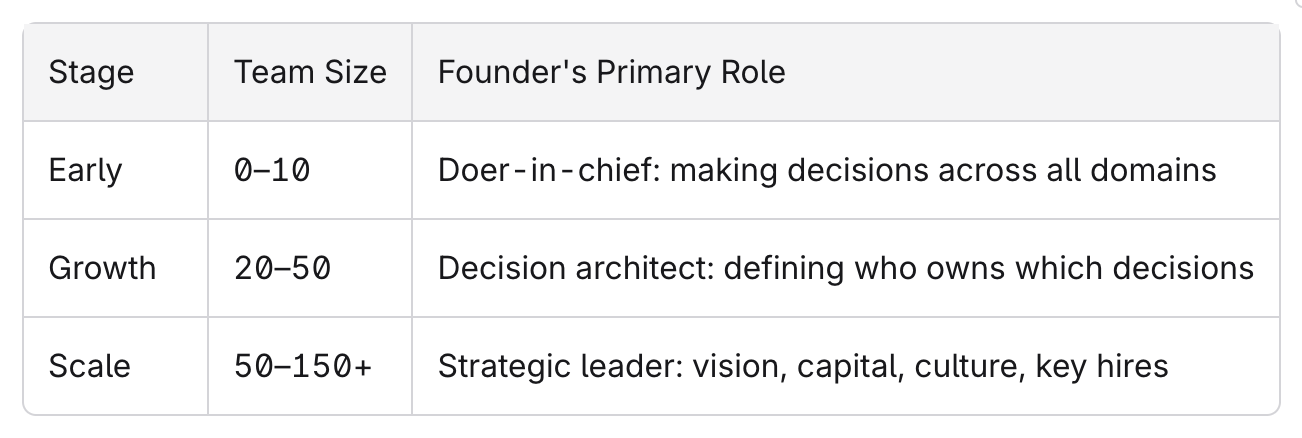
One FMCG founder was making decisions on more than 40 items per day. After documenting processes and delegating roles, that number dropped below 15 - a 70-percent reduction. Work hours went from over 70 per week to around 50, and the business ran smoothly even during the founder's absence. Adaptability helps entrepreneurs identify unforeseen opportunities, but only if the founder has the mental bandwidth to notice them.
Decisions to keep: long term goals and strategy, VP-level and executive hires, capital allocation, defining the product vision, and setting cultural standards.
Decisions to give away: tooling choices, routine purchasing, minor discount approvals, standard process issues, and mid-level hiring within defined criteria.
The trap is that problem solving feels productive. Every question you answer gives a small dopamine hit. But the person who stays the hero problem-solver at 50 employees creates a bottleneck that no amount of effort can clear. A successful entrepreneurial mindset includes a long-term vision combined with short-term execution, and the short-term execution at scale is building decision systems, not making every call yourself.

A Simple Clarity Framework: Four Buckets for Every Decision on Your Plate
Not every decision deserves the same process. A practical way to protect your focus is to categorize decisions along two axes: impact and reversibility.
- High impact, hard to reverse → Founder decides. Examples: pricing model overhaul, entering a new market, hiring a managing director for a new region.
- High impact, easy to reverse → Leadership team decides with founder oversight. Examples: launching a feature experiment, adjusting a go-to-market channel, testing a new onboarding flow.
- Low impact, hard to reverse → Define a clear process and assign a domain owner. Examples: choosing a benefits provider, signing a multi-year vendor contract.
- Low impact, easy to reverse → Delegate fully with default rules. Examples: comping a frustrated customer's bill, selecting which technology stack for an internal tool, approving routine creative assets.
At a 40-person SaaS company called Cobalt Labs, decision logging revealed that more than 60 percent of the decisions the founder was handling were reversible and operational. Fewer than 15 percent truly required founder-level involvement. Once decisions were tiered, the teams trusted the finality of each call, rework dropped, and the founder reclaimed strategic blocks every week.
This framework supports entrepreneur discipline by eliminating unnecessary context-switching. You do not necessarily need to touch every decision - you need to design ownership so the right person touches it at the right level.
Disciplined Entrepreneurship and Decision Discipline
The myth of the "chaotic genius" founder makes for great movie scenes but terrible companies. Disciplined entrepreneurship, a concept championed by Bill Aulet at the MIT Sloan School of Management and the Martin Trust Center for MIT Entrepreneurship, offers a different theory. Aulet's program teaches students and founders to break big, ambiguous choices into a repeatable sequence of smaller, testable ones.
You do not need to enroll in an MIT entrepreneurship education to borrow the principle. Here is where decision discipline matters most:
- Choosing a target customer segment: Define criteria such as market size, willingness to pay, and accessibility - then decide based on data, not gut feeling alone. Customer obsession drives entrepreneurs to focus on solving genuine problems instead of falling in love with their original ideas.
- Sequencing product features: Rank by expected value, development cost, and strategic alignment. Ad hoc feature lists lead to scattered resources and inconsistent experiences for customers.
- Raising capital vs. pursuing profitability: Set thresholds (revenue run-rate, burn rate, growth trajectory) and let the numbers guide the timing. Entrepreneurial mindsets view calculated risks as necessary for progress, but discipline means you define what "calculated" actually looks like.
The difference between ad hoc and disciplined strategies is visible in execution speed, team confidence, and how reliably new businesses within your portfolio hit their milestones.
Protecting Leadership Clarity in the Middle of Constant Input
Slack pings, investor texts, customer escalations, and team questions all compete for the same hour. Leadership clarity is the ability to maintain a coherent mental model of your business despite noisy, conflicting signals. Successful entrepreneurs emphasize continuous learning and customer feedback, but absorbing everything in real time is not the same as learning.
Practices that protect clarity:
- Daily decision journal: Write down the top three decisions you made, your reasoning, and their current status. Over weeks, patterns emerge that would otherwise stay invisible.
- Weekly thinking blocks: Block 90 minutes to two hours with no meetings, no Slack, no email. Use this time for developing strategies, reviewing metrics, and revisiting your plan for the quarter.
- Written decision principles: Document "how we decide here" and share it with teams. This reduces ambiguity and cuts down the number of escalations that reach you.
- Channel discipline: Define which topics require asynchronous communication, which require a scheduled meeting, and which warrant an urgent interruption. Most things are not urgent.
- Structured review cadence: A Friday review - similar to what Cobalt Labs implemented - where you assess decisions made, deferred, and misdelegated during the week.
The Harvard Business Review's research on fast-growing companies identifies "structured empowerment" as the emerging standard: distributing decision authority with clarity and periodic review so that founders maintain oversight without becoming the bottleneck.
Innovation suffers when leaders are buried in operational noise.
When to Step Back and When to Step In: Calibrating Founder Involvement
This is the core tension in every scaling company. Stay too involved, and you slow everything down. Step back too far, and standards drift.
Signals it's time to step in:
- Core quality or ethical standards are being violated
- Strategic misalignment - the team or product direction diverges from the vision
- Repeated errors in a delegated domain suggest the process or the person needs attention
- Key metrics drift without a clear explanation from the responsible leader
Signals it's time to step back:
- Leaders consistently make sound decisions in their domain
- You become the bottleneck - delays happen because teams wait on your approval
- Your review adds diminishing returns and slows execution
- Team members hesitate to act because they expect over-checking
A practical example: a founder lets a managing director own all regional hiring decisions while retaining final say on VP-level roles and above. This creates confidence in the leadership team and preserves founder involvement only where the stakes justify it. The knowledge of when to lead and when to trust is what separates great entrepreneurs from overwhelmed ones.
Common Mindset Traps as the Company Grows (and Better Alternatives)
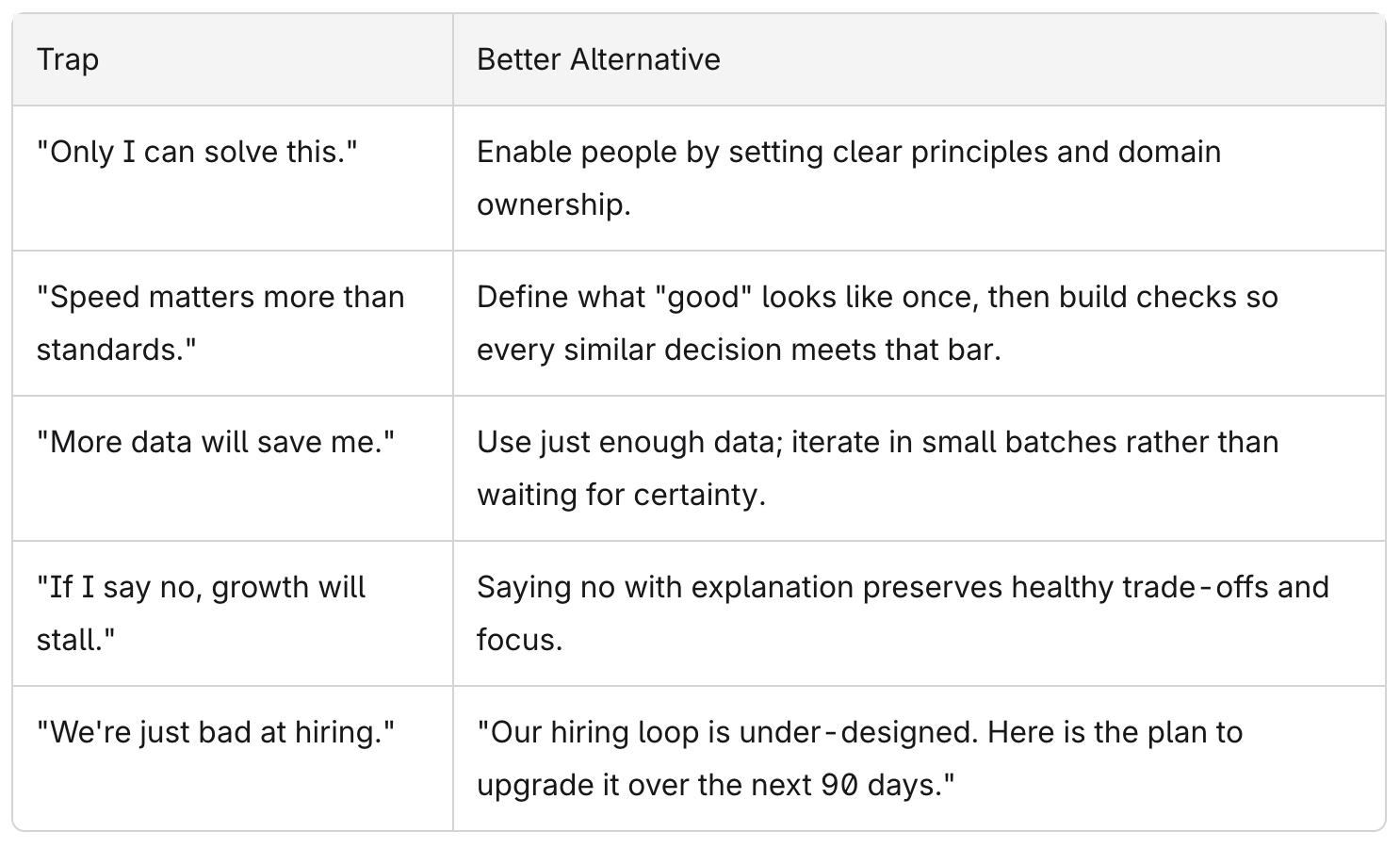
Resilient entrepreneurs treat setbacks as data rather than defeat. An entrepreneurial mindset is resilient and solutions-oriented, which means the response to a wrong outcome is to examine the system, not to question your career or your identity.
Using the word "yet" fosters a growth mindset in practice. "We haven't cracked retention yet" is fundamentally different from "We can't retain customers." The first opens a creative path forward. The second closes it.
Each of these traps feeds decision overload. When you believe only you can solve a problem, every problem becomes your problem. When you refuse to say no, every opportunity becomes your obligation. The efforts you put into upgrading your mindset directly reduce the volume and complexity of choices on your plate.
Building a Culture That Shares the Entrepreneur Mindset
The founder mindset cannot live in one person forever. If it does, you will never achieve the leverage that scaling is supposed to create.
Practical ways to embed this mindset into your organization:
- Decision principles in onboarding: New hires learn how decisions get made, not just what their job description says. Entrepreneurial mindsets prioritize taking initiative and acting without waiting for direction, and this must be taught explicitly.
- Post-mortems focused on learning, not blame: An entrepreneurial response to problems seeks solutions and improvement rather than compliance with the status quo.
- Promote for judgment, not just output: Recognize leaders who show entrepreneur discipline and good decision-making, not just the ones who ship the most.
- Monthly decision review: A lightweight meeting where the leadership team reviews major decisions from the past 30 days - what went well, what would change, what to delegate differently.
- Written "how we decide here" documents: These serve as the management playbook for your company's decision culture.
Anti-fragility is a key quality of an entrepreneurial mindset. The goal is to build an organization that gets stronger from stress, not one that depends on a single person absorbing all of it. A serial entrepreneur who builds multiple companies over a life and career often codifies this mindset early so it outlives them in each venture. Entrepreneurship can be taught and is a learned skill - this applies not only to students in a program but to every person on your team.
Think of leaders like Bill Gates, who built Microsoft not by making every decision himself, but by developing a culture and development process that scaled decision quality across the entire world of the company.
Practical Weekly Reset: A Simple Founder Discipline Ritual
A 60- to 90-minute weekly review - Friday afternoon or Sunday evening - can be the single most important habit for sustaining leadership clarity.
What to review each week:
- The top three decisions you made and your confidence level in each
- Three decisions you deferred - and whether the deferral was strategic or avoidance
- Two decisions you handled that should have been delegated
- One decision that needs revisiting with new data or a changed market condition
- A growth mindset reflection: what shifted in your understanding of the business this week, and how that will change next week's priorities
- A quick scan of whether your teams are operating within the standards and principles you have defined
Do this in writing. A simple document or notebook creates a record you can review quarterly to spot patterns - recurring bottlenecks, skills gaps, areas where you consistently add value versus areas where your involvement adds nothing.
This ritual connects to long term goals: small, consistent practices keep judgment, patience, and standards from eroding under pressure. It is not complex, and it does not require technology beyond a notebook. But it is crucial for any founder who wants to succeed at scale without burning out.

How Drew Can Help: Applying the Entrepreneur Mindset in Your Context
The core idea is simple: a clear entrepreneur mindset lets you make fewer, higher-quality decisions as your company grows, instead of drowning in choices. But implementing these frameworks inside your specific business - with your team, your market, your stage - requires more than reading an article.
Drew works with founders and leadership teams to install practical clarity, decision, and discipline frameworks tailored to the realities of growth-stage companies. This is not generic advice or motivational speaking. It is founder-to-founder guidance on business decision making, leadership clarity, and the systems that let you lead without losing control.
If you are ready to explore what this looks like in your context, start a conversation about a speaking engagement or advisory session with Drew.

FAQ: Entrepreneur Mindset, Growth, and Decision Overload
These questions come directly from conversations with founders navigating decision overload during growth. If your situation is more specific, the best next step is a direct conversation with Drew.
How is an entrepreneur mindset different from generic "positive thinking"? An entrepreneur mindset is not about optimism. It is about having systems to categorize, delegate, and review decisions so that growth does not erode your judgment. It combines a growth mindset with decision discipline - teaching entrepreneurship principles to yourself and your team, not just hoping things work out.
Can a founder with a historically fixed mindset actually change how they think? Yes. A randomized trial with necessity entrepreneurs in Tanzania showed that growth mindset training led to measurably more entrepreneurial action compared to a control group. Mindset is a skill you develop, not a trait you are born with. Research at Penn State found that a single growth mindset construct underlies multiple entrepreneurial abilities.
What's one small change that quickly reduces my daily decision fatigue? Log every decision you make for one week. Categorize each by impact and reversibility. Most founders realize that the majority of their decisions are low-impact and easily reversible - and can be delegated immediately with simple rules.
How do I share this mindset with a leadership team that's already stretched thin? Start with a written document outlining "how we decide here" and introduce a monthly decision review meeting. These rituals take minimal time but build shared confidence and reduce the number of decisions that escalate to you.
Does an entrepreneur mindset mean ignoring data and trusting my gut? No. It means using just enough data to make a sound decision at the current stage, then iterating. Analysis paralysis is as dangerous as recklessness. The best startups in the world combine data rigor with speed.
share this
Related Articles
Related Articles