




Thought Leadership: How Experts Build Authority Without Turning Every Idea Into Self‑Promotion
Thought Leadership: How Experts Build Authority Without Turning Every Idea Into Self‑Promotion
Most executives don't need more content. They need clearer thinking from the people they're about to trust with six- and seven-figure decisions.
This article lays out a practical model for building authority, executive visibility, and demand through thought leadership-without the pressure to constantly sell yourself or perform online.
Start Here: Why Thought Leadership Matters to Decision‑Makers in 2026
Picture two SaaS vendors competing for a multinational's AI deployment contract. Both offer solid security, competitive pricing, and similar features. Vendor A publishes original research showing how its product reduces regulatory risk in AI adoption, complete with frameworks built from field data and interviews with risk officers. Vendor B sends generic content about productivity and best practices.
The decision-maker leans toward Vendor A-not because of flashier features, but because Vendor A demonstrated subject matter expertise about problems the buyer actually loses sleep over. Vendor A moves through due diligence faster. Vendor B stalls on the shortlist.
This story plays out daily. Decision-makers in 2026 are flooded with content but starved for clear thinking that reduces risk and helps them decide. What they value is insight that clarifies trade-offs and frames complexity into next steps. When your ideas do that work before the first sales call, you shorten procurement cycles, improve deal velocity, and attract higher-quality lead generation because the prospects who engage with deep insights tend to have real budgets and authority.
So what separates thought leadership from generic content marketing or personal branding? Content marketing typically chases reach through volume, tactics, and search engines. Personal branding centers on persona and following. Thought leadership is about producing original ideas that help a specific audience make better decisions-backed by evidence, a clear point of view, and professional credibility. It positions individuals as informed authorities in their field.
Hard business outcomes of strong thought leadership:
- Trust built early reduces procurement and due-diligence timelines
- Close rates increase when buyers see you as a credible authority before they reach out
- Stronger pricing power follows when your positioning shifts from vendor to trusted partner
The promise of this article: a system for executives and experts to build authority and demand over 12–24 months, aligned with business outcomes rather than vanity metrics.

What Thought Leadership Is (And How It Differs from Personal Branding & PR)
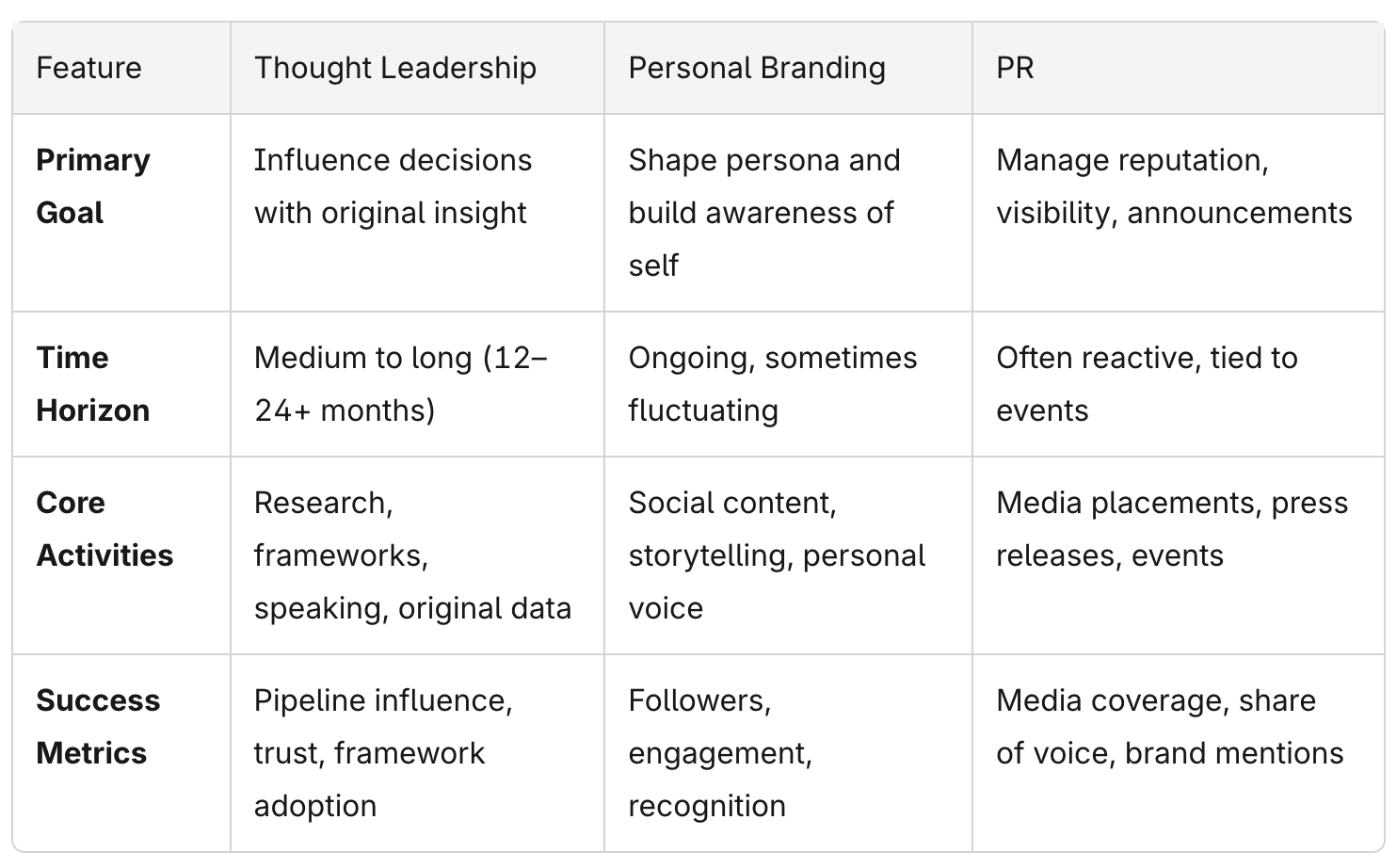
Three terms overlap constantly-thought leadership, personal brand, and PR-but they serve different purposes. PR manages reputation and public presence. Personal branding shapes perception of the individual. Thought leadership hinges on ideas: what you believe, what evidence supports it, and how those ideas change behavior or decisions.
Thought leadership means being known for useful, original ideas that help a defined target audience make better choices at critical moments. It enhances credibility and trust among clients and peers, and credibility is the foundation of persuasive communication.
Strong thought leadership can power earned media, executive visibility, and professional credibility-but those are outcomes, not the starting point. The starting point is always the quality of the idea.
For example, Satya Nadella didn't just promote Microsoft products. He championed empathy and cloud transformation as a leadership philosophy, reshaping how the industry evaluated tech adoption. Similarly, a niche CFO who coins the term "responsible AI spend" and publishes decision frameworks for finance leaders builds credibility not through self-promotion, but through value that helps real people determine how to allocate budgets.
The Business Case: From Ideas to Pipeline, Talent, and Influence
Executives often ask: "How does thought leadership translate into revenue?" The answer is direct. Research from the IBM Institute for Business Value finds that thought leadership programs produce an average ROI of 156% and drive an estimated $265 billion in purchasing decisions globally. Engaging in thought leadership increases career and business opportunities across every level.
Higher-intent lead generation. Thought leadership attracts potential customers who already trust your thinking. Gartner's 2025 research emphasizes tracking "content-assisted pipeline"-deals influenced by thought pieces-over raw traffic numbers. Research indicates that effective thought leadership influences customer loyalty long after the first engagement.
Category positioning. By introducing new problem definitions or proprietary frameworks, companies shape how an entire market evaluates solutions. Competitors become followers. This is how you escape price competition by establishing premium positioning.
Talent attraction. Thought leadership attracts high-caliber talent and fosters stronger networks. For example, Tend, a health-tech startup, used thought leadership to raise its profile among investors and specialist talent pools-while also saving roughly 24 hours per week through a streamlined content creation process.
Pricing leverage. Buyers pay more when they perceive you as an authority, not a commodity. Effective thought leadership can shape industry influence and trends, giving your company control over how "good" is defined.
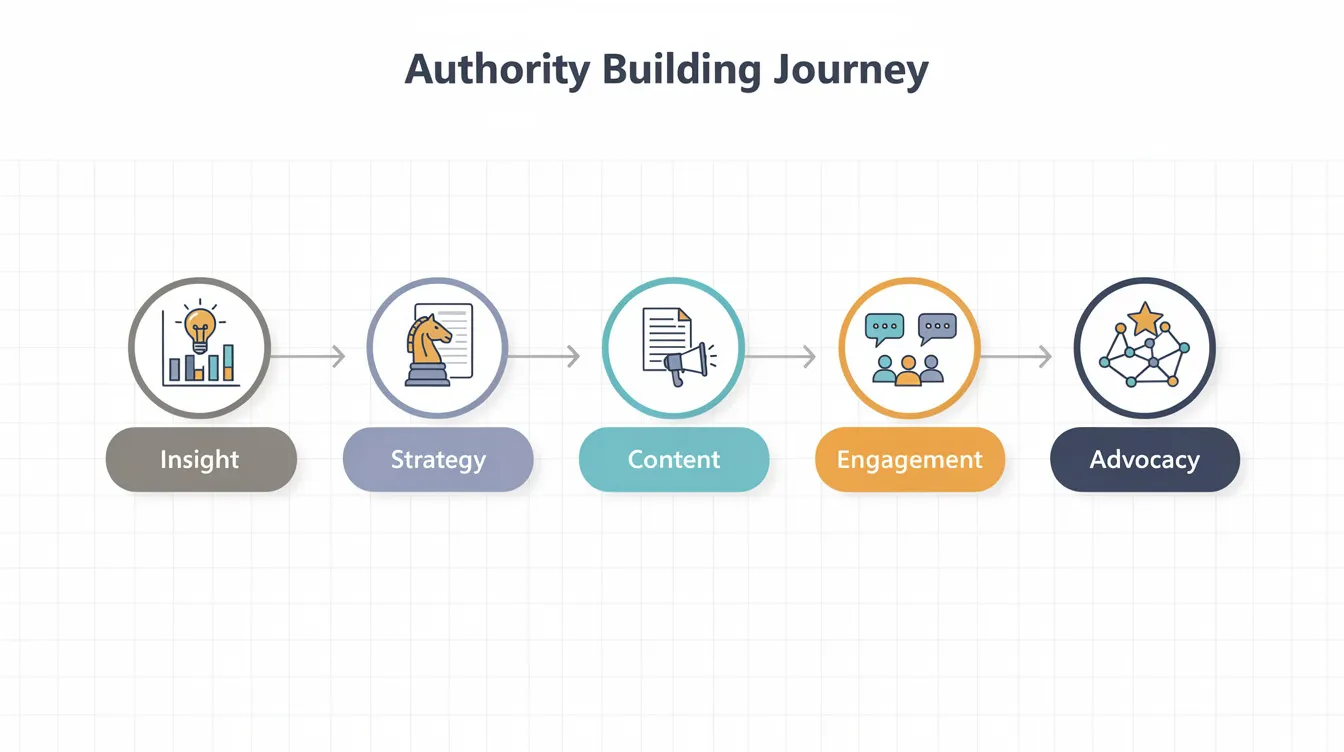
The compounding path looks like this: Insight → Visibility → Trust → Demand → Advocacy. You surface original insight, make it visible to your audience, which builds trust; trust generates demand; demand produces advocates who cite and refer you. While ROI is rarely instant, this authority building over 12–24 months outperforms sporadic campaigns in the long run.
The Credibility Ladder: From Expert to Recognized Authority
Not everyone starts at the same rung. Here's a model for understanding where you are and what it takes to climb.
Practitioner. Deep hands-on experience, low visibility. Your audience is your immediate team and clients. Content is mostly internal-case studies, reports. Professional credibility is built through consistent, genuine work at this stage.
Documented Expert. You start publishing-bylined articles in industry publications, a blog post series, whitepapers with evidence and real stories. Visibility extends to industry readership. Timeline to reach this from practitioner: roughly 6–12 months of disciplined effort.
Referenced Expert. Others begin citing your work. Analysts, media, and peers ask for contributions. Your professional reputation is shaped by others' perceptions at this point, not just your own claims. Building relationships with journalists increases media quotes. Timeline: 12–24 months beyond documented expert.
Recognized Authority. Speaking engagements position executives as thought leaders at this level. You occupy keynotes, major conferences, and high-visibility forums. Awards validate executive expertise and enhance brand visibility. Timeline: 2–3 years of consistent presence.
Agenda-Setting Leader. You define the conversation. Your frameworks and language are used widely. You may influence regulation or industry standards. Your reputation travels with you beyond your current organization. Timeline: 3–5 years.
The goal is not fame. It's being findable and trusted by the right target audience-buyers, partners, investors, future employers. To assess your current rung, ask: Is your content cited outside your immediate clients? Are you invited to speak? Does your work include original data or frameworks? Do industry media reference your ideas? If most of your evidence is internal, you're likely between practitioner and documented expert-and that's a perfectly strong foundation to build from.
The Core of Thought Leadership: Original Ideas That Are Actually Useful
Most thought leadership fails because it restates consensus. If your article could have been written by any competent professional in your industry, it doesn't build authority. It fills knowledge gaps for no one.
What counts as an "original idea" in business? New language that reframes a stale problem. A new lens on an existing challenge-like evaluating supply chain risk through environmental data instead of traditional cost metrics. A new process that solves a decision bottleneck.
Or new evidence that changes what smart people do next. Thought leaders share deep insights and original ideas to educate their industry.
Publishing original research gives others a reference point for industry data.
Apply a three-part usefulness test to every idea you develop:
- Does it reduce confusion? Does it clarify what's ambiguous or disputed?
- Does it change priorities? Would someone shift resources based on your insight?
- Does it clarify the next step? Can someone act on your framework immediately?
Sources of original ideas include field data from your own clients, pattern recognition across sectors, contrarian views supported by evidence, and lessons from failed projects. Targeting unaddressed topics can distinguish thought leadership efforts from the noise.
Forward-thinking thought leaders focus on future industry trends and challenges, not just today's talking points.
Authentic expertise is rooted in genuine knowledge and hands-on experience. Document ideas over time with an "idea log." Record the questions customers ask repeatedly. Run quarterly synthesis sessions to mine those logs for themes, then refine drafts through speaking and writing until they're sharp enough to publish.
Designing a Thought Leadership Content Strategy (Without Becoming a Full‑Time Influencer)
Most senior leaders don't have 20 hours a week for content creation. They shouldn't need to. A strategic approach built on 2–4 focused hours weekly-supported by a small team-can produce serious results.
A content strategy guides how a company creates content. It includes planning, creation, and governance phases. Here's a five-step framework:
- Define your target audience. Identifying the target audience is crucial for effective content strategy. Who are they, what decisions do they face, where do they consume content?
- Clarify business outcomes. Defining goals is the first step in creating a content strategy. Reduce sales cycle by 20%? Increase qualified leads from named accounts?
- Choose 1–2 anchor themes. Long-lived problem spaces-like responsible AI adoption, sustainable logistics, or founder succession-that all your ideas attach to.
- Select 2–3 core formats. Whitepapers, bylined articles, speaking engagements, podcast interviews, or proprietary research.
- Plan a sustainable publishing rhythm. One flagship piece per month, smaller derivatives weekly, talks quarterly.
Content strategy should align with business goals and user needs-not chase every trending topic on social media. For example, a COO focused on "operational resilience under disruption" could launch an anchor theme report in month one, publish two bylined articles in months two and three, deliver a webinar in month four, and iterate through month twelve with new data and case studies.
The goal is coherence, not volume. One strong, well-distributed piece per month can outperform daily shallow posts and deliver meaningful business growth.

Channels That Compound Authority: Owned, Earned, and Shared Media
In expert positioning, channels fall into three categories: owned media (your website, newsletter, podcast), earned media (guest articles, analyst citations, media coverage), and shared media (LinkedIn, X, community platforms, and other channels where peers engage).
Use owned media as your home base. Your website or newsletter should house your deepest thinking-frameworks, reports, original data. This is your "source of record" that search engines index and audiences return to. Even a well-crafted professional headshot and bio on your site signals professionalism and respect for your audience.
Earned media amplifies authority through third-party validation. Media coverage builds executive visibility and credibility. Guest articles in industry publications, analyst references, and selective podcast appearances build credibility in ways self-publishing cannot. Building relationships with journalists over time-not just pitching them-increases the likelihood of being quoted and referenced.
Social media enhances executive visibility and personal branding. Use LinkedIn and niche platforms to test ideas, engage with peers, and drive attention back to deeper assets on your website. Thought leaders should engage in industry conversations beyond their own channels.
Thought leadership fosters meaningful conversations with industry peers when you listen and respond rather than broadcast.
A concrete distribution pattern: publish your flagship piece on your site first. Pitch a condensed version to an industry outlet. Atomize into four social threads. Send the core insight to your email list. Resurface in your next speaking engagement.
Making It Non‑Cringey: Serving Before Selling
The fear of appearing self-promotional is valid. Bad thought leadership often slips into hype or thinly veiled sales pitches. Here's how to avoid that while maintaining professionalism and building trust.
Five guardrails:
- Lead with problems, not products. Start every piece by describing the challenge your audience faces.
- Disclose your biases. Transparency about your vantage point and limitations builds respect.
- Show your working. Explain how you reached conclusions, what data you used, what you're still unsure about.
- Share failures. What didn't work, and why? This demonstrates depth and reliability and professionalism build long-term trust.
- Spotlight others' work. Cite peers, reference competing frameworks, link to interesting research. Mature thinkers build relationships, not walls.
Aim for a service ratio: 80–90% of content helping with no direct ask, 10–20% clearly labeled invitations to engage or collaborate.
Example rewrite: Self-promotional version: "We just launched our premium plan with feature X-contact us now." Reframed: "Here are three trade-offs to weigh when evaluating feature X in enterprise SaaS plans. One of those trade-offs is exactly what feature X addresses. If you want help assessing fit, here's how to reach out."
Treat comments and questions as opportunities to deepen the conversation, not defend your reputation. This builds trust and approachability with your target customers.

Practical Publishing Rhythm for Busy Leaders
Thought leadership can be built on 2–4 focused hours per week if the system is tight. The rest can be handled by a small support team-a content strategist, editor, or researcher-who turns raw ideas and voice notes into polished writing without losing authenticity.
Sample monthly cadence:
- 1 flagship piece (report, framework, or deep article)
- 1 live or recorded conversation (webinar, panel, podcast)
- Weekly social media posts (threads, shorter commentary)
- 1 short email or internal memo distilling a key idea
Each month should produce one substantial asset, 3–5 derivative pieces, and at least one experiment with a new format or channel.
Consistent sharing of quality insights can build a reliable reputation. Consistency in delivering quality work enhances credibility-and consistency over 12+ months matters far more than intensity for 4–6 weeks. Build rituals: standing "idea hours," quarterly reflection days, content calendar check-ins.
This rhythm supports professional development without requiring you to become a full-time influencer. The difference between executives who build durable authority and those who flame out is almost always discipline, not talent.
Measuring Impact: Beyond Vanity Metrics
Likes and impressions are easy to count but rarely matter to the people who control budgets. Focus instead on metrics that connect to decisions.
Three-horizon measurement framework:
- Reach: Who saw it? Track share of voice, branded search growth, and discoverability across channels.
- Resonance: Who cared? Measure dwell time, repeat visits, downloads, newsletter signups, and quality of social comments.
- Results: What changed? Pipeline influence, win-rate improvement, price negotiation leverage, inbound speaking invitations, and analyst or media references that cite your frameworks.
Signals that matter for authority building: inbound requests to speak at events, higher-intent inbound leads, shorter sales cycles for deals where prospects engaged with your content, and stronger deal engagement overall.
Track attribution practically. Add "How did you first encounter our ideas?" fields to forms. Record anecdotal evidence from sales calls-"They referenced your article on digital transformation." Review metrics quarterly, adjust your content strategy to double down on what draws the right target audience, and divest from purely performative channels.
Common Thought Leadership Pitfalls (And How to Avoid Them)
The most frequent failure modes are predictable-and avoidable.
Inconsistency. Launching with a burst of content and then going dark for months. Better: a modest but regular rhythm sustained by calendar discipline and clear roles.
Topic drift. Chasing every trending topic without connecting back to anchor themes. Better: use your anchor themes as a lens. New topics should relate back to your core expertise.
Ego-driven content. Posts about achievements, promotions, and self-congratulation rather than audience problems. Better: frame every piece from the listener's perspective. What do they need to determine or decide?
Outsourcing the thinking. Heavy reliance on ghostwriters who don't engage with your real experience or data. Better: provide raw insights through interviews and voice notes. Outsource the packaging, never the ideas.
Over-reliance on AI. AI helps with research, first drafts, and repurposing. But too much reliance produces generic, undifferentiated content that fills no knowledge gaps and builds no authority. Keep your own voice, your own data, and your own story front and center.
Periodically audit your published content. Prune outdated, repetitive, or off-brand material so your overall body of work stays coherent, credible, and interesting to the right audience.
When to Bring in Outside Help-and What to Look For
Many executives won't execute a full thought leadership program alone. Strategic support can accelerate impact, especially during key transitions.
When external help makes sense: new market positioning, pre- or post-funding stages, M&A, product category creation, or major role transitions where authority matters to online and offline audiences.
What to look for in advisors:
- Ability to challenge your ideas, not just polish them
- Track record in executive visibility and earned media
- Understanding of distribution-not just content creation
- Respect for your voice and unique needs
A strong partner contributes through idea development, content strategy, speech refinement, media prep, and thoughtful distribution planning. They help you develop resources that compound authority without diluting authenticity.
When you need experienced perspective on building serious thought leadership-whether through speaking, advising, or strategic contribution-invite Drew Rhoden to the conversation.

FAQs on Thought Leadership, Authority, and Executive Visibility
How is thought leadership different from "being an influencer"? Influencers optimize for attention and following. Thought leaders optimize for trust and decision-shaping. The difference is whether your audience is entertained or equipped to act. Expert positioning is earned through ideas, not impressions.
How often should I publish to see results? One flagship piece per month with consistent social presence is a strong starting point. Results typically begin showing within 6–12 months as compounding trust builds. The expected timeline depends on your industry and existing credibility.
Can a smaller firm or solo expert compete with big brands? Absolutely. Smaller firms can target unaddressed topics with depth that large companies rarely match. Subject matter expertise in a specific niche often outperforms broad, diluted brand content.
How do I maintain credibility if my views change? Transparently. Explain what new data or experience changed your thinking. Audiences respect intellectual honesty far more than rigid consistency. This is a crucial role of maturity in thought leadership.
What if my company has strict compliance rules? Work with legal and compliance early. Many regulated industries-finance, healthcare-allow thought leadership when it focuses on frameworks and industry education rather than specific claims about services or outcomes.
Does thought leadership work for professional development, not just business development? Yes. Building authority expands career opportunities, strengthens your professional network, and opens doors to advisory roles, board positions, and speaking engagements-regardless of whether your company directly benefits.
Where should I focus first if I'm just starting? Start by documenting what you already know. Turn recurring client questions into a framework. Publish one substantial piece and engage with the responses. That single step separates practitioners from documented experts.
Thoughtful, well-structured contribution-not constant self-promotion-is what builds durable authority in 2026 and beyond.
share this
Related Articles
Related Articles