




Colombia Business Travel Lessons: What This Trip Taught Me About Planning, Creative Work, and International Teams
Every founder I know romanticizes the international trip until the second day, when logistics, fatigue, and unclear plans start competing with the creative work you actually came to do. Here are the Colombia business travel lessons I brought home - and how they changed the way I plan production, lead teams, and show up for clients abroad.
Fast answers: Key Colombia business travel lessons up front
Before the full breakdown, here are the biggest takeaways from my trip to colombia so I can save you the scroll if you're short on time. The detail comes later.
- Build buffer days into every international trip. You will need them for weather, energy, and re-scouting.
- Over-communicate with your team before the trip, not during it. Roles, schedules, and deliverables should be locked before anyone boards a flight.
- Dedicate real scouting time in cartagena de indias and Medellín. Walking a location on camera is not the same as walking it the day before with fresh eyes.
- Travel days are low-output days. Stop scheduling them like normal work days.
- Your colombia business travel lessons will only stick if you document what worked, what failed, and what changes for next time - whether you're an entrepreneur, photographer, executive, or creator doing international trip planning.
- Hire local. A bilingual fixer or location scout will save you more money than they cost.
- Protect your sleep and hydration the same way you protect your gear.
If I compare how I planned my first shoot week in colombia versus how I'd plan it now: I'd add two more days of slack, run gear checks 48 hours before departure instead of the night before, and hand every local crew member a written brief with clear role ownership.
The sections below go deeper on logistics, overseas creative production, leadership through travel, and what cartagena and Medellín specifically taught me about working with local teams. (See the Medellín planning section below for systems-level detail.)
Context: Why I took a production team to Colombia in 2024
In March 2024, I flew to colombia with a small production team to shoot across two cities: cartagena de indias and Medellín, with a brief routing through bogota. The work included photo and video production for a Cartagena travel recap, leadership content, portfolio work for clients, and on-location interviews with local founders.
The trip had concrete goals:
- Test a repeatable framework for overseas creative production
- Capture portfolio work that speaks to entrepreneurs and executives
- Stress-test remote team systems across time zones
- Build content around working with local teams in south america
The team was lean: a director (me), a DP, a producer doubling as client liaison, and a remote editor back home handling rough cuts and client comms. This article is a founder authority recap, not tourism advice. Every lesson ties back to business value.
Why colombia specifically? The country sits in a time zone close to Eastern, offers direct flights from major U.S. cities, has a growing creative scene across latin america, and client demand was already pointing toward cities like Medellín and cartagena's historic center. Colombia has over 200 years of diplomatic ties with the U.S., and many colombian executives have studied or lived in the States, making the business bridge shorter than you might expect.
The real story isn't that we went. It's how the planning held up once boots hit the ground.

Lesson 1: Plan international trips backward from your non-negotiables
Backward planning means you lock in your immovable commitments first - the client shoot, the key interview, the person who's only available on Thursday - and then you build flights, scouting days, and rest around them.
In colombia, that looked like this: a two-day shoot in cartagena's historic center with a local entrepreneur, a sunrise session on the city walls, and a client meeting in El Poblado, Medellín later that week. Those were non-negotiable. Everything else - arrival day, weather backup day, transit between cities - got scheduled around them.
The old way many founders travel: stack meetings immediately after landing, assume perfect energy and perfect Wi-Fi, and let airfare sales dictate the entire calendar. That approach breaks on international trips.
When planning your own trip, decide first on three things:
- The must-shoot locations
- The must-meet people
- The must-ship deliverables
Then buy flights. Avoid letting a cheap fare on a bad day compress your schedule into something unsustainable. This principle applies whether you're heading to colombia, mexico, or anywhere else across the americas.
Later sections cover how to handle scheduling creative work, jet lag, and team capacity - this lesson is the foundation for all of them.
Lesson 2: Treat travel days as strategy days, not production days
On the flight from Atlanta to cartagena, I had grand plans: edit a full video, write three emails, and outline the week's shot list. What actually happened was customs, a delayed bag, and arriving at the hotel with just enough energy to review the next day's call sheet.
Most leaders schedule travel days as if they'll get six to eight hours of deep work. They won't. International flights, airport transfers, customs lines, and ground transportation eat real time. The mismatch between your calendar and reality creates stress before the trip even starts.
I re-framed travel days as "strategy and review" days: listening to previous footage on the plane, outlining rough shot lists, reviewing story arcs, and refining client questions - all tasks that survive an internet outage or a turbulent landing.
A few practical rules:
- Only schedule light admin on travel days
- Keep commitments to 30–60 minute windows
- Use offline task lists and downloaded files in case Wi-Fi fails
- Don't promise anyone a deliverable on a day you're in transit
Being realistic about your own capacity prevents over-promising to clients, team members, and partnerships on the ground. Because we intentionally under-loaded the arrival day, I showed up rested enough to scout cartagena's walled city on foot before the first shoot - and that scouting saved us from a noisy plaza the next morning.
Lesson 3: Over-prepare logistics so you can under-stress on set
Colombia is logistically friendly - good airports, solid hotels, and rideshare apps that work - but still unpredictable. Weather shifts fast.
Traffic stalls without warning. Local holidays can close streets.
Here's what we handled ahead of time:
- Flights into Rafael Núñez International Airport (cartagena) and José María Córdova (Medellín), confirming that the Rafael Núñez airport is just about 10 minutes from downtown and the busiest in colombia's caribbean region
- Hotels with verified Wi-Fi upload speeds
- Ground transportation arranged through the hotel for arrival
- Baggage rules for camera gear confirmed with airlines
- Drone regulations reviewed through Aerocivil and the Colombian Film Commission
U.S. citizens need a valid passport for colombia entry, and your passport must be valid for six months beyond your arrival date. No visa is required for stays of 60 days or less, though fines apply for unapproved stays exceeding 60–90 days. Colombian visas can be extended from six months to five years if your project requires a longer stay. Colombia has international airports in 10 major cities, and frequent domestic flights connect them, so traveling between major cities is typically done by air for efficiency.
One logistical mistake: we underestimated traffic from El Poblado to the Medellín airport and nearly missed a flight. The fix going forward is adding a 90-minute buffer for any airport run in a colombian city.
When the basics are predictable, you can focus attention on direction, client presence, and capturing unexpected moments instead of scrambling.
Lesson 4: Ground transportation and safety mindsets that actually work
Safety is a real concern for business travelers in colombia, especially in large cities. The U.S. State Department issues travel warnings for
Colombia, currently at Level 3, citing crime and other risks. But risk can be managed with consistent, thoughtful habits.
Here's how we actually moved around cartagena de indias and Medellín:
- Used authorized taxis and hotel-arranged pickup at every airport
- Relied on ride-hailing apps like InDrive and Uber where common
- Never hailed a street taxi, especially at night
- Shared live phone locations with a colleague during every ride
Taxis in cartagena do not have fare meters, so fares are negotiated or set at fixed rates from airport booths - typically COP 15,000–25,000 (roughly USD 4–6). Transcaribe, a mass transit system, began operating in 2015 and serves parts of the city. Using local transportation services is recommended for security during business travel in colombia. Road travel outside major cities is not recommended, and travelers should avoid rural areas controlled by criminals.
Practical guidelines:
- Arrange airport pickup in advance
- Keep valuables in a hotel safe to reduce theft risk
- It's vital to keep personal belongings secured and avoid displaying valuables in public
- Pickpocketing and scams are common in major cities - stay aware in crowded areas
- Check official travel advisories before every trip
A thoughtful safety mindset lets you relax enough to notice creative opportunities - a mural, a street vendor, a shaft of golden light - instead of spending the whole visit on edge. I encourage every person reading this to treat security as a system, not a feeling.
Lesson 5: Build a local "brain trust" before you land
Colombia became dramatically easier once I had local contacts. In cartagena, a bilingual producer knew every courtyard worth shooting in.
In Medellín, a camera operator familiar with El Poblado and Laureles backstreets made us twice as efficient as we'd have been alone.
Types of local partners that matter most:
- A bilingual producer or fixer who can negotiate in spanish and translate on the fly
- A location scout familiar with the historic center and Getsemaní
- A Medellín-based assistant who knows the neighborhoods, traffic rhythms, and permit requirements
How to vet them: referrals from past clients, Instagram portfolios with verifiable credits, creative communities, and production companies with real work online. Colombian executives often have studied or lived in the U.S., so many understand both business cultures. Spanish is commonly preferred over english in colombian business interactions, so having someone who bridges both languages is not optional.
Start messaging potential partners 30–45 days before your trip. Do at least one video call, and align expectations on rates, hours, and responsibilities before the flight.
One concrete save: a local collaborator warned us about a festival scheduled in a plaza we'd planned to use for an interview. We moved to a quieter courtyard two blocks away and got clean audio. That kind of local knowledge is worth more than any guide book.
Fewer surprises, less wasted scouting time, and more culturally sensitive storytelling - that's what a local brain trust buys you.
Lesson 6: Leading international teams requires clearer roles than you think
International work - spread across time zones and languages - magnifies any existing leadership fuzziness around who owns what. If roles aren't written down, they'll be assumed differently by everyone.
For colombia, the team structure looked like this:
- On-site: director, DP, producer/client liaison
- Off-site: remote editor, marketing manager, assistant handling client comms back home
Two friction points came up fast. First: who confirms call times with a local client when the producer is in transit and the assistant is in a different time zone? Second: who speaks in spanish versus english during vendor negotiations, and who releases payments to local crew? Neither was explicitly assigned.
Those moments led to clearer pre-trip documents:
- Written run-of-show notes for each day
- A WhatsApp group thread for operations, a separate one for creative feedback
- One-sheet briefs naming who owns each decision
Always have business agreements documented and legally vetted - even informal ones with local crew. If a payment or deliverable isn't written down, it doesn't exist.
Practical tips for readers building international partnerships:
- Write down role ownership in simple language before departure
- Establish how decisions are made on the ground (one decision-maker per domain)
- Keep communication channels simple - one main chat for logistics, one for creative
- Assign a single point of contact for the local team
International travel doesn't magically make a team more creative. Structure and clarity do.
Lesson 7: Time zones and schedules - using Colombia's advantage
Colombia operates on Eastern Standard Time year-round (UTC-5), which is a major advantage for north American entrepreneurs and executives. No daylight saving time shifts. No 3 a.m. calls.
In practice, this meant running morning shoots in cartagena or Medellín, then jumping on late-afternoon Zoom calls with U.S. clients without anyone working absurd hours. Colombia has a workweek of Monday to Friday, with normal working hours from 8 a.m. to 5 p.m. - nearly identical to what most U.S. teams expect.
A sample day schedule from the trip:
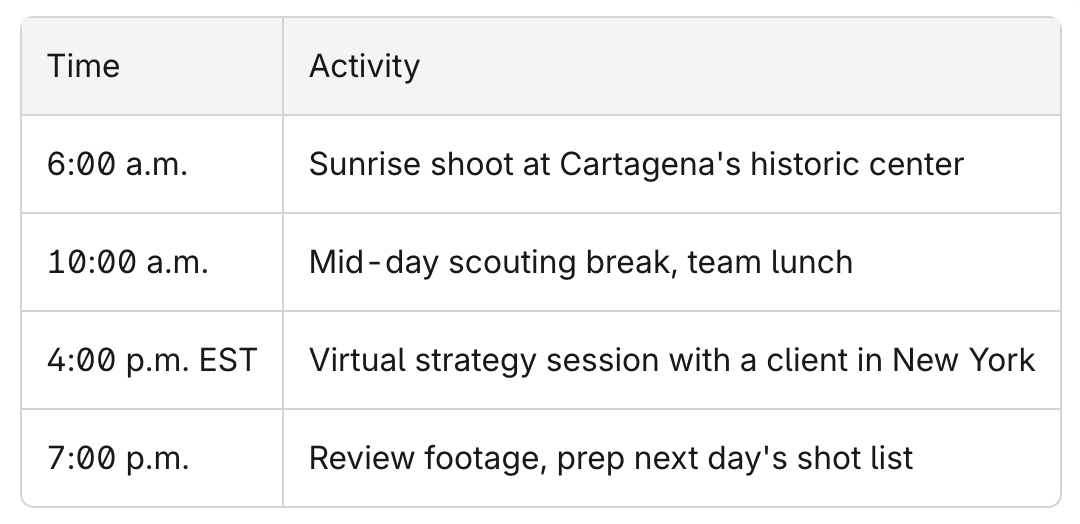
Protect sleep. Don't stack late-night edits on top of early-morning call times, even when time zones seem easy.
Guidelines for calendar design:
- Block out "no meeting" windows on heavy production days
- Cluster remote calls on non-shoot days
- Pre-send agendas knowing that hotel Wi-Fi sometimes dips
- Colombian business meetings expect punctuality from foreign guests - build in arrival buffer
Colombia's time zone advantage only pays off if you intentionally design your schedule around it. Otherwise, it's just as easy to burn out as anywhere else.
Lesson 8: Creative work on the road needs a different workflow
Creative production in colombia looked like this: shooting in bright caribbean light along cartagena bay, recording interviews in Medellín's cafes, and capturing b-roll in crowded streets where foot traffic, music, and weather change by the hour.
Office workflows break on location. You don't have unlimited time, controlled lighting, or quiet rooms. Client energy levels spike and dip throughout the day. The detail that matters in a studio - perfect framing, color-matched walls - gives way to a different set of priorities: capturing authentic moments, adapting to the environment, and not wasting the narrow windows when light and energy align.
How I adjusted:
- Shorter shot lists with clear priorities ranked as "must-have vs. nice-to-have"
- Flexible b-roll plans that could shift neighborhoods without derailing the day
- Fast on-site reviews each evening to catch gaps before leaving a city
On a compressed shoot day in cartagena's historic center, weather forced us to abandon an exterior location mid-morning. Because we had a prioritized list, we immediately pivoted to a shaded courtyard and captured two of the best interviews of the trip. Without that list, we would have spent 30 minutes debating what to do next.
Guidelines for creative travelers:
- Build a "must-have vs. nice-to-have" list for every day
- Schedule 30-minute nightly debriefs with your team
- Use a simple naming and backup system that works on slow hotel Wi-Fi
- Never leave a city without reviewing your footage against the original shot list
When your workflow is robust, clients feel confident even when street noise, crowds, or afternoon storms make conditions less than perfect. That confidence is delivering value, even on chaotic days.

Lesson 9: Gear, backups, and what I'd pack differently next time
Colombia is a gear-intensive environment. Humidity in cartagena de indias can fog a lens in seconds. Altitude changes if you route through bogota add physical stress. Crowded streets limit how fast you can move with heavy bags, and you won't find specialty camera shops easily.
Core gear categories I brought:
- Camera bodies and lenses (two bodies minimum)
- Audio kits: shotgun mic, two lavaliers, portable recorder
- Laptops, hard drives, and power accessories compatible with colombia's 110V standard
- Rain covers and dry bags for cartagena's sudden showers and caribbean sea humidity
One real gear scare: a lavalier cable failed on day two. Because I carry backup cables in a separate bag, we swapped in under five minutes and didn't lose the interview. Had I packed only one cable, we'd have lost irreplaceable audio.
Packing guidance:
- Carry-on for all essential camera gear - never check it
- At least two separate backup drives stored in different bags
- Rain protection rated for tropical downpours, not just light drizzle
Digital "gear" matters just as much: offline translation apps, downloaded maps, copies of passports and shot lists saved locally on your phone, and printed addresses in spanish for taxi drivers who may not use the same app you do.
Smart redundancy doesn't mean hauling everything you own. It means knowing exactly what you can't afford to lose on a given shoot - and making sure that item has a twin in a different bag.
Lesson 10: Cultural cues and business customs that change how you show up
Culture in colombia varies by region. Coastal cartagena is warm, relaxed, and informal. Inland bogota runs more conservative and punctual. Medellín falls somewhere in between - entrepreneurial energy with a slightly more formal business tone. Colombia has distinct regional business cultures affecting communication and etiquette, and understanding those differences changes how you show up.
Personal observations: vendors in cartagena's historic center were friendly and camera-curious. Meetings in Medellín's business districts started with 10 minutes of small talk about family and food before anyone mentioned the project. This tracks with Colombian business culture - initial meetings often focus on building rapport before discussing business. Colombians may express disagreement indirectly to avoid conflict, which means you need to listen carefully and read the room.
Colombian business culture emphasizes trust and personal relationships over transactional speed. Colombians prefer in-person meetings over virtual interactions, and face-to-face meetings are highly valued. Networking through business lunches and conferences is common.
Business attire is formal for daytime engagements in colombia, and dress code in colombia is generally formal for business meetings - even in warmer cities.
Etiquette notes:
- Greet people with a handshake and eye contact
- Learn a few spanish phrases - it goes further than you think
- Show up on time even if the local culture is more flexible
- Avoid jumping into contracts or storyboards before small talk
One moment that improved a shoot: taking 15 minutes to chat about local restaurants and the person's family before setting up cameras turned a stiff interview into a relaxed, authentic conversation. That warmth showed up in the final footage.
Reading the room well is part of building long-term partnerships, not just getting through a single project.
Lesson 11: Cartagena de Indias - turning a historic city into a production asset
Cartagena de indias was the first major stop: a UNESCO World Heritage city - designated since 1984 - with a walled city, caribbean light, and intense mid-day heat. The city averages 27°C throughout the year, which means sweat, glare, and energy management are constants. Cartagena is sometimes called la heroica, and it earns that name through its colonial architecture, layered history, and visual intensity.
I scouted the city by walking the walls at sunrise, checking plazas like Plaza de Santo Domingo and Plaza de los Coches, and evaluating sound levels and foot traffic. Castillo de San Felipe de Barajas dates back to the 17th century and serves as one of the most iconic backdrops in the town. The city hosts the International Music Festival every january, so scheduling around major events matters.
A typical shoot day structure:
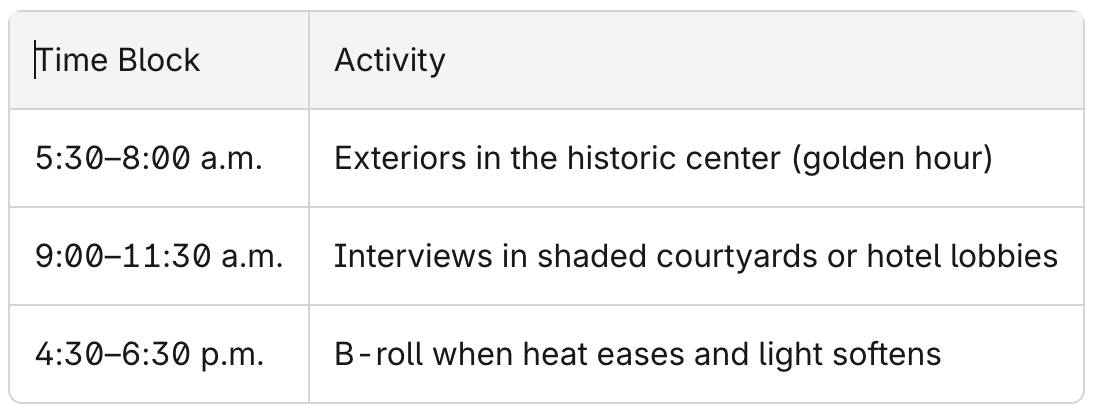
Cartagena has over 20 beaches in nearby islands complexes, and cartagena has over 20 beaches for local seafood dining - making it a versatile destination for both work and leisure scenes. The city features a vibrant nightlife and cultural festivals, and nightclubs along the waterfront draw a large number of visitors.
Getsemaní is known as cartagena's hippest neighborhood - murals, street art, and a different energy from the main plazas. Cartagena's gastronomy features a mix of international and local flavors, including traditional dishes like arroz con chipi chipi and local cuisine like pork loin in tamarind sauce. The restaurants in this part of the world blend caribbean flavors with global influence.
What cartagena taught me: use the city's architecture, light, and rhythm as part of the story rather than just a backdrop. The location itself becomes a character.

Lesson 12: Medellín - building systems in the "City of Eternal Spring"
Medellín was the second key city: milder climate, a strong entrepreneurial ecosystem, and a pace that felt more like a working capital than a tourism destination. Where cartagena is sensory overload, Medellín is operational - a place where you can build systems.
I used Medellín as both a production base and a systems test: working from a coworking space in El Poblado, scheduling remote calls with U.S. clients, and editing colombia footage in between local shoots. The industry around co-working and remote work here is mature, with reliable spaces in El Poblado and Laureles.
A concrete day looked like this:
- Morning client strategy session over coffee in Laureles
- Mid-day filming in a founder's workspace
- Late-afternoon review with the remote editor via cloud uploads
Guidance for readers considering Medellín:
- Pick accommodation that balances walkability with quiet - streets off the main nightlife strips are ideal
- Verify upload speeds for heavy footage before booking a hotel
- Pre-test collaboration tools on your home network before departure
One Medellín-specific lesson: hills and elevation (roughly 1,500 meters) affect walking times more than you'd expect. Add afternoon storms and you're looking at schedule disruptions on any outdoor shoot. We learned to front-load outdoor work before noon and save indoor sessions for afternoons.
Medellín is a great "lab" city for entrepreneurs and creators to test working abroad while still staying aligned with North American clients. The future of remote creative production in the americas likely runs through cities exactly like this one.
Lesson 13: Working with local talent and crews without micromanaging
Local colombian creatives often know their city and culture better than you ever will - and that's an advantage, not a threat. The motivation behind hiring locally isn't just cost. It's access to knowledge you can't replicate from a hotel room.
On the cartagena shoot, we brought on a local photographer who'd been shooting the walled city for more than a century of combined family experience. We reviewed her portfolio, co-designed a shot list that blended my brand standards with her local style, and agreed on non-negotiable deliverables: resolution, framing guidelines, and brand tone.
Then I gave space. And the results were better than anything I'd have directed alone.
How to avoid micromanaging:
- Agree on deliverables up front (specs, deadlines, usage rights)
- Send mood boards showing what you like instead of rigid shot-by-shot instructions
- Pay fairly in local currency - keep colombian pesos for these transactions
- Be transparent about timelines and how the content will be used
One moment that made the final cut: our Medellín camera operator suggested a rooftop location in Laureles we never would have found. The skyline shot from that spot became the opening frame of the recap video. That suggestion happened because the person felt trusted enough to speak up.
The point of working with international teams is not to clone your home workflow. It's to broaden it. Giving friends and collaborators creative room produces better work and builds the kind of human resources network that pays dividends across future trips.
Lesson 14: Money, budgeting, and the real cost of "cheap" locations
Colombia does not automatically mean "cheap work." Yes, some costs run lower than U.S. metros - mid-range hotels generally cost USD 80–150 per night, and a local menú del día lunch runs USD 4–8. But travel time, coordination overhead, and the commercial cost of pulling yourself out of your home market add up fast.
Main budget buckets I tracked:
- Flights (international and domestic)
- Hotels and accommodation
- Ground transportation
- Local crew day rates
- Permits and location fees
- Food and incidentals
- Contingency funds (I recommend 10–20% above base projections)
Hidden costs founders forget:
- Extra travel days that pull you away from other revenue
- Gear insurance for international shoots
- Last-minute schedule changes that require rebooking
- The mental cost of context switching across clients and cities
- Keep local currency (colombian pesos) for small expenses - ATM fees accumulate
One smart tradeoff: I paid more for a centrally located hotel in cartagena to save roughly two hours of daily commuting. That investment in proximity freed up time for scouting, rest, and an extra b-roll session that produced three usable social media clips. The value of that content far exceeded the hotel premium.
Colombia business travel lessons only pay off if the trip supports long-term positioning, content assets, or client relationships. Cool photos without a commercial strategy behind them are a vacation, not a business investment. The market for entrepreneur and executive-facing content is competitive - every asset needs a purpose.
Lesson 15: Personal energy, health, and "founder fitness" on the road
International trips can exhaust even the most driven founders, and creative output is directly linked to personal energy. You can have perfect logistics and still produce mediocre work if you're running on four hours of sleep and street empanadas.
Conditions in colombia that affected energy:
- Cartagena's heat and humidity (that consistent 27°C with high moisture)
- Medellín's hills, which turn a "10-minute walk" into a 20-minute climb with gear
- Long walking days in the historic center on uneven cobblestone
- Rich food eaten late at night, sometimes after 9 p.m. - common in colombian culture but rough on early-morning schedules
- The weather itself: afternoon storms disrupted fun outdoor plans and forced indoor pivots
Habits I used or wish I'd started sooner:
- Hydrating far more than usual - the caribbean heat is deceptive
- Short daily workouts or walks before the team gathers
- Light breakfasts before heavy shoot days
- Strict cut-off times for late-night editing
If your trip includes bogota, note the altitude (about 2,600 meters). Acclimate for 24–48 hours and avoid overexertion in the first day. Even a visit where you're only transiting through can leave you winded.
Practical tips:
- Schedule "no-obligation" time in each city
- Resist the urge to cram every spare hour with meetings or events
- Treat sleep as non-negotiable infrastructure
Your team and clients don't need a superhero. They need a leader who makes stable, clear decisions day after day. Founder fitness on the road is supposed to look boring - that's how you know it's working.
Lesson 16: Turning a Colombia trip into long-term business value
The real colombia business travel lessons don't crystallize on the flight home. They crystallize when you sit down to integrate the footage, stories, and insights into your brand and operations.
Concrete outputs I created or planned from the trip:
- A colombia travel recap video
- Behind-the-scenes content for social media
- Case studies for companies considering international shoots
- Internal playbooks for future overseas creative production
Each asset maps to a specific business goal:
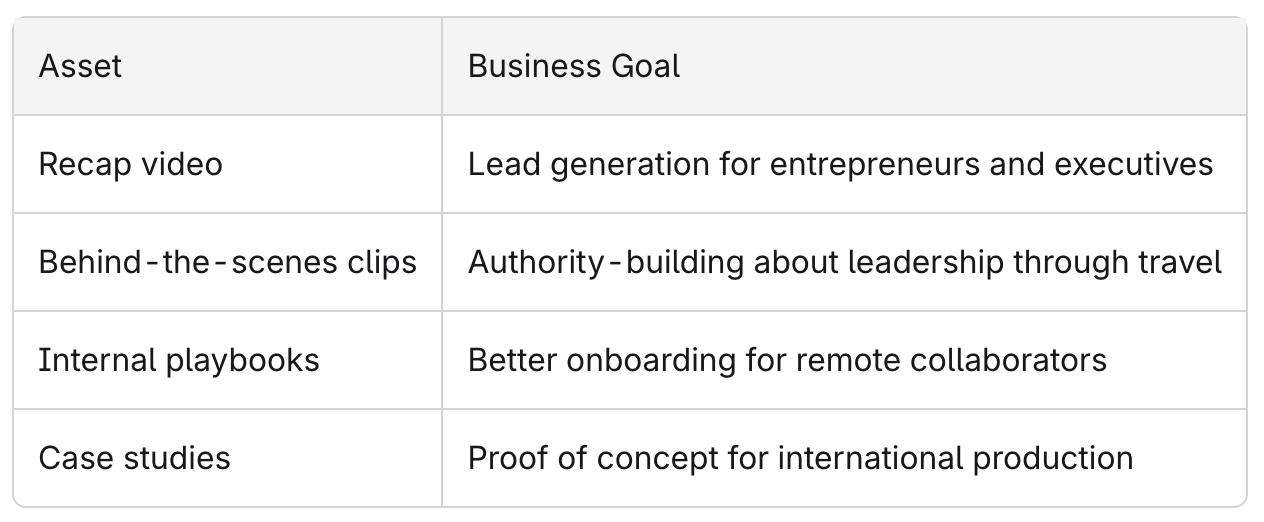
For further information on how to capture this kind of value, schedule a debrief session with your team within a week of returning. Document what worked and didn't. Decide which parts of your colombia playbook become standard for future trips across any regions you work in.
One permanent change: mandatory scouting days are now built into every international project. No exceptions. Before colombia, scouting was "nice to have." Now it's infrastructure.
Other suggestions:
- Create a standardized packing checklist
- Write required role briefs for every international shoot
- Archive all raw footage with clear naming conventions so it becomes a long-term content library
- Review budget versus actual spend to calibrate future planning
Travel is an investment, not a vacation expense, when it's deliberately tied to systems, assets, and leadership growth. The world opens up for your brand when each trip builds on the last one instead of starting from scratch.
Next step: Watch the recap and apply these lessons to your own trip
These colombia business travel lessons came from real days on the ground in cartagena de indias and Medellín - not from a guidebook or a highlight reel. Every section in this article connects to an actual decision, mistake, or breakthrough from the trip.
Watch the Colombia recap video to see what these lessons looked like in practice: behind-the-scenes production decisions, leadership in real time, and how an international team operated across two cities with different rhythms, weather, and culture.
If you're an entrepreneur, photographer, executive, or creator planning your own international trip - whether to colombia, another destination in south america, or a similar market in the same time zone - adapt these lessons to your own project. The framework works even if your cities, clients, and creative goals are different from mine.
A soft next step: follow Drew for practical leadership and travel insights, and consider reaching out if you want help planning overseas creative production or documenting your next international project. Whether it's cartagena bay at sunrise or a founder's office in Medellín, the approach is the same: plan backward from what matters, lead with clarity, and treat every trip as a system you're building.
Future content will expand on specific topics - working with local teams, ground transportation safety across the caribbean and beyond, building global creative systems, and turning a single trip into an island of content that serves your brand for months. This article is the beginning, not the end.

share this
Related Articles
Related Articles