




Transformational Leadership: When Leaders Need to Change More Than a Process

In early 2022, Amgen's operations division faced a problem that no process improvement could fix. Employees were telling leadership, plainly, that the old way of working no longer made sense. The world had shifted, expectations had shifted, and the culture needed to shift too. Rather than launch another initiative or update another policy document, senior leaders did something harder: they changed themselves. They moved away from strict oversight toward trust, care, and listening. The result was a more adaptive, people-centered culture that could hold up in a volatile environment.
That story is not unusual. It is increasingly the norm. Today's volatility-technology shifts, workforce changes, economic uncertainty-makes "process tweaks" insufficient. Leaders themselves must transform. Transformational leadership focuses on long-term inspiration and changing the status quo, not just managing what already exists. It connects leaders and followers to inspire positive changes across organizations, teams, and communities.
This article is for executives, founders, senior managers, and educators who lead meaningful change. You will walk away with practical strategies, real examples, and diagnostic questions you can use this quarter. The perspective comes from DrewRhoden.com's work with leadership change and culture-grounded in research, tested in practice.
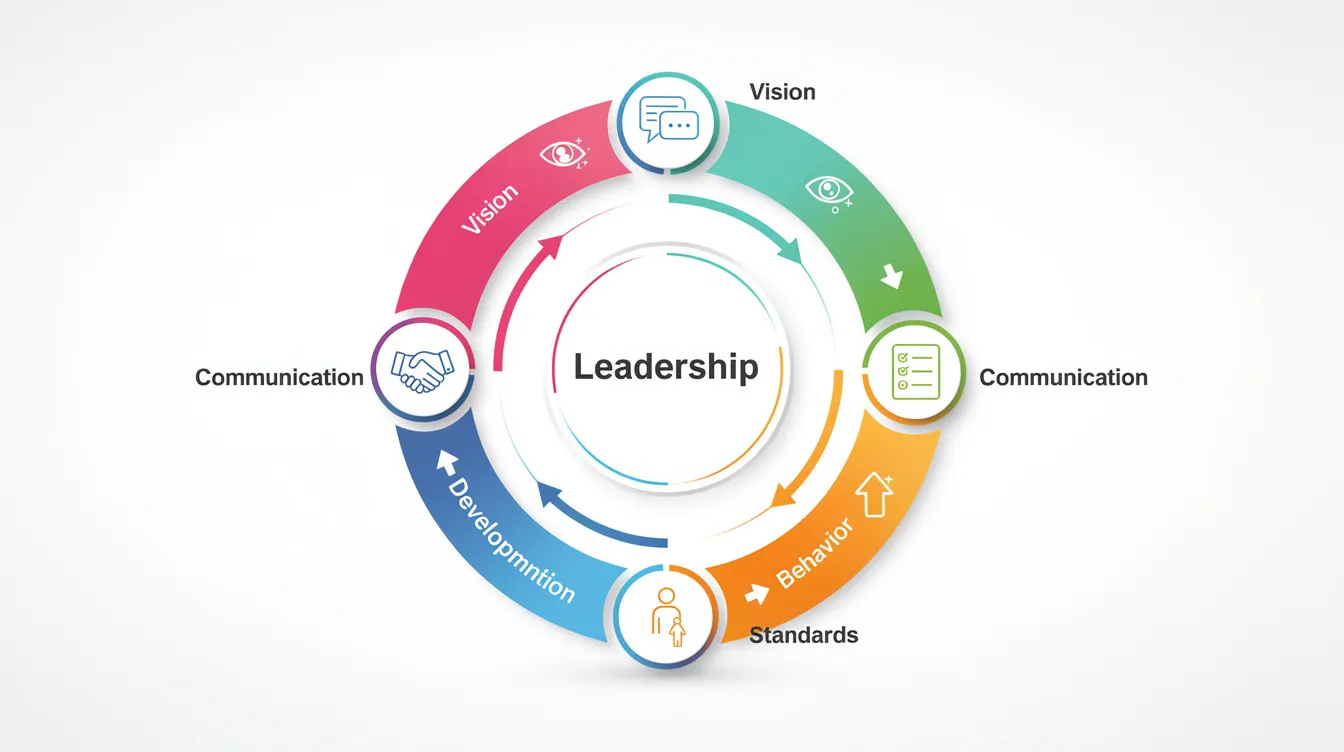
In the sections ahead, we will connect vision, standards, trust, team development, communication, culture, and leadership behavior into one integrated approach. Not as theory. As something you can start doing.
What Is Transformational Leadership? Core Definition and Origins
Transformational leadership is a leadership approach centered on changing mindsets, behavior, and culture-not just restructuring org charts or updating workflows.
The concept has a clear history. James MacGregor Burns coined transformational leadership in the 1970s, drawing a sharp distinction between leaders who trade on agreements and those who elevate the people around them. Burns argued that transformational leaders act as change agents who elevate moral and performance levels, raising both leader and follower to higher ground. In the 1980s, Bernard Bass expanded Burns's theory into a measurable model, identifying specific behaviors that could be observed, taught, and developed.
The four core components of transformational leadership include Idealized Influence, Inspirational Motivation, Intellectual Stimulation, and Individualized Consideration. Idealized Influence is a characteristic where the leader acts as a role model-someone the team trusts and wants to follow. Inspirational Motivation involves articulating a clear and appealing vision that gives people a sense of purpose. Intellectual Stimulation encourages creativity and challenges the status quo, pushing teams to rethink how they solve problems. Individualized Consideration focuses on the unique needs of each follower, treating development as personal, not generic.
Transformational leaders align values and identities with a compelling vision. That meaning is what separates this approach from conventional management. More recent leadership and cultural studies have adapted the model for global, hybrid, and cross-functional teams-recognizing that the concept must flex across different circumstances while keeping its core principles intact.
Transformational vs. Transactional Leadership: Getting the Balance Right
The distinction between transformational and transactional leadership matters because most organizations need both, but rarely in equal measure.
Transactional leadership relies on exchanges and rewards for performance. Think of it as a contract: hit this quota, earn this bonus. Transactional leaders evaluate employees based on predetermined criteria-KPIs, compliance checklists, output targets. This works well for baseline performance, safety protocols, and legal requirements where rules and consistency are non-negotiable.
Transformational leadership differs from transactional leadership by focusing on higher ideals and values. Transformational leaders focus on a shared vision beyond job tasks. They tap into intrinsic motivation rather than relying on external rewards. Transformational leadership seeks to increase motivation and commitment beyond compliance, and it inspires intrinsic motivation in employees-the kind of drive that shows up even when no one is watching. Transformational leadership contrasts with transactional leadership styles not by replacing structure, but by adding purpose, growth, and meaning on top of it.
Consider a 2023 scenario: a mid-size tech company needs to pivot its product line after a major market shift. The transactional response-adjust quotas, update incentives-might keep the wheels turning. But the transformational response asks deeper questions: Why does this pivot matter? What does it mean for our customers, our team, our future? A leader who combines both styles uses transactional clarity to set expectations and transformational energy to drive belief.
What Is Transformational Leadership? Core Definition and Origins
Transformational leadership is a leadership approach centered on changing mindsets, behavior, and culture-not just restructuring org charts or updating workflows.
The concept has a clear history. James MacGregor Burns coined transformational leadership in the 1970s, drawing a sharp distinction between leaders who trade on agreements and those who elevate the people around them. Burns argued that transformational leaders act as change agents who elevate moral and performance levels, raising both leader and follower to higher ground. In the 1980s, Bernard Bass expanded Burns's theory into a measurable model, identifying specific behaviors that could be observed, taught, and developed.
The four core components of transformational leadership include Idealized Influence, Inspirational Motivation, Intellectual Stimulation, and Individualized Consideration. Idealized Influence is a characteristic where the leader acts as a role model-someone the team trusts and wants to follow. Inspirational Motivation involves articulating a clear and appealing vision that gives people a sense of purpose. Intellectual
Stimulation encourages creativity and challenges the status quo, pushing teams to rethink how they solve problems. Individualized
Consideration focuses on the unique needs of each follower, treating development as personal, not generic.
Transformational leaders align values and identities with a compelling vision. That meaning is what separates this approach from conventional management. More recent leadership and cultural studies have adapted the model for global, hybrid, and cross-functional teams-recognizing that the concept must flex across different circumstances while keeping its core principles intact.
Transformational vs. Transactional Leadership: Getting the Balance Right
The distinction between transformational and transactional leadership matters because most organizations need both, but rarely in equal measure.
Transactional leadership relies on exchanges and rewards for performance. Think of it as a contract: hit this quota, earn this bonus. Transactional leaders evaluate employees based on predetermined criteria-KPIs, compliance checklists, output targets. This works well for baseline performance, safety protocols, and legal requirements where rules and consistency are non-negotiable.
Transformational leadership differs from transactional leadership by focusing on higher ideals and values. Transformational leaders focus on a shared vision beyond job tasks. They tap into intrinsic motivation rather than relying on external rewards. Transformational leadership seeks to increase motivation and commitment beyond compliance, and it inspires intrinsic motivation in employees-the kind of drive that shows up even when no one is watching. Transformational leadership contrasts with transactional leadership styles not by replacing structure, but by adding purpose, growth, and meaning on top of it.
Consider a 2023 scenario: a mid-size tech company needs to pivot its product line after a major market shift. The transactional response-adjust quotas, update incentives-might keep the wheels turning. But the transformational response asks deeper questions: Why does this pivot matter? What does it mean for our customers, our team, our future? A leader who combines both styles uses transactional clarity to set expectations and transformational energy to drive belief.

The Inner Work of Transformational Leaders: Mindset, Identity, and Self-Awareness
Transformational leadership begins with leaders examining their own assumptions, triggers, and identity. You cannot ask others to change if you haven't done the work on yourself.
Transformational leaders practice self-awareness and personal growth-not as a one-time exercise, but as a discipline. They remain open-minded to new ideas and perspectives, even when those perspectives challenge their existing beliefs. Transformational leaders lead with humility and admit limitations, which earns respect rather than diminishing authority.
Key inner capacities:
- Self-awareness: Knowing your defaults under stress-control, avoidance, deflection-and choosing differently.
- Emotional regulation: Managing your emotions without suppressing them. Your team reads your energy before they read your strategy.
- Curiosity: Approaching problems and people with genuine interest rather than judgment.
- Willingness to receive hard feedback: Not just tolerating it, but actively seeking it.
Practical practices that support this work: reflective journaling, 360-degree feedback using validated tools like the Multifactor Leadership Questionnaire (MLQ), professional coaching, peer advisory groups, and deliberate habit tracking.
Consider a leader who shifted from a control-oriented style to a coaching-oriented one. It didn't happen through a workshop-it happened through months of tracking specific behaviors, receiving feedback, and choosing discomfort over default. The team's outcomes followed: higher engagement, faster decision-making, and stronger relationships built on respect rather than hierarchy.
Behavior Change: Turning Insight into New Daily Habits
Without behavior change, "transformational leadership" remains a notion-a label without substance. Behavior is the visible proof of transformation.
Good transformational leaders are adaptable and innovative, and they are proactive in making bold decisions. But those qualities only matter when they show up consistently in daily actions. Transformational leadership increases intrinsic motivation among employees when leaders model the behaviors they expect.
Simple behavior-change principles applied to leadership:
- Cue–routine–reward: Identify triggers (e.g., a team member bringing a problem), design the new routine (ask open questions before offering solutions), and reinforce the reward (better answers, stronger ownership).
- Implementation intentions: Plan the "when, where, how" in advance. "When I start a 1:1, I will ask what's going well before diving into problems."
Micro-behaviors you can change starting this week:
- Ask one open-ended question before giving direction in every meeting.
- Delegate one decision per week that you'd normally make yourself.
- Recognize one person's specific effort publicly each day.
- Pause for five seconds before reacting to unexpected news.
- End each week by writing down what you learned, not just what you accomplished.
Create accountability structures: a buddy system with another leader, a leadership cohort that meets biweekly, or transparent commitments shared with your team. Connect behavior change to positive reinforcement-consistent, specific appreciation shapes new norms faster than any policy.
Start small. Track 1–3 behavior experiments over a 90-day period. Progress compounds.
Practical Strategies to Lead Real Organizational Change
Transformational leadership is positively associated with organizational commitment and readiness for change. Transformational leadership helps employees adapt to market shifts through engagement. But turning principles into real organizational change requires a playbook.
Here is a five-phase approach you can apply to a real initiative:
- Diagnose: Assess current culture and performance honestly. Use surveys, interviews, and observation-not just dashboards.
- Define: Set a clear vision with specific metrics. What does success look like in 12 months? What will people experience differently?
- Design: Identify the behaviors, systems, and process changes needed. Involve secondary leaders and middle management early, giving them clear mandates and decision space.
- Deploy: Start with pilots, not organization-wide rollouts. Gather feedback, adjust, and communicate what you're learning.
- Deepen: Scale what works. Embed changes into hiring, promotion, recognition, and daily rituals so they outlast the initial energy.
Tips for handling resistance:
- Run listening tours before launching changes. People resist what they don't understand.
- Clearly explain "what's changing and what's not."
- Surface unspoken fears-often the real resistance lives in questions people are afraid to ask.
Use 30–60–90 day milestones for the first wave of visible change. Early wins build momentum; long silences breed skepticism.
Transformational Leadership Across Cultures and Generations
Transformational leadership must adapt to cultural context. A 2025 meta-analysis across 519 samples and 39 nations found that transformational leadership is positively correlated with performance, innovation, and citizenship behavior regardless of national culture-but the strength of those effects varies.
In cultures with higher power distance and collectivism, the effects tend to be even stronger. In cultures emphasizing individualism, transactional approaches sometimes carry more weight for specific outcomes. These differences matter for leaders operating across borders.
Generational expectations also shape how transformational leadership lands. Research shows that preferences for transformational leadership are relatively stable across generations, but what differs are expectations about feedback speed, autonomy, flexibility, and transparency. Younger generations often place higher value on purpose, two-way communication, and seeing their development as central-not peripheral.
Strategies for leading diverse, global teams:
- Co-create team norms rather than imposing them. Different approaches to conflict, communication, and decision-making deserve exploration.
- Rotate meeting times across time zones to distribute the burden of inconvenience.
- Use culturally aware decision-making: ask how decisions are typically made in each context, then find common ground.
Consider a leader managing teams in the US and Germany. In the US, the team expected informal check-ins and rapid iteration. In Germany, the team expected thorough preparation and structured communication. The leader kept core principles-vision, trust, development-consistent, but adapted the delivery. That adaptation wasn't compromise; it was respect.
Common Pitfalls and Myths About Transformational Leadership
Myth: Transformational leadership is just charisma. It is not. The moral component matters deeply. Research on pseudo-transformational leadership shows that charisma without ethical foundations can be destructive-leaders who inspire but serve only their own interest cause real harm.
Myth: It ignores accountability. Transformational leadership does not exist in opposition to structure. Transactional elements-clear expectations, reward systems, performance standards-form the foundation. Transformation builds on that foundation.
Myth: It only works in startups. Large enterprises, educational institutions, healthcare systems, and government agencies have all benefited from transformational approaches. The context changes; the principles hold.
Common mistakes to watch for:
- Over-promising change without infrastructure or middle management buy-in
- Launching vision statements but failing to align incentives, hiring, and daily rituals
- Relying on one-off retreats or keynotes instead of sustained behavior change
- Performing transformation (new language, new messaging) while keeping old systems and social behavior intact
If you hear yourself saying these, pause and check:
- "Everyone's on board" → Have you actually asked, or assumed?
- "We just need better execution" → Is the real issue clarity, not effort?
- "Culture will follow" → Are you actively shaping it, or hoping?

Assessing Your Own Leadership: A Quick Self-Diagnostic
Before you can lead transformation, you need an honest baseline. Use these questions to gauge how transformational your current leadership is across the six pillars.
In the last 30 days, how often have you…
- Vision: Clearly connected a team decision to the organization's larger purpose?
- Standards: Addressed a gap between expected behavior and actual behavior-directly and with care?
- Trust: Admitted a mistake or shared the reasoning behind a difficult trade-off with your team?
- Development: Had a substantive conversation about a team member's growth that wasn't part of a formal review cycle?
- Communication: Asked an open-ended question and genuinely listened to the answer, even when it was uncomfortable?
- Behavior: Identified one of your own default reactions and deliberately chose a different response?
Score yourself honestly: each question is either "yes, consistently," "sometimes," or "rarely/never."
Where you see "rarely," you've found your growth area. Where you see "consistently," you've found your foundation.
The real power of this diagnostic comes when you share these questions with your team and invite their perspective. That conversation alone is an act of transformational leadership.
Real-World Examples: Transformational Leadership in Different Sectors
Tech Scale-Up (2021–2024): A 200-person SaaS company hit a growth wall. Revenue was climbing, but turnover among senior engineers was unsustainable. The CEO realized the problem wasn't compensation-it was culture. Engineers felt like execution machines, not contributors to the vision. The leadership team redefined standards for how product decisions were made, opened monthly forums where engineers could challenge roadmap priorities (intellectual stimulation in practice), and tied individual development plans to the company's three-year vision. Within 18 months, senior engineer retention improved by 34%, and the team shipped two products that originated from frontline ideas.
Legacy Manufacturer (2019–2023): A fourth-generation family-owned manufacturer in the Midwest was losing market share. The new CEO-determined to shift the culture from "we've always done it this way" to one that could explore different ways of working-started with herself. She engaged an executive coach, ran a 360-degree feedback process, and discovered that her leadership team perceived her as competent but emotionally distant. She began holding weekly listening sessions with plant supervisors, invested in training middle managers as coaches rather than enforcers, and introduced recognition rituals tied to the company's renewed vision. Gallup data showing global engagement at roughly 20% gave urgency to the effort. Over two years, engagement scores at the company rose from 28% to 51%.
Educational Nonprofit (2022–2025): A regional education nonprofit serving underperforming schools was struggling with staff burnout and program inconsistency. The executive director realized that the organization's existence depended on transforming how leaders at every level-from program directors to site coordinators-communicated, set standards, and developed their teams. By implementing peer coaching circles, transparent decision logs, and quarterly retrospectives, the nonprofit created a culture where every person felt empowered to surface problems early. Student outcomes improved, and staff retention stabilized for the first time in five years.
FAQs About Transformational Leadership
Can transformational leadership work in highly regulated industries? Yes. Regulated industries (healthcare, finance, legal) still need vision, trust, and development. The transactional baseline-compliance, safety protocols, law-stays intact. Transformational leadership adds purpose, engagement, and innovation on top of that structure.
How long does culture change take? Expect meaningful, measurable progress in 18–36 months. You will see early signals-shifts in conversation, energy, behavior-within 90 days if you're consistent. But deep culture change requires sustained effort and realistic milestones.
Do I have to be naturally charismatic? No. Charisma as commonly understood is not a requirement. What matters is authenticity, consistency, and genuine care. The abilities that define transformational leadership-listening, coaching, modeling values-can be developed by any person willing to do the work.
How do I measure transformational leadership impact? Use both qualitative and quantitative indicators. The Multifactor Leadership Questionnaire (MLQ) is the most validated tool for measuring transformational leadership behaviors. Combine that with outcome metrics: engagement scores, retention rates, innovation output, and organizational citizenship behavior. Meta-analyses show effect sizes between 0.25 and 0.40 for transformational leadership on performance outcomes.
What if my organization's senior leadership isn't on board? Start where you have influence. Transformational leadership doesn't require permission from the top-it starts with how you show up in your own team. Document results, build a track record, and let the evidence make the case.
Is transformational leadership just a theory, or does it work in practice? It is both a well-researched theory and a proven practice. Decades of empirical research across industries, nations, and organizational sizes confirm its beneficial impact on performance, engagement, and innovation. The key is moving from understanding the concept to consistently practicing the behaviors.
Can one leader really change a whole culture? Not alone. But one leader can catalyze change by developing other leaders who carry the vision forward. That's why the development pillar is so crucial-transformation scales through people, not through a single person at the top.
Taking the Next Step: From Insight to Action
Remember the Amgen operations story from the opening? What made that leadership shift work wasn't a new org chart or a better incentive system. It was leaders willing to change themselves-their mindset, their daily behavior, their relationship to control. Twelve months in, the culture looked different because the leaders looked different.
You don't need to transform everything at once. Pick one real priority initiative and apply the six-pillar framework and behavior-change ideas in the next 90 days.
A 7-day starter plan:
- Day 1: Write down your current vision in one sentence. Is it clear enough for your team to repeat?
- Day 2: Ask two team members what standard or expectation feels unclear right now.
- Day 3: Make one trust deposit-share the reasoning behind a recent decision.
- Day 4: Have a development conversation with one person focused on their growth, not their tasks.
- Day 5: Send a communication that connects a current project to the larger vision.
- Day 6: Identify one default behavior you want to change. Write down when and how you'll try the new behavior.
- Day 7: Reflect on the week. What did you learn about yourself as a leader?
If your organization needs deeper support with leadership change and culture, explore the speaking and strategic advisory work at DrewRhoden.com. Not every transformation needs outside help-but the ones that do benefit from someone who has seen the patterns, the risks, and the real work involved.
Here is the question worth sitting with: If you changed how you lead-truly changed, not just adjusted a process-what would that unlock for the people who follow you?

share this
Related Articles
Related Articles