




Business Mentor: When Founders Need Experience, Perspective, and Accountability
Running a business can become more complicated as the decisions get bigger.
A founder may be deciding whether to expand, restructure a team, pursue a partnership, enter a new market, change direction, or invest in another opportunity. An executive may have experienced people around the table but still need an outside perspective before making an important decision.
At that level, generic motivation is rarely enough.
A business mentor can provide another perspective for leaders who need to think through decisions, challenge assumptions, and stay accountable to the priorities they have set.
DrewRhoden.com connects business owners, founders, and executives seeking experienced strategic perspective through founder advisory and speaking inquiries supported by the Masterly Consulting Group team.
Founders Do Not Always Need More Information
Business leaders have access to more information than ever.
There are books, podcasts, conferences, online courses, reports, consultants, and endless opinions about how a company should grow.
Information is often not the real problem.
The harder question is what applies to your company right now.
A founder may have several reasonable options and still struggle to decide which one deserves attention. An executive may understand the numbers but want an outside perspective on the larger business implications.
A business mentor can create space for those conversations.
The purpose is not to make every decision for the founder. It is to provide perspective that helps leadership examine the decision more carefully.
A Business Mentor Can Challenge the View of Small Business Owners From Inside the Company
Leadership can be isolating.
Employees may see one part of the business. Vendors see another. Customers experience the company from the outside. Investors and partners may have their own interests.
The founder sits in the middle.
That can make objective thinking difficult, especially when the person making the decision is also responsible for the consequences.
Working with a business mentor for entrepreneurs gives a founder another place to examine important questions without relying only on the people involved in daily operations.
Sometimes the value comes from a different question.
What problem are you actually trying to solve? What happens if you wait? Does this opportunity support the larger direction of the company? Is leadership spending time on the right priority?
The conversation can help reveal issues that are harder to see from inside the business, and it can also expand a leader’s professional network beyond the company’s day-to-day circle.
Experienced mentors may also introduce founders to valuable industry contacts, including partners or investors, when that is relevant to the decision being discussed.
Strategic Decision Support Matters When the Stakes Increase
Small decisions happen every day.
Others can change the direction of a company.
A new partnership may affect operations and reputation. Expansion can require additional people, systems, and capital. A new service may create opportunities while pulling resources away from the core business.
These situations benefit from strategic decision support.
That does not mean someone outside the company should dictate the answer.
It means leadership has an opportunity to examine the decision from more than one angle before moving forward.
A founder mentor can help create that discipline by asking questions, testing assumptions, and keeping the conversation connected to the business rather than the excitement or pressure surrounding one opportunity.
Executive Business Guidance Can Help Leaders See the Larger Picture
Executives often spend their days solving immediate problems.
There are employees to manage, customers to serve, financial decisions to make, projects to oversee, and deadlines to meet.
Urgency can slowly replace strategy.
Professional executive business guidance gives leaders an opportunity to move beyond today's issue and consider what the business needs next.
That may involve conversations about growth, leadership, operations, positioning, marketing, organizational priorities, or other strategic concerns facing the company.
The specific discussion should reflect the business.
A founder running a professional firm will face different issues from an executive leading a growing creative company. The value comes from addressing the actual decisions in front of leadership, with guidance that reflects the company's stage, instead of forcing every business into the same formula.
Business Accountability Turns Priorities Into Ongoing Conversations
Most business owners already have a list of things they know need attention.
The challenge is maintaining focus when another urgent issue appears.
A strategic initiative gets delayed. A difficult decision remains open. A project keeps moving to next quarter. Leadership becomes consumed by operations.
Business accountability creates a reason to return to those priorities.
An outside advisory relationship can help a founder revisit commitments, discuss what changed, and examine why important actions have stalled.
Accountability is not about creating pressure for its own sake.
It is about keeping meaningful business priorities visible when everyday demands make them easy to postpone.
For some leaders, that ongoing conversation is one of the most useful reasons to work with a business mentor, especially when business goals are clear and leadership wants follow-through.
A Founder Mentor Should Not Offer Generic Motivation
Motivation has its place.
But founders making serious business decisions often need something different.
They need questions from good mentors who bring relevant experience and strong listening skills.
They need perspective from effective mentors.
They may need someone willing to challenge an assumption rather than automatically agree with it.
A founder mentor relationship should remain connected to the decisions, responsibilities, and goals of the person leading the company, and it works best when the mentor is genuinely interested in the leader's long-term success.
That is different from simply telling an audience to work harder, think bigger, or stay positive.
DrewRhoden.com is positioned for leaders looking for substantive business conversations and strategic perspective rather than generic motivational content.
Experience Can Add Context to Business Plan Decisions
Business decisions rarely happen under perfect conditions.
The information may be incomplete. Several priorities may compete for the same resources. The company may need to act before every question has an answer.
This is where experienced perspective can be useful.
A mentor can help a leader consider practical questions around timing, tradeoffs, people, execution, and consequences, while sharing practical insights from experience that help avoid common mistakes.
The goal is not certainty.
No advisor can remove every risk from running a business or guarantee the outcome of a decision.
The goal is a stronger decision-making conversation.
That distinction matters for founders who want practical perspective without unrealistic promises.
Advisory Relationships Can Provide Emotional Support to the Founder Behind the Business
A company can grow faster than the leadership habits that created it.
The founder who once handled every decision personally may eventually need managers, systems, outside professionals, and a different approach to leadership.
That transition can be difficult.
The founder is still responsible for the direction of the business, but the role itself is changing.
A business mentor for entrepreneurs can provide a place to discuss those changes from the perspective of the leader, not just the organization.
The conversation may involve priorities, decision-making, delegation, growth, leadership challenges, confidence, or emotional support as the founder's role shifts.
This keeps the advisory relationship connected to both the company and the person responsible for leading it, and it can develop over time as the business grows and the founder faces new challenges.
Business Speaking Should Give Leaders Something Substantive to Consider
The same principle applies to speaking engagements.
Business owners and executives have heard plenty of motivational speeches.
Professional audiences often want more.
They want ideas that connect to leadership, decision-making, growth, accountability, and the realities of building organizations.
A business speaker can bring those issues into a larger conversation for executive groups, conferences, business associations, leadership programs, company events, and networking events where owners often meet potential mentors and peers.
Organizations interested in a speaking engagement can submit a founder inquiry through the team to discuss the audience, event, objectives, and appropriate subject matter.
Speaking and founder advisory are different engagements, but both can center on the same principle: business leaders benefit from meaningful perspective rather than generic advice.
Masterly Consulting Group Supports Business Leaders
Founders often need expertise beyond one advisory conversation. Some owners also work with a score mentor through the small business administration, a source of free business consulting for U.S. business owners.
As businesses grow, leadership may encounter questions involving strategy, organizational structure, employee relations, branding, risk, operations, and other areas that require professional attention.
The Masterly Consulting Group provides broader business consulting support for companies seeking professional guidance. In the U.S., more than 1,000 small business development centers also support business development with practical tools. Online platforms such as Micromentor connect entrepreneurs with volunteer mentors.
That allows founder and executive conversations to remain connected to the practical realities of operating a business.
The appropriate scope depends on the company, leadership team, and issues involved.
The objective is not to provide a standard formula for every entrepreneur. Early-stage companies may instead look to a business incubator for mentorship and resources, and many organizations offer similar support through local programs.
It is to understand the situation and determine what kind of professional support makes sense.
Real World Experience Can Add Context to Major Decisions
Founders often have the knowledge and training needed to run their companies, but leadership becomes more complex as the business grows. Decisions involving expansion, hiring, partnerships, investment, positioning, or operations may have consequences that extend far beyond the immediate issue. A business mentor with real world experience can play a critical role by bringing another perspective to these major decisions. The purpose is not simply to offer advice or tell an executive what to do. It is to provide thoughtful specific advice and strategic discussion based on the circumstances, priorities, and common challenges facing that particular business.
Business Mentoring Should Fit the Way Leaders Work
An advisory relationship should also work with the realities of an executive's schedule. Depending on the engagement, conversations may involve in person meetings, scheduled phone calls, or other appropriate ways of staying connected. These discussions give leadership dedicated time to move away from daily operations and focus on decisions that may influence business growth, organizational priorities, and the founder's role. The key takeaways from a productive advisory conversation should relate to the actual business rather than generic motivational ideas that could apply to anyone.
The Right Advisory Relationship Can Create Meaningful Connections
Business leadership does not happen in isolation. Founders regularly interact with employees, customers, professional advisors, partners, vendors, and other people who influence the organization. Experienced business relationships can sometimes help leaders develop meaningful connections, expand their perspective, and gain access to ideas or professional resources they may not have considered on their own. In some circumstances, the right relationships may also open doors to useful conversations or introductions, although no mentor can promise specific opportunities, partnerships, or business outcomes.
Move Beyond a Generic Mentor Search
An online mentor search may produce directories, programs, and numerous mentor profiles, but a list of names does not determine whether someone is the right fit for a founder. Business owners seeking serious strategic perspective should consider whether the relationship can address the decisions, responsibilities, and challenges they actually face. DrewRhoden.com gives founders and executives a direct path to inquire about advisory conversations centered on perspective, accountability, leadership, and practical business concerns rather than selecting a mentor based only on a profile.
Frequently Asked Questions About Working With a Business Mentor
What does a business mentor do?
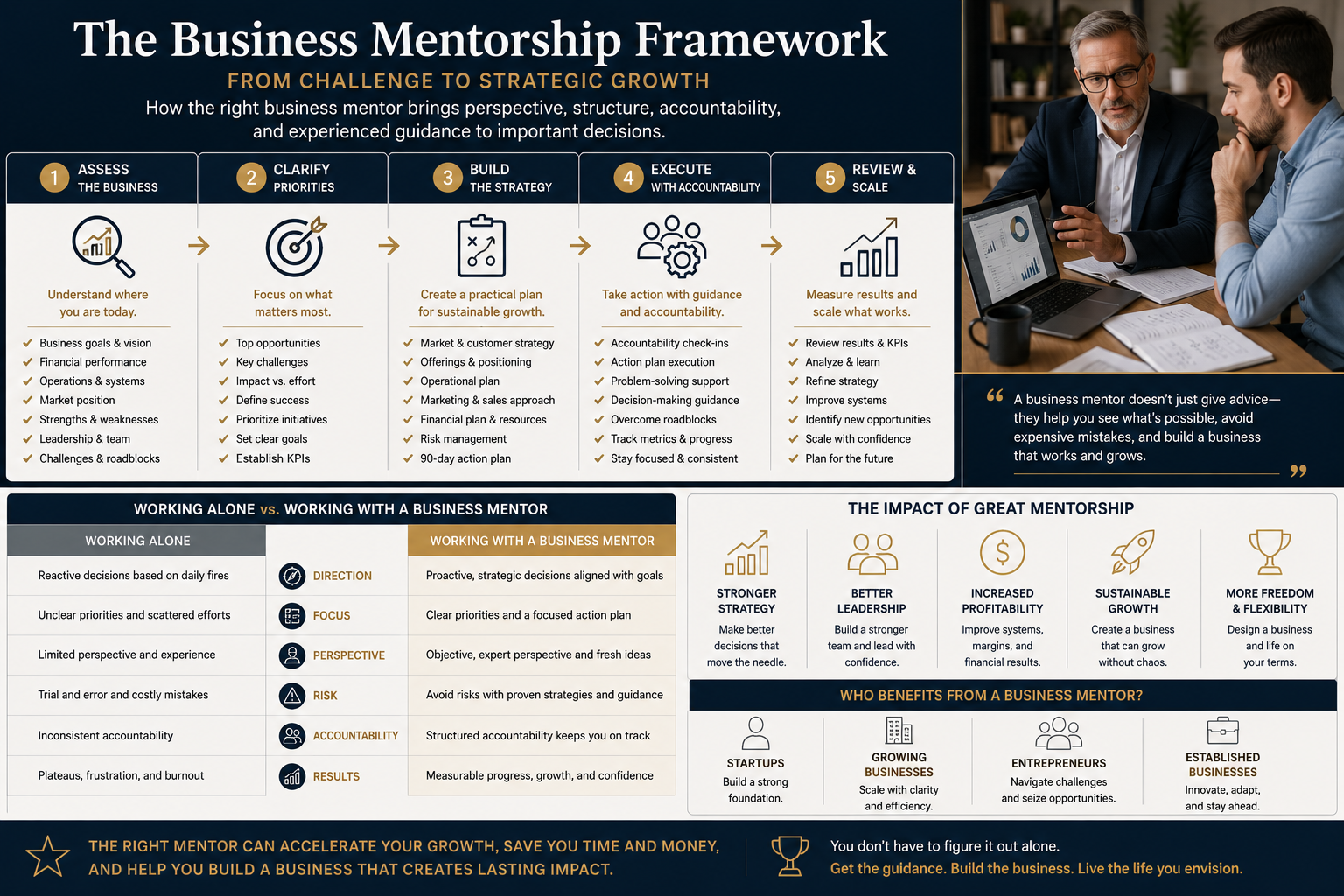
A business mentor provides perspective, questions, accountability, and strategic discussion for business owners or executives. The specific relationship depends on the leader's goals and business needs, and may be one on one with strategic insights, accountability, and support tailored to clear business goals; unlike project-based business consultants, mentorship is typically an ongoing relationship.
Who should consider a business mentor?
Founders, business owners, and executives facing important decisions, growth challenges, changing leadership responsibilities, or a need for greater business accountability may benefit from an outside strategic perspective. That support can be valuable for small business owners, solo entrepreneurs, and new entrepreneurs at any stage of the business. The right business mentor depends on the leader’s goals, company stage, and current challenges.
What is business mentorship for entrepreneurs?
A business mentor for entrepreneurs works with business leaders who want experienced perspective on decisions, priorities, leadership, growth, and other issues affecting the company. Entrepreneurs may seek business mentorship when testing a business idea, building a business plan, or preparing for growth, with support that can help at different stages as the business develops.
Is a founder mentor the same as a consultant?
Not necessarily. A founder mentor may focus on an ongoing relationship that can develop over time around perspective, decision-making, and accountability, while consultants often help solve defined projects, specific business problems, or professional services; both can support business success in different ways depending on the need. An engagement can be structured around the client's actual needs.
Can a business mentor make decisions for me?
The business owner or executive remains responsible for company decisions. A mentor can provide strategic decision support by helping leadership examine options more effectively through clear goals, assumptions, priorities, and possible consequences.
What is executive business guidance?
Executive business guidance provides leaders with outside perspective on strategic and leadership issues affecting their organization. The subject of the discussions depends on the executive and business.
Does business mentoring guarantee growth?
No. Business outcomes depend on many factors, and mentoring does not guarantee revenue, growth, profitability, or other results.
Can Drew Rhoden be considered for a business speaking engagement?
Organizations seeking a business speaker can submit a speaking or founder inquiry through the team to discuss the event, audience, objectives, and potential fit.
Request a Founder Advisory or Speaking Inquiry Through the Team
You do not need another person simply telling you to work harder.
When the business is growing, the decisions are becoming more complex, or leadership needs an experienced outside perspective, the right conversation can help you examine what deserves attention.
Connect through DrewRhoden.com to discuss working with a business mentor, founder advisory needs, executive business guidance, strategic decision support, or to compare mentorship options through your local community or professional network, as well as a potential business speaking engagement.
Call (888) 209-4055 or submit a founder advisory or speaking inquiry through the team.
share this
Related Articles
Related Articles