



Business Leadership: Setting Standards Before You Build a Management Layer
Leadership sets the organizational tone in every company, whether it has three employees or three hundred. But in a founder-led business, business leadership doesn't begin when you hire your first VP or promote your first team lead. It starts the moment you define how decisions get made, how expectations are communicated, and what standards your team is held to.
This article is for founders, small-business owners, executives, and team leaders who are building their first management structure between now and 2027, often in teams of 5 to 100 people. If you're in that window, the next 12 to 18 months will determine whether your company scales on a solid foundation or cracks under the weight of undefined norms.
What follows is not about leadership training programs, certifications, or academic theory. It's about just what you, as a founder or executive, must define before you delegate authority. Effective business leadership involves inspiring people and navigating change, and that work starts before titles, hierarchy, or org charts exist.

What Is Business Leadership in a Founder-Led Company?
Business leadership in an early-stage company is how decisions get made, communicated, and enforced before a formal management hierarchy exists. It's not about charisma or a corner office. It's about the routines, standards, and behaviors that shape how your team operates every day.
Here's how to think about the distinctions:
- Business leadership is the standards, trade-offs, and decision-making habits the founder embeds into the company. It's the operating system.
- People management is the act of coaching, evaluating, and developing individuals. It often comes later, with your first managers.
- Executive leadership is a title-level concept tied to formal authority. It matters at scale, not at 12 people.
Consider a concrete example: a 15-person SaaS company in 2025. No one has the title "manager." The founder decides who sets product priorities, how trade-offs between feature requests and technical debt are handled, and what the team's communication rhythm looks like.
That's business leadership in practice.
A survey of 188 startup leaders in Germany found that founders rate vision, strategy, and decision-making as their top leadership priorities,ahead of formal HR or people-development skills. This makes sense: in a founder-led company, leadership style influences organizational culture and employee behavior from day one. And research consistently shows that higher leadership quality is positively associated with organizational performance.
Business leadership skills, then, are behaviors and routines, not just personality traits. They're observable, repeatable, and learnable.
From Founder Heroics to Leadership Standards
In years one through three, most founders operate in what's often called "hero mode." You answer every question. You fix every problem. You make ad-hoc decisions because you're the only person who holds the full context. This is normal. It works when your team is six people and everyone sits within earshot.
But this approach breaks somewhere between 8 and 20 employees. Here's what typically happens:
- Decisions become inconsistent because you're making dozens per day without a framework.
- Teams get confused about priorities because nothing is documented.
- The founder burns out from being the single point of failure for every issue.
- Strong leadership navigates crises effectively during disruptions, but hero mode makes every day feel like a crisis.
Autocratic leadership involves top-down command and control decision-making, and in early-stage hero mode, that's essentially what you're running, even if you don't call it that.
Leadership standards are the way out. They are your explicit choices about quality, pace, ethics, and trade-offs, written down and shared so the team can make decisions without routing everything through you.
Here's a 2026 scenario: a SaaS company with 15 engineers and 5 sales reps has no formal managers. The founder defines a standard for product prioritization (customer revenue impact versus feature investment), a communication cadence (weekly summaries and a Monday planning session), quality benchmarks (bug count thresholds per release), and decision rights around feature shipping. Teams begin making certain decisions independently. Execution accelerates. The founder's calendar opens up. Growth unlocks because the bottleneck is gone.
Standards create a bridge from solo decision-making to a repeatable management layer. Without them, adding managers just adds confusion.

Core Business Leadership Skills Founders Can't Delegate
Before you can set standards, you need to develop skills that no hire or advisor can own for you. These are the daily habits that shape every meeting, decision, and piece of feedback you give.
- Communication skills. Founders must articulate priorities, trade-offs, and timelines with clarity. This isn't about being eloquent. It's about being understood. Strong communication skills are essential for effective leadership at every stage.
- Strategic thinking. Connecting today's decisions to where the company must be 12 to 36 months ahead. Strategic thinking shapes which clients you say "no" to, which product features you kill, and how you allocate limited resources. It's not a quarterly planning exercise; it's a daily leadership routine.
- Problem solving. When ambiguity is the norm and there's no precedent to follow, problem solving becomes a core leadership muscle. Good decision-making skills are vital for effective leadership, especially when data is incomplete.
- Expectation management. Setting realistic timelines, scope, and outcomes with your team, customers, and investors. Misaligned expectations are the root cause of most early-stage conflict.
- Emotional intelligence. Reading the room, regulating your reactions, and building trust through how you handle pressure. Emotional intelligence is essential for effective leadership, particularly in small teams where the founder's mood sets the weather.
- Self awareness. Knowing your blind spots, your default reactions, and where your judgment is strong versus where it's weak. Self awareness is the starting point for improving any other business leadership skill.
These are often lumped together as soft skills, but that label undersells their importance. They are the foundation of how you lead. Great leaders like Steve Jobs didn't just have vision; they built systems around how decisions were communicated and enforced. These skills are learned through hands on experience, not just books or a course. They are daily habits embedded into meetings, decisions, and feedback loops.
Leadership Standards: The Foundation Before Management
Leadership standards are written expectations about how decisions are made, how people behave, and what "good" looks like across your company. They are not HR policies. They are not compliance checklists. They are your organization's operating principles.
Here are concrete examples relevant to B2B and SaaS companies in 2026:
- Decision standard for pricing: "Any discount over 10% requires founder review and must preserve our profit margin floor."
- Customer promise: "All client-facing emails get a response within 4 business hours. Escalations go to the founder within 24 hours."
- Product quality: "All customer-facing releases must pass peer review. More than two critical bugs per release triggers a postmortem."
A clear vision aligns teams with business strategy for growth, and standards are how that vision shows up in daily work. Without them, each person interprets "quality" or "speed" in a certain way based on their own past experience.
Why must standards come before hiring managers? Because if you add managers without shared standards, each one will invent their own norms. You'll end up with inconsistent micro-cultures across teams, misaligned priorities, and unpredictable decisions. Integrity and accountability inspire employees to follow their leaders, and standards are how you make those values visible.
The ideal format is simple: a one-page document shared with the whole team and reviewed quarterly. Focus on behavior, communication, and judgment, not legalese or compliance language. Effective leadership enhances productivity and innovation, and this document is the mechanism.
Communication Skills as the First Leadership System
If you only build one system before adding managers, make it communication. Every founder-led team runs on the quality of information flow, and when communication breaks down, everything else follows.
Here's what that looks like in practice:
- Weekly standups (15 minutes): Each person shares their top priority, their biggest blocker, and one thing they need from someone else.
- 1:1s (biweekly, 30 minutes): Founder and each team member discuss progress, concerns, and development. These are not status updates. They're relationship-building conversations.
- All-hands (monthly, 30 minutes): Founder shares company direction, recent wins, honest challenges, and upcoming changes.
Effective communication fosters trust and collaboration in teams, and clear communication improves decision-making and project outcomes. These aren't abstract concepts. When you run a consistent Monday standup, your team walks into the week knowing the priority.
When you hold monthly all-hands, your organization avoids the rumor mill.
Expectation management lives inside communication. Here are example scripts founders can adapt:
- Delayed launch: "We're pushing the release from March 15 to April 1. Here's why: [specific reason]. Here's what changes for your work this week: [specific task adjustment]."
- Changed priority: "We're pausing Project X to focus on Project Y. This isn't a reflection of the work you've done. Here's the reasoning: [business rationale]. Let's discuss how to transition."
- Missed target: "We hit 70% of our Q1 goal. Here's what I think went wrong and what I'm changing. I want your input by Friday."
Listening actively enhances team dynamics and engagement. That means founders must resist the urge to fill silence in meetings or steamroll over feedback. Effective communication can increase job satisfaction among team members, and it starts with the founder modeling the behavior they want to see.
Emotional Intelligence and Self Awareness in Business Leadership
Emotional intelligence isn't therapy talk. In a commercial context, it's the ability to read situations accurately, regulate your own reactions, and respond in ways that build rather than erode trust.
Here's why it matters in 2026: founders face uncertainty, market pressure, remote work stress, and investor scrutiny. In a small team, the founder's emotional state cascades through the entire organization. If you panic, your team panics. If you shut down, communication dies.
Concrete emotional intelligence behaviors include:
- Regulating reactions in crisis. When a major client threatens to leave, you take 30 minutes before responding rather than firing off an emotional email. Leaders with high emotional intelligence resolve conflicts quickly because they don't escalate situations unnecessarily.
- Reading the room in meetings. You notice that your lead engineer has gone quiet during sprint planning. You follow up privately rather than putting them on the spot.
- Listening before responding. When a team member raises a concern about workload, you hear them out fully before offering solutions. Emotional intelligence helps leaders build trust and support.
- Naming trade-offs honestly. Instead of pretending a decision has no downsides, you say, "Here's what we gain and here's what we lose." High emotional intelligence boosts team morale and productivity because people trust leaders who are honest about the situation.
Consider a founder handling a round of layoffs. The emotionally intelligent approach isn't to hide behind an HR script. It's to meet with affected people directly, explain the reasoning clearly, acknowledge the impact, and follow through on commitments like severance and references. Conflict resolution is faster and less damaging when the leader operates with emotional awareness.
Emotional intelligence helps leaders handle workplace challenges effectively, and self awareness is the starting point. If you don't know your default reaction under stress, you can't change it. Emotional intelligence is essential for effective leadership development, which means it's not optional. It's foundational.
Strategic Thinking: Connecting Daily Work to a Clear Direction
Strategic thinking is connecting today's decisions to where the company must be in 12 to 36 months. It's not a quarterly offsite activity. It's how you open Monday meetings, how you approve projects, and how you evaluate whether a new opportunity is a distraction or an accelerator.
Consider a 2024 to 2027 strategy arc for a B2B company. In 2024, the focus is product-market fit and the first 50 customers. In 2025, it's repeatable sales and the first management hires. In 2026, it's scaling operations and entering a second market. In 2027, it's profitability and competitive positioning. Strategic planning means each quarter's priorities tie directly to this arc.
Effective leadership accelerates strategic alignment across departments, even when those "departments" are just three people sitting in a shared office. When founders use strategic thinking to prioritize initiatives, they create focus. They also create the ability to say "no" to distractions, good ideas that don't serve the current phase.
Transformational leadership focuses on vision-driven inspiration, and strategic thinking is how that vision becomes a set of choices your team can act on. Every founder needs a clear vision, but vision without a strategic framework is just aspiration.
Problem solving fits inside strategic thinking when the issues are ambiguous and cross-functional. A pricing dispute with a key customer isn't just a sales problem. It's a strategy question about which customers you want to serve and at what margin.
Visionary thinking defines a compelling future state for the organization, but strategic thinking is the discipline that connects that future state to the task list your team works from today.
Building Relationships as a Leadership Asset, Not a Soft Perk
Building relationships is not networking for its own sake. In a founder-led company, it's a core business leadership behavior that directly affects execution, retention, and revenue.
Internal relationships:
- Trust with early employees determines whether people stay through the hard years or leave at the first recruiter call. Effective leaders balance concern for people with a focus on performance.
- Trust with emerging managers determines whether your standards get enforced or ignored once you delegate authority.
- Trust across functions (engineering, sales, operations) determines whether teams collaborate or build silos.
External relationships:
- Key customer relationships give you unfiltered feedback and early warning signals. Monthly founder-customer calls can surface issues months before they show up in churn data.
- Investor relationships built on honest updates create goodwill when you need flexibility. Quarterly investor updates that share both wins and risks build the kind of trust that matters during downturns.
- Advisor and partner relationships in 2024 to 2026 ecosystems give you knowledge and expertise you can't afford to hire full-time.
Leaders must adapt to changes and foster team collaboration, and relationships are the infrastructure that makes adaptation possible. Informal lunch sessions with new hires, for example, give founders a read on team morale that no survey can replicate.
Hands On Experience: Learning Leadership in the Work Itself
Founders cannot outsource early leadership. You earn judgment by making real decisions with real consequences: hiring, firing, pricing, product bets, and uncomfortable conversations. No advisory board, book, or course can substitute for this.
The gap between theoretical leadership advice and live decisions is enormous. A book can tell you to "have difficult conversations early." Only hands on experience teaches you how to fire a friend you hired, reprice your product mid-contract, or tell your co-founder their idea won't work.
Investing in education enhances leadership skills for business growth, but education without application is incomplete. Self awareness is a key component of leadership development, and it deepens through lived experience, not reading about it.
Here's a simple learning loop for founders:
- Act. Make the decision. Have the conversation. Ship the feature.
- Reflect. Within 48 hours, debrief: what went well, what you'd change, what you didn't anticipate.
- Adjust. Change one behavior or process for the next similar situation.
Continuous growth is vital for effective leadership development. When you codify what you learn from early leadership into documents, playbooks, or standards, you create a knowledge base that formal managers can inherit when they join.
Expectation Management: Aligning Standards, People, and Reality
Expectation management is the glue between leadership standards and day-to-day work. It's how you set, communicate, and adjust what people should expect, whether those people are employees, clients, or investors.
Expectation management improves team focus and motivation because people perform better when they know exactly what success looks like. Clear expectations enhance decision-making in projects because teams don't waste effort on work that doesn't matter. Managing expectations fosters trust among team members because no one likes surprises.
Concrete workplace examples:
- Resetting a delivery date. The product won't ship on time. You communicate the new date, the reason, and the adjusted scope in writing before anyone asks.
- Changing a sales target mid-quarter. Market conditions shifted. You explain the new number, the reasoning, and what support the sales team will get.
- Revising a hiring plan. Budget tightened. You share the updated plan with timelines and explain which roles are paused versus canceled.
Key components of effective expectation management:
- Clarity: say what you mean, with specifics.
- Documented agreements: if it's not written down, it's not an expectation, it's a hope.
- Regular updates: weekly or biweekly, not just when things change.
- Transparent reasoning: explain why, not just what.
Effective communication is crucial for managing expectations, and expectation management can improve job satisfaction significantly. In small-business settings, this directly connects to reduced burnout, better morale, and more predictable results. When your team can successfully manage their own workload because the expectations are clear, you've built something that scales.
Designing a Simple Leadership Operating Rhythm
A leadership operating rhythm is the set of recurring meetings and communication rituals that embody your leadership standards. Think of it as the heartbeat of your organization.
Here's a concrete rhythm for a 20 to 50 person company:
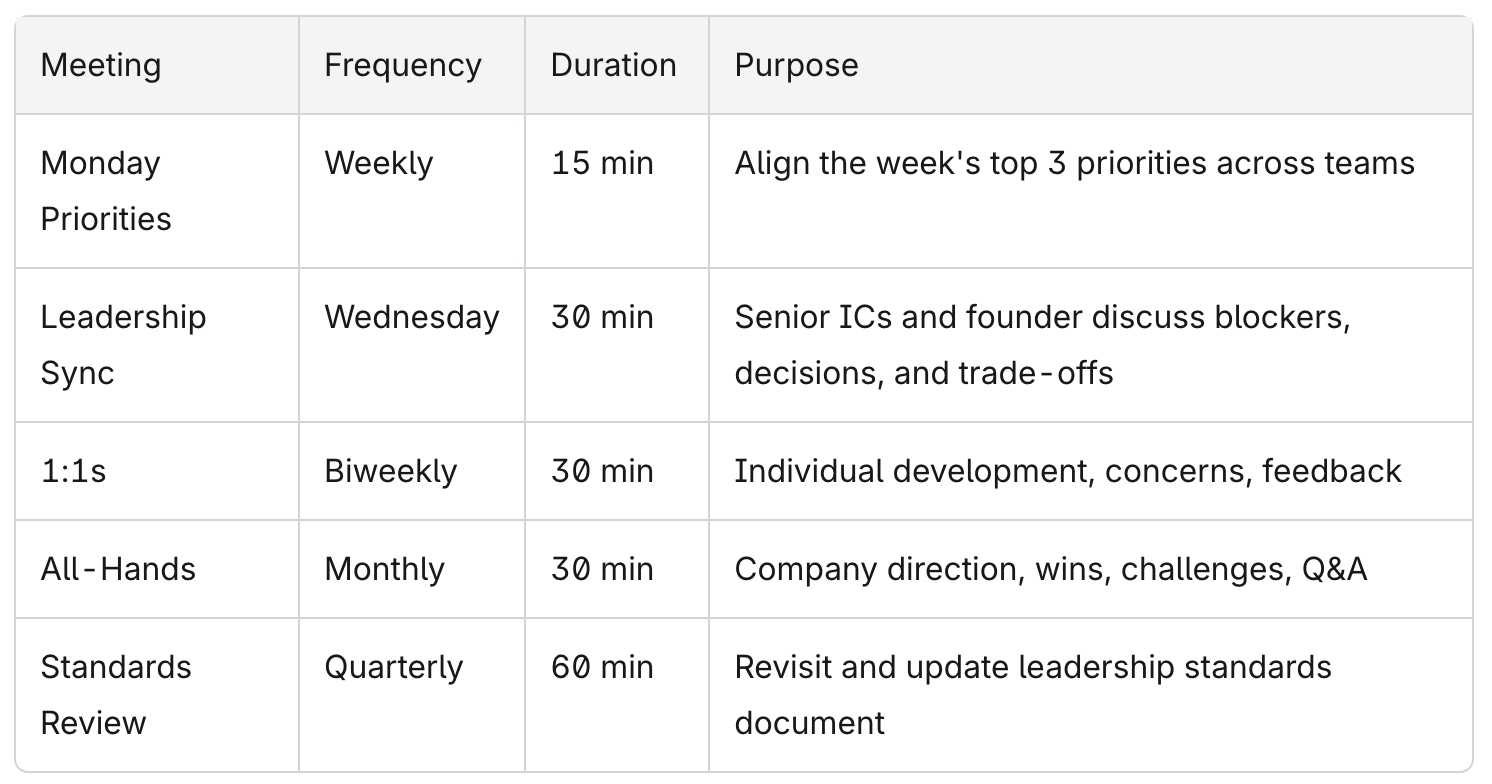
This rhythm is where communication skills, strategic thinking, and expectation management show up in practice. Democratic leadership actively seeks team input before making decisions, and a well-run leadership sync is where that happens.
For partly remote teams, keep routines lightweight but consistent. Use written agendas before meetings and written summaries after. Empowerment and delegation provide autonomy to team members, but only when the rhythm provides enough structure to catch problems early.
The key insight: start using this rhythm before you have managers. Then, when you add managers, they step into existing routines rather than inventing their own.
Translating Leadership Standards into Management Expectations
As you add managers, your leadership standards must become explicit management expectations. This is the moment where your effort in defining standards pays off, or where the lack of it creates chaos.
Here's what to define for first-line managers:
- Decision rights: "You can approve any expense under $2,000. Above that, loop me in before committing."
- Performance expectations: "Every manager holds monthly 1:1s and quarterly growth conversations with each direct report."
- Communication cadence: "You attend the Wednesday leadership sync and send a written weekly update to the founder by Friday at noon."
- Coaching responsibility: "You are responsible for identifying skill gaps on your team and proposing a development plan within 60 days of each new hire."
Transactional leadership relies on clear metrics and performance-based rewards, and that clarity starts here. Servant leadership prioritizes the development and well-being of team members, and your management expectations should reflect that value if it's part of your standards.
Leadership development programs cultivate adaptability and strategic thinking in managers, but those programs only work if managers know what's expected of them first. Without this step, each manager creates their own micro-culture, and your company fragments.
Write these expectations down. Review them with each manager. Revisit them at least twice a year.
Common Business Leadership Mistakes When Building a Management Layer
Here are the most frequent pitfalls founders hit when transitioning from solo leadership to a management layer:
- Promoting top individual contributors without standards. Your best engineer becomes a manager and has no idea what's expected. Performance drops on both fronts. Research on startup competency gaps shows that this is a consistent failure pattern.
- Copying big-company org charts. You're 25 people. You don't need a VP of Engineering, a Director of Product, and a Head of Operations. You need one or two managers who embody your standards.
- Delegating accountability but not authority. Telling a manager they're "responsible for delivery" but requiring founder approval on every decision. This creates frustration and stalls execution.
- Vague communication about roles. "You're in charge of the team" means nothing without documented decision rights and expectations.
- Laissez-faire leadership without guardrails. Laissez-faire leadership provides substantial autonomy to capable employees, but in early management structures, too much autonomy without standards leads to drift. The balance between autonomy and alignment is where most founders struggle.
- Ignoring early warning signs. When retention drops or projects stall after a management change, founders often blame the new manager instead of examining the system. Positive leadership reduces turnover rates, but only if the underlying standards support it.
Course-correction actions you can take within 30 to 60 days:
- Write or rewrite your one-page standards doc.
- Hold a 90-minute leadership workshop with new managers to align on expectations.
- Identify one recurring decision that's been inconsistent and create a standard for it.
- Ask each manager to write down what they think their decision rights are, then compare against your intent.
Business Leadership in Remote and Hybrid Teams
The shift toward remote and hybrid work between 2020 and 2026 has permanently changed what small-business leadership demands.
When you can't rely on hallway conversations, leadership standards must be even more explicit.
Communication skills must adapt:
- Over-communicate in writing. What was a quick verbal update in an office must become a written message in a shared channel. Decisions should be logged so people in different time zones can catch up asynchronously.
- Asynchronous updates. Written weekly briefs from each team member replace the "walk by and check in" habit. These create visibility without requiring everyone to be online at the same time.
- Virtual office hours. Block two hours per week where anyone on the team can drop into a video call. This replaces the open-door policy.
Expectation management in remote contexts means defining response-time norms (for example, "respond to messages within 4 hours during business hours"), documenting which tools are used for which types of communication, and being transparent about when meetings are truly necessary versus when an async update will do.
Technology enables distributed leadership, but only if the standards and routines are clear enough to survive without in-person reinforcement.
Measuring the Impact of Business Leadership Standards
Leadership needs observable outcomes, not just good intentions. If you can't assess whether your standards are working, you're operating on hope.
Leading indicators (early signals):
- Meeting quality: Are discussions focused or circular? Are decisions made, or deferred?
- Decision speed: How long does a typical product or pricing decision take from question to resolution?
- Communication clarity: Do team members report knowing the company's top three priorities this quarter?
Lagging indicators (results over time):
- Employee retention: Are you keeping your best people?
- Customer satisfaction: NPS or direct feedback trends.
- Execution reliability: Are releases shipping on time? Are sales targets being met?
Simple measurement approaches for teams under 100 people:
- Quarterly pulse surveys (5 to 7 questions, anonymous, focused on clarity and support).
- Monthly NPS from customers.
- Quarterly churn tracking for both employees and customers.
Link each metric directly to a specific leadership routine or standard. If retention drops after you changed the communication cadence, investigate the connection. Review these measures at least quarterly in a founder check-in.
Business Leadership vs. Executive Leadership Training Programs
There's an important distinction between setting internal leadership standards and purchasing external leadership-training services.
Leadership standards are what you define inside your company: how decisions are made, how people communicate, what accountability looks like. No external program can substitute for this foundational work. External training programs are most valuable once standards exist and managers are in place, because the training has context to land in.
If you invest in executive leadership courses or certificates before your internal standards are clear, you'll get managers who learned frameworks they can't apply, because there's no organizational foundation to apply them to.
Think of it this way: training is the curriculum, but standards are the school. Build the school first.
This article is complementary to formal training. It lays the groundwork so that when you do invest in a leadership development program, the concepts stick and the practice transfers to daily work.
Case Snapshot: A Founder Defining Leadership Before Scaling

Here's a composite scenario drawn from common patterns in the industry.
The situation: A SaaS founder in 2024 runs a 12-person company. Delivery dates are missed regularly. Quality is inconsistent. Roles and decision rights are undefined. The founder is the bottleneck for every discussion, spending 60% of each day in reactive mode.
The leadership moves:
- The founder wrote a one-page leadership standards document defining the decision process for product priorities (revenue impact versus technical investment), communication norms (weekly team sync, written project memos), and escalation protocols for missed deliverables.
- She instituted a Wednesday leadership meeting with senior individual contributors to review blockers and make trade-off decisions together.
- She clarified which decisions she retained (pricing, hiring, customer escalations over a certain threshold) versus which she delegated to the product lead and sales lead.
The outcomes over 9 months:
- Missed delivery dates dropped from roughly five per quarter to one.
- On-time releases improved measurably, with the team shipping consistently for the first time.
- Retention of early technical hires improved as people felt clearer about priorities and less frustrated by shifting goals.
- The founder's calendar freed up enough to focus on strategic partnerships and fundraising.
Key disciplines that made it work: feedback loops (the founder asked for input on the standards doc and revised it twice), self awareness (she recognized her own bottleneck behavior), and continuous improvement (she adjusted the communication cadence after realizing the remote portion of the team wasn't getting enough visibility).
Practical Checklist: Are You Ready to Add a Management Layer?
Use this checklist to identify gaps before you hire or promote your first managers. Each unchecked item is a focused area for your leadership development plan over the next 12 to 18 months.
- [ ] You have a written one-page leadership standards document shared with the full team.
- [ ] Decision rights are defined: what only you decide, what others can decide independently.
- [ ] You run a consistent weekly communication rhythm (standup, sync, or brief).
- [ ] Expectations for quality, pace, and customer response are documented, not assumed.
- [ ] You hold regular 1:1s with each team member (at least biweekly).
- [ ] You have a process for giving and receiving feedback that your team knows about.
- [ ] You can articulate your company's three strategic priorities for the next 12 months without checking notes.
- [ ] Your team can articulate those same priorities independently.
- [ ] You have defined what management expectations look like for the first manager role you'll create.
- [ ] You have reviewed your standards and expectations with at least one trusted advisor or peer.
- [ ] You have a method for measuring whether your leadership routines are working (pulse surveys, retention tracking, etc.).
- [ ] You have reflected on your own leadership blind spots and have a plan to address at least one.
If you marked fewer than 8 items, focus on filling those gaps before adding a formal management layer. The effort you invest now will create the confidence and clarity your future managers need to succeed.
FAQs on Business Leadership and Early Management Structures
When should I hire my first manager?
Most founders report that complexity spikes around 15 to 20 employees. But timing is less about headcount and more about whether your leadership standards are defined and your communication routines are stable. If those foundations exist, you're ready. If they don't, adding a manager adds chaos, not clarity.
How do I communicate new leadership standards to my team?
Share the document in a team meeting. Walk through each standard, explain the reasoning, and invite questions. Follow up with the written version in your shared workspace. Revisit it quarterly and update it based on what's working and what isn't.
What if my early leadership mistakes damaged trust?
Acknowledge them directly. Discuss what happened, what you've learned, and what you're changing. Trust rebuilds through consistent behavior over time, not through a single apology. This is where emotional intelligence and self awareness become most critical.
Are business leadership skills personality traits, or can they be learned?
They can be learned. Research from the Center for Creative Leadership identifies four foundational leadership skills, self awareness, communication, influence, and learning agility, that can be developed at every career stage. Personality helps, but practice matters more.
Do I need different standards for executives versus frontline managers?
The core standards (decision-making principles, communication norms, quality benchmarks) should be consistent across the company. What changes is the scope of decision rights and the level of strategic responsibility. Define those differences explicitly when creating each role.
How do leadership standards work in a remote or hybrid team?
The same principles apply, but documentation and visibility become even more important. Standards that live in the founder's head or in hallway conversations don't reach remote professionals. Write them down, share them in tools everyone accesses, and reinforce them in your virtual meeting rhythm.
Can a founder be an effective leader without being a people person?
Yes, if you define "people person" as being naturally extroverted. Business leadership is about clarity, consistency, and commitment to standards, not about personality type. Many of the most impactful founders lead through well-designed systems and honest communication rather than charisma.
How This Approach Fits with Drew Rhoden's Speaking and Advisory Work
The concepts in this article reflect the approach Drew Rhoden brings to founders and executive teams: define your leadership standards before scaling your management layer.
In practice, Drew works with leadership teams through diagnostics that surface unclear standards, workshops focused on communication skills and expectation management, and sessions designed to align founders and their first managers on decision rights, quality benchmarks, and communication rhythms.
This isn't about prescriptive methods or one-size-fits-all templates. It's about helping founders identify what's undefined, create the structures that support their team, and enhance their ability to lead through growth phases. External support works best once you commit to defining and practicing your own leadership standards.
Primary CTA: Explore Drew Rhoden Speaking and Advisory Opportunities
If you're a founder, small-business owner, or executive about to add or rebuild a management layer in the next 6 to 18 months, this is the moment to get your leadership standards right.
Drew Rhoden works with leadership teams through keynotes, offsites, and advisory sessions focused on business leadership, helping you achieve clarity before complexity arrives.
This is paragraph text. Click it or hit the Manage Text button to change the font, color, size, format, and more. To set up site-wide paragraph and title styles, go to Site Theme.
share this
Related Articles
Related Articles